Origin Dollar (OUSD)
A rebasing, yield-bearing stablecoin from Origin Protocol that auto-compounds DeFi lending/AMM yield directly into holders' wallet balances — exploited for $7M weeks after launch, then fully compensated, relaunched, and still running at modest scale.
▶ Run interactive simulation animated mechanism with editable parameters
How it works onchain
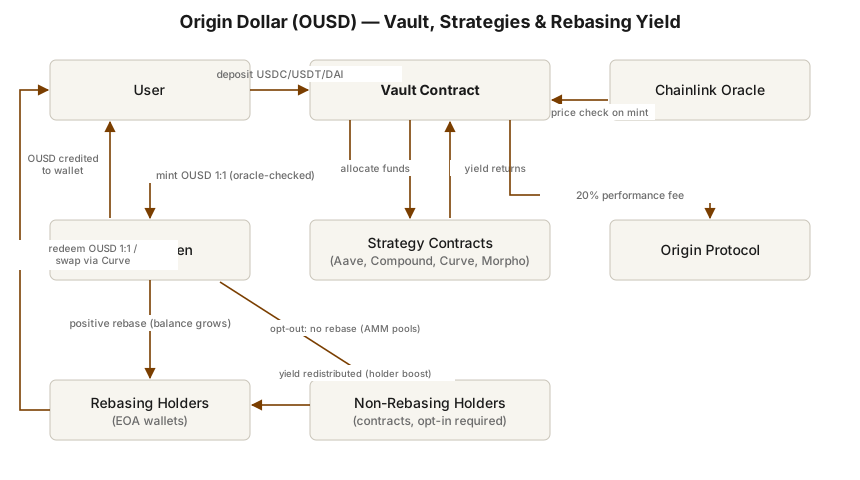 Open full-size diagram
Summary
Origin Dollar (OUSD) launched on Ethereum mainnet on September 23, 2020, built by Origin Protocol (founded 2017 by Josh Fraser and Matthew Liu, both ex-YouTube). It was one of the first "yield-bearing stablecoins": an ERC-20 pegged to $1 whose supply rebases upward so that yield earned by the protocol appears directly as a growing token balance in holders' wallets — no staking, locking, or claiming. Users minted OUSD against USDT/USDC/DAI deposited into a Vault, which routed collateral into strategy contracts on Aave, Compound, and Curve. Eight weeks after launch, in November 2020, a flash-loan-assisted reentrancy exploit drained $7M and broke the peg. Origin compensated depositors 100%, relaunched in December 2020 after multiple audits, and the product still operates today — now 100% USDC-backed with Morpho and Curve strategies — though at a small scale ($5–11M TVL in 2025–26) relative to both its early-2022 peak ($190M+ circulating per contemporary reports) and the yield-bearing-dollar category it helped pioneer.
Design (Mechanism)
- Mint/redeem: Deposit supported stablecoins (originally USDT/USDC/DAI; today USDC) into the Vault to mint OUSD 1:1 (oracle-checked via Chainlink); redeem back through the dapp or exit instantly via Curve/AMM pools.
- Rebasing yield distribution: OUSD holds the peg at $1 and distributes yield by increasing every holder's balance (positive rebase), similar to Ampleforth's elastic supply but driven by real strategy earnings rather than price targeting. Internally balances are tracked as credits divided by a global credits-per-token ratio.
- Vault + strategy contracts: A central Vault allocates collateral to pluggable strategy contracts (originally Compound, Aave, Curve; later Morpho lending markets across Ethereum/Base and Curve OUSD/USDC LP, with cross-chain routing over Circle's CCTP).
- Opt-in rebasing for contracts: EOA wallets rebase by default, but smart contracts must opt in. Yield attributable to non-rebasing contract balances (e.g., AMM pools) is redistributed to rebasing holders, structurally boosting holder APY above raw strategy yield.
- Fees: Origin charges a 20% performance fee on generated yield.
- Governance: Initially team-managed with timelocks post-relaunch; a veOGV governance token (OGV) was introduced in 2022 and later consolidated back into Origin's OGN token.
Outcome
OUSD's early trajectory was defined by the November 16–17, 2020 exploit: an attacker used a 70,000 ETH flash loan and a missing validation check — introduced during a gas-optimization refactor — to pass a malicious fake "stablecoin" contract into mint, re-entering mid-transaction to inflate OUSD supply via a manipulated rebase, then dumping the printed tokens on Uniswap/SushiSwap for ~$7M. The peg collapsed to ~$0.11. Origin published a same-day disclosure, a full technical postmortem, and a 100% compensation plan (smaller holders repaid fully in new OUSD; larger holders 25% OUSD upfront plus 75% in OGN locked one year at 25% interest). The protocol relaunched in December 2020 after Trail of Bits and Solidified audits (OpenZeppelin audited later), adding timelocks and ongoing security practices. OUSD then grew substantially during the 2021–22 cycle (roughly $190M+ circulating in early 2022 per contemporary press), but supply contracted sharply through the bear market and as Origin's focus shifted to OETH and Super OETH (its ETH liquid-staking yield products). As of 2025–26 OUSD remains live, pegged, and fully USDC-backed with ~$5–11M TVL and ~5% APY.
Why it worked
- Genuinely novel UX primitive: "The stablecoin is the savings account" — yield without staking, claiming, or a second receipt token — was a real simplification over Compound/Aave positions and predated the wave of yield-bearing dollars (sDAI, sUSDe, USDM, etc.).
- The opt-in rebase subsidy: redistributing yield from non-opted-in contract balances gave passive wallet holders above-market APY, a clever structural incentive to just hold.
- Exemplary crisis response: immediate disclosure, a detailed public postmortem naming the exact bug, 100% compensation (funded significantly by the founders/company), and a re-audited relaunch preserved enough trust for the product to regrow — rare among 2020-era exploit victims.
- Real, conservative collateral: fully backed by bluechip stablecoins deployed into audited, well-known venues; the peg itself never suffered a solvency failure after the relaunch.
Where the design broke
- Launched unaudited into adversarial conditions: the mainnet deployment went live before independent audits were complete, during the height of 2020's flash-loan exploit season; a gas-optimization refactor dropped an input-validation check, and the reentrancy-protection assumptions in the mint/rebase path failed under that gap, costing $7M and the crucial early-momentum window.
- Rebasing is integration-hostile: elastic balances break naive integrations (CEXs, bridges, many DeFi contracts), which limited distribution; later competitors chose non-rebasing wrapped/share models (wOUSD itself was a retrofit).
- Yield compression and competition: OUSD's yield is a levered function of DeFi lending rates minus a 20% fee; as rates compressed and T-bill-backed and delta-neutral competitors (sDAI, USDe/sUSDe) scaled, OUSD never regained category leadership.
- Attention migrated in-house: Origin's own growth engine moved to OETH/Super OETH, leaving OUSD as a maintained but small product (~$5.5M TVL on the official site in mid-2026).
Lessons
- A missing require() introduced in a "safe" gas refactor can be fatal: diff-audit every refactor as if it were new code, and never let mainnet TVL precede completed audits.
- Flash loans mean any invariant that holds only across transactions (not within one) is an exploit surface; rebase/supply accounting must be reentrancy-proof at the function level.
- Full, fast, transparent compensation is survivable and even reputation-enhancing; ambiguity and delay are what kill exploited protocols.
- Rebasing distributes yield elegantly to EOAs but taxes composability; if your token must live inside other protocols, ship a non-rebasing share-token representation from day one.
- Being first in a category (yield-bearing dollars) does not confer durable share when the yield source is commodity DeFi rates that competitors can match or beat with different collateral (RWAs, basis trades).
Redesign (EDITORIAL — hypothesis, not fact)
This section is a hypothesis, not a statement of fact. A redesigned OUSD would likely invert the token model: make the base asset a non-rebasing ERC-4626 vault share (maximal composability with AMMs, bridges, and money markets) and offer the rebasing "balance goes up in your wallet" token as an optional wrapper for retail EOAs — the opposite of OUSD's historical layering. The opt-in-rebase yield subsidy is worth keeping, but should be surfaced explicitly as a "holder boost" rate to market the mechanism. On security, the November 2020 exploit suggests launching behind a hard supply-growth circuit breaker: any rebase that increases supply faster than the maximum plausible strategy yield per block should auto-pause the Vault, a cheap invariant check that would have capped the 2020 loss near zero. Strategically, a stablecoin whose yield is purely levered DeFi lending will always be rate-cyclical; blending in uncorrelated yield sources (RWA T-bill wrappers, LST basis) under the same rebasing UX would make the headline APY defensible across cycles — though this adds custodial and regulatory dependencies the original permissionless design deliberately avoided.
Sources
- Origin Dollar (OUSD) — official docs — primary (docs)
- OUSD token contract (Etherscan) — primary (contract)
- Urgent: OUSD was hacked and there has been a loss of funds (Matthew Liu, Nov 2020) — primary (retrospective)
- What We've Changed Since the OUSD Attack (Daniel Von Fange) — primary (retrospective)
- Origin Dollar (OUSD) Detailed Compensation Plan (Micah Alcorn) — primary (governance)
- Origin Dollar Audit — OpenZeppelin — primary (audit)
- Origin Debuts OUSD, a Stablecoin That Works Like a Savings Account (CoinDesk, Sep 23 2020) (news)
- Origin Protocol Loses $7M in Latest DeFi Attack (CoinDesk, Nov 17 2020) (news)
- Origin Protocol Relaunches Stablecoin Following Hack (Crypto Briefing) (news)
- Origin Dollar TVL — DefiLlama (analysis)
Related experiments
Last verified: 2026-07-26 · Spot an error? Suggest a correction