Otherside (Otherdeeds)
Yuga Labs' metaverse land sale that minted 55,000 Otherdeed NFTs at a flat 305 APE each, raised roughly $317M in hours, and burned ~$150M+ in Ethereum gas in one of the largest mint congestion events in NFT history.
▶ Run interactive simulation animated mechanism with editable parameters
How it works onchain
 Open full-size diagram
Summary
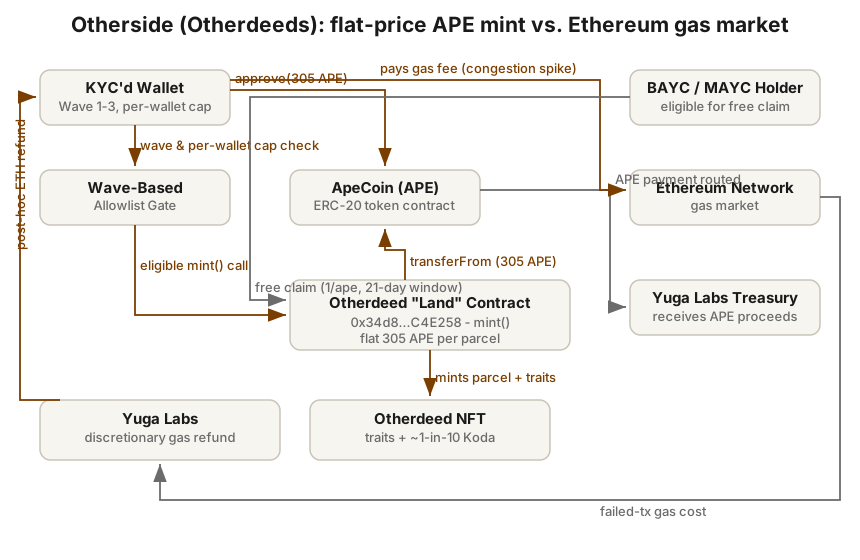
Otherside is Yuga Labs' metaverse project attached to the Bored Ape Yacht Club universe, and Otherdeeds are its ERC-721 land parcels (contract name "Land," symbol OTHR, at 0x34d85c9CDeB23FA97cb08333b511ac86E1C4E258 on Ethereum). On April 30, 2022 — near the absolute top of the NFT cycle — Yuga sold 55,000 Otherdeeds at a flat price of 305 ApeCoin (~$5,800 at the time) to KYC-approved wallets, raising roughly $317M in a few hours. Demand so overwhelmed Ethereum that more than $150M worth of ETH was burned in gas, transaction fees spiked to levels not seen in months, Etherscan briefly buckled, and thousands of transactions failed. Yuga apologized ("We're sorry for turning off the lights on Ethereum for a while"), refunded gas on failed mints, and suggested ApeCoin might need "its own chain" — a comment that foreshadowed ApeChain. A further tranche of Otherdeeds was claimable free by BAYC/MAYC holders (1 per ape, 21-day window), with remaining supply of the planned 100,000 reserved for Yuga and project contributors. As a fundraise the sale was a historic success; as a product, Otherside has shipped only intermittent "Trips," tech demos, and tooling in the four years since, and Otherdeed prices have fallen far below mint.
Design (Mechanism)
- Flat price instead of Dutch auction. Yuga initially planned a Dutch auction, then publicly reversed course in a Mirror post titled "Dutch auctions are actually bullshit," arguing descending-price auctions merely relabel gas wars. The replacement: a flat 305 APE price for every Otherdeed.
- KYC-gated allowlist. Only wallets that completed KYC in advance could mint — unusual for 2022 NFT drops — intended to throttle bots and satisfy compliance.
- Wave-based purchase limits. Sale was structured in waves: up to 2 mints per KYC'd wallet in Wave 1, higher limits in later waves, meant to spread demand over time.
- ERC-20-denominated pricing. Payment was exclusively in ApeCoin, tying the sale to Yuga's token economy (APE hit all-time highs into the mint), and adding an ERC-20
approve+transferFromto every mint's gas cost. - Embedded traits and future claims. Each Otherdeed carried procedurally assigned environments, sediments, resources, artifacts, and — on roughly 1 in 10 plots — a "Koda" character, later detachable as a separate collection ("Otherdeed Expanded"/Kodas in 2023).
- Post-hoc gas refund. After the mint, Yuga refunded gas fees for every failed mint transaction — an off-mechanism, discretionary remedy.
Outcome
The 55,000-parcel sale sold out within about three hours, generating ~16.8M APE (≈$317M; total sale value including claims was reported as high as $561M). Gas burn during the mint was reported at ~$150–180M (CoinDesk cited $157M+), with individual users sometimes paying more in gas than the 305 APE price itself. Thousands of transactions failed; Yuga refunded that gas. Secondary prices briefly ran ~4x mint, and an Otherdeed later sold for a record $1.5M. Yuga faced accusations of preferential treatment and a poorly gas-optimized contract; critics (including CoinDesk's "could have been prevented" analysis) noted the contract lacked standard optimizations and that the wave mechanic failed to meter demand. Product delivery has been slow: "First Trip" (July 2022) and "Second Trip" (March 2023) tech demos, Legends of the Mara, then layoffs and strategy resets at Yuga in 2023–2024. Under returned co-founder Greg Solano as CEO, Yuga refocused on Otherside as its core product: a Feb 2025 "Project Dragon" test put 2,100+ concurrent players in one server (a Guinness record), and a 2025/2026 roadmap promises AI building tools, Biome asset unlocks, Voyager 2.0, and a "Resources" land economy in 2026. Otherdeed floors, however, sit around ~1 ETH or below — a tiny fraction of mint-week pricing in dollar terms.
Why it worked
- Brand gravity. BAYC was the strongest brand in NFTs at the peak of the cycle; attaching land to it guaranteed demand regardless of mechanism.
- KYC allowlist did suppress botting relative to open mints, and the flat price eliminated winner's-curse dynamics of Dutch auctions.
- The gas refund and apology limited reputational damage and set a norm later drops copied.
- As pure capital formation, it remains one of the largest primary NFT sales ever conducted.
Where the design broke
- Demand metering failed. Everyone allowed in Wave 1 showed up in the same blocks; a flat price with no rate-limiting beyond per-wallet caps converts price competition into gas competition — exactly the failure mode Yuga said Dutch auctions had.
- Unoptimized contract at massive scale. The mint contract's gas profile (plus APE approval overhead) multiplied the congestion; analysts argued simple optimizations and staggered eligibility windows would have saved tens of millions.
- Sold promises, not product. Land utility depended on an unbuilt metaverse; four years on, gameplay remains in testing phases, and holder value collapsed with the broader metaverse-land narrative.
- Token coupling cut both ways. Pricing in APE pumped the token pre-mint and transferred sell pressure to it after; APE fell steeply in subsequent months.
Lessons
- A flat-price hyped mint without genuine rate-limiting is a gas auction by another name; the fee just goes to the network instead of the seller.
- Mint mechanics are mechanism design at scale: contract gas optimization, staggered eligibility, and commit-reveal or raffle allocation are worth millions of dollars at high demand.
- Selling land before the world exists front-loads capital but back-loads obligation; the value of "deed" assets decays with every quarter of undelivered product.
- Discretionary refunds can repair trust, but they are an admission that the mechanism, not the users, failed.
- Denominating a sale in your own token entangles product demand with token speculation and amplifies both directions of volatility.
Redesign (EDITORIAL — hypothesis, not fact)
This is editorial speculation. A cleaner design: replace the first-come wave sale with an over-subscription raffle — KYC'd wallets deposit 305 APE into an escrow contract over a 48-hour window (no time pressure, no gas spike), then a verifiable-random drawing allocates parcels and auto-refunds losers. Gas cost becomes one flat deposit transaction per wallet regardless of demand. Alternatively, a sealed-bid uniform-clearing-price batch auction (à la later "gas-less" allowlist systems) would have captured the ~$150M burned as ETH gas for the seller or the DAO treasury instead of destroying it. On the product side, vesting utility to land — e.g., escrowing 50% of sale proceeds on-chain, released to development milestones verified by holder vote — would have aligned Yuga's delivery incentives with the four-year wait holders actually experienced.
Sources
- Otherdeed (OTHR) 'Land' contract — Etherscan — primary (contract)
- Otherside FAQs (official Mirror post) — primary (docs)
- Dutch auctions are actually bullshit (official Mirror post) — primary (docs)
- Yuga Labs Refunds Gas Fees for Failed 'Otherdeed' Transactions (news)
- The Yuga Labs Catastrophe Could Have Been Prevented (analysis)
- Soaring Gas, Simmering Suspicion, and 50,000 NFTs: Inside Yuga's Zany Metaverse Mint (news)
- $310M in sales for Yuga Labs Otherside (news)
- Yuga Labs Reveals The Otherside NFT Roadmap For 2025/2026 (news)
Related experiments
Last verified: 2026-07-27 · Spot an error? Suggest a correction