Pendle
A DeFi protocol that tokenizes future yield by splitting yield-bearing assets into tradable Principal Tokens and Yield Tokens, creating an on-chain fixed-income and yield-trading market.
▶ Run interactive simulation animated mechanism with editable parameters
How it works onchain
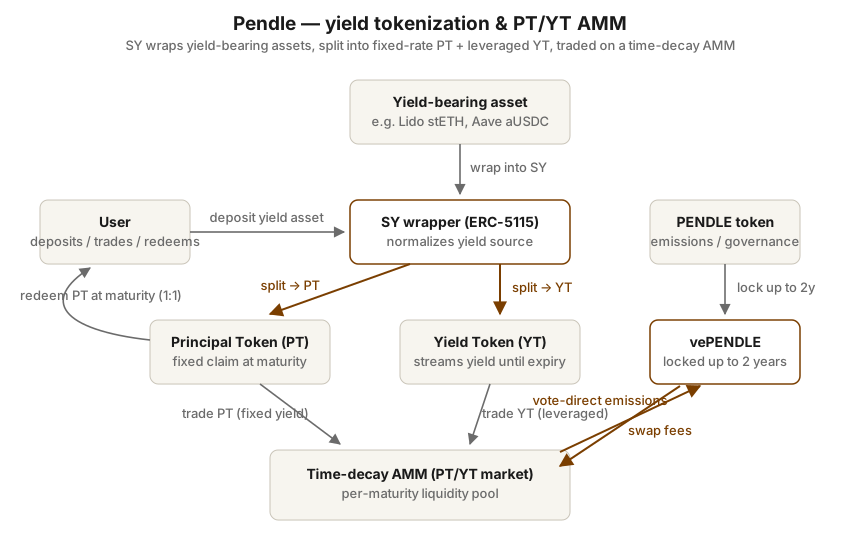 Open full-size diagram
Summary
Pendle is a DeFi protocol that turns future yield into a tradable asset. It takes a yield-bearing token (for example Lido stETH or Aave aUSDC), wraps it into a Standardized Yield (SY) token, then splits that into a Principal Token (PT) — redeemable 1:1 for the underlying at a fixed maturity — and a Yield Token (YT) — which captures all yield accrued until maturity. Because PT trades at a discount to face value, buyers lock in a fixed yield; YT buyers gain leveraged, directional exposure to a yield rate. Paired with a purpose-built automated market maker for time-decaying assets, this effectively created an on-chain fixed-income / interest-rate market where none previously existed.
The project began in late 2020 under the name Benchmark and launched publicly as Pendle in June 2021, with the PENDLE token issued in April 2021. It was co-founded by TN Lee (CEO, a founding-team member and former head of business at Kyber Network) alongside Vu Nguyen and pseudonymous engineers known as GT and YK. A $3.7M private round was led by Mechanism Capital. After a slow start, Pendle V2 (November 2022) and the DeFi restaking/points boom of 2024–2025 propelled it to become one of the largest DeFi protocols by TVL.
Design (Mechanism)
- SY (Standardized Yield): An ERC-5115 wrapper (a standard Pendle helped author) that normalizes heterogeneous yield-bearing tokens into a common interface so the rest of the system can treat them uniformly.
- PT / YT split: SY is decomposed into PT + YT. PT is a zero-coupon-like claim on principal at expiry; YT streams the underlying yield until expiry and then expires worthless. Buying PT = locking fixed yield; buying YT = long yield / long "points."
- Time-decay AMM (V2): Pendle's V2 AMM prices PT and YT in a single pool and concentrates liquidity around the expected yield range, claiming up to ~200x more capital efficiency than V1. The curve accounts for PT's convergence to par as maturity approaches, minimizing impermanent loss for LPs.
- vePENDLE governance & incentive layer: Users lock PENDLE for up to 2 years to receive vote-escrowed vePENDLE (a ve(3,3)-style design). vePENDLE holders vote to direct PENDLE emissions to pools, earn a share of protocol swap fees and YT fees on pools they vote for, and boost their own LP yields. This spawned a vote-incentive ("bribe") economy and Convex-style meta-governance layers such as Penpie and Equilibria.
- Boros (2025): An Arbitrum-based extension that tokenizes perpetual-futures funding rates into "Yield Units (YU)," letting traders hedge, lock, or speculate on funding rates with leverage — extending the yield-trading thesis into perps.
Outcome
Status: major_success (ongoing). Pendle became the dominant yield-tokenization protocol and one of DeFi's clearest product-market-fit stories.
- TVL: Grew roughly 20x in 2024 to ~$4.4B, capturing a majority of the yield-tokenization sector, then surged from ~$3B to ~$10B between May and August 2025.
- Adoption drivers: The 2023–2025 wave of liquid restaking tokens (LRTs), points programs (EtherFi, Renzo, Ethena's sUSDe), and stablecoin yield strategies made Pendle the primary venue to lock fixed yield or lever up on points — a near-perfect fit for its PT/YT split.
- Security: The core Pendle protocol has never been directly exploited. However, in September 2024 the third-party vePENDLE-aggregator Penpie suffered a ~$27M reentrancy exploit; Pendle proactively paused contracts as a precaution. The incident was an ecosystem/partner failure, not a Pendle-core failure.
- Expansion: Deployed across 9+ chains and launched Boros (August 2025) plus 2025 plans to target Solana, Hyperliquid, and TON.
Why it worked
- A genuinely new primitive: Splitting principal from yield created on-chain fixed income and interest-rate speculation — capabilities TradFi has but DeFi lacked. This was differentiated, not a fork.
- Rode secular tailwinds: LSTs, restaking, and points programs generated exactly the kind of variable, speculative yield that Pendle is built to package and trade. Pendle became the default venue for leveraged points speculation and fixed-yield locking.
- Aligned incentive flywheel: vePENDLE tied governance, fee-sharing, and emissions together, attracting deep LP liquidity and a bribe market that other protocols paid into to bootstrap their own pools.
- Persistence: The team iterated for years (Benchmark → Pendle V1 → V2 → Boros) through a period of near-zero traction, positioning them when the restaking narrative arrived.
Limitations and criticisms
Pendle's model carries structural weaknesses:
- Reflexive dependence on yield narratives: Much of its TVL is tied to transient points/restaking hype (e.g., Ethena, LRTs). Demand for YT can collapse when points programs end or airdrops disappoint, making TVL cyclical.
- Maturity/liquidity fragmentation: Yield is siloed by expiry date and asset; each maturity is a separate market that must be re-seeded, and post-maturity capital must roll over or exit.
- Ecosystem risk: The Penpie exploit showed that value routed through third-party ve-aggregators inherits their smart-contract risk, even when Pendle core is sound.
- Complexity barrier: PT/YT/SY, implied vs. fixed APY, and time decay are non-intuitive, limiting the addressable user base to sophisticated DeFi participants.
Lessons
- Financial primitives compound: By tokenizing yield into a standard (SY/ERC-5115) and building an AMM around it, Pendle became infrastructure other protocols build on — capturing more durable value than a single-strategy app.
- Timing plus persistence beats early hype: Pendle spent 2021–2023 with modest traction; surviving to meet the restaking/points wave was decisive. The primitive mattered less than being ready when demand appeared.
- Vote-escrow tokenomics can bootstrap deep liquidity but export risk: vePENDLE created a powerful incentive flywheel and a bribe economy, yet the aggregators it spawned (Penpie/Equilibria) became attack surfaces the core team could not fully control.
- Standards create moats: Co-authoring ERC-5115 let Pendle integrate new yield assets quickly and made it the natural default as the ecosystem grew.
Redesign (EDITORIAL — hypothesis, not fact)
The following is speculative analysis by the researcher, not established fact.
If rebuilding Pendle from scratch, three areas invite redesign. First, maturity fragmentation. Fixed expiries splinter liquidity and force constant rollovers; a "perpetual PT/YT" design (or an auto-rolling maturity ladder abstracted behind a single LP position) could concentrate liquidity and smooth user experience, at the cost of a more complex pricing curve — Boros's funding-rate approach is arguably a step in this direction. Second, reflexivity risk. Because much demand is points-driven and cyclical, a redesign could add native primitives for shorting implied yield or hedging points decay directly at the core layer, reducing the reliance on external speculative narratives and giving conservative capital a reason to stay through cycles. Third, ecosystem safety. Given that the realized losses came from third-party ve-aggregators, a first-party, audited, canonical boosting/aggregation layer — with standardized, permissioned integration hooks and circuit breakers — could internalize the incentive flywheel while reducing the "wildcat aggregator" attack surface that produced the Penpie loss. The tension throughout is that Pendle's strengths (composability, permissionless integration, sophisticated derivatives) are also the sources of its risk; a redesign is largely a choice about how much safety to trade for openness.
Sources
- Pendle official website — primary (docs)
- Pendle Documentation (V2) — primary (docs)
- pendle-core-v2-public (GitHub source) — primary (contract)
- PENDLE token on Etherscan — primary (contract)
- Pendle V2 Launch (Part 3/3) — Updated Tokenomics — primary (docs)
- Interview with Pendle co-founder TN Lee (PANews) — primary (retrospective)
- Podcast Episode: TN Lee from Pendle Finance (Decentralised.co) (retrospective)
- Explained: The Penpie Hack (Halborn) (audit)
- Pendle pauses contracts after Penpie $27M exploit (The Defiant) (news)
- Pendle TVL, Fees, Revenue & Volume (DefiLlama) (analysis)
- Pendle 2025 outlook — Solana, Hyperliquid, Ton (Blockworks) (news)
- Pendle lets crypto traders bet on BTC/ETH funding rates with Boros (CoinDesk) (news)
Related experiments
Last verified: 2026-07-26 · Spot an error? Suggest a correction