NFTX
A protocol that pools similar-value NFTs into fungible ERC-20 'vTokens' backed 1:1 by the underlying NFTs, creating AMM-tradeable liquidity for otherwise illiquid collections.
▶ Run interactive simulation animated mechanism with editable parameters
How it works onchain
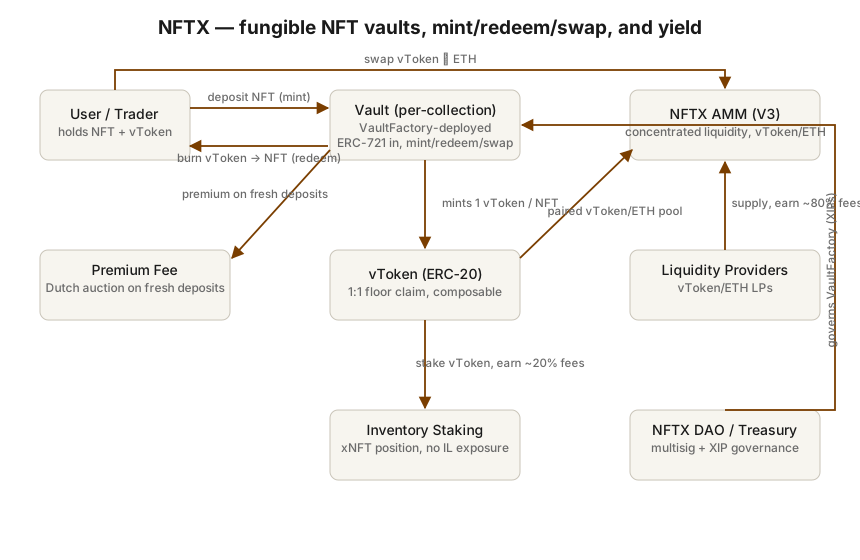 Open full-size diagram
Summary
NFTX is an Ethereum protocol that turns illiquid NFTs into liquid, fungible ERC-20 tokens. Users deposit an NFT from a supported collection into a per-collection vault and receive one fungible vToken in return (e.g., 100 CryptoPunks deposited means 100 PUNK tokens in circulation, backed 1:1). Those vTokens trade on automated market makers, so a floor-priced NFT can be bought or sold instantly at an AMM-quoted price instead of waiting for a bilateral marketplace match. NFTX was created by Alex Gausman, who began the work in fall 2020 under the name "PunkFund" (initially targeting CryptoPunks) before generalizing it into a permissionless vault factory. The NFTX token launched January 5, 2021 via a community "origin raise," and the protocol grew into a full NFT AMM/DEX through V2 (2021) and V3 (announced/rolled out from 2023 into 2024). It is one of the canonical "NFTfi" liquidity experiments of the 2021 cycle.
Design (Mechanism)
The core primitive is the fungible vault token. A VaultFactory deploys one vToken contract per NFT collection; by default a vault accepts any tokenID from its linked ERC-721/ERC-1155 collection, though eligibility modules can restrict which IDs qualify. Three operations define the vault:
- Mint: deposit an NFT, receive 1 vToken.
- Redeem: burn 1 vToken to withdraw an NFT. In V1/V2 the withdrawn NFT was pseudorandom (targeted/specific redemptions carried a premium); this is what made vTokens fungible "floor" claims rather than claims on a specific piece.
- Swap: exchange a wallet NFT for a vault NFT in one action.
Each operation charges a percentage fee (historically ~3–10% depending on action and version). Because a vToken is a standard ERC-20, it composes with the rest of DeFi: it can be pooled on Uniswap/SushiSwap against ETH, used as collateral, or added to index products (e.g., the Scalara NFT Index used NFTX tokens as constituents).
Two yield roles distribute captured fees:
- Inventory staking: stake vTokens (or NFTs) to earn a share of vault fees (~20%) without impermanent-loss exposure; in V3 the staked position is represented as an ERC-721 "xNFT."
- Liquidity provision: supply vToken/ETH to the AMM to earn the remaining fee share (~80%) plus trading fees.
V3 is the largest redesign: NFTX ships its own concentrated-liquidity AMM (a fork of Uniswap V3) with proportional vault fees routed to LPs, vault fees denominated in ETH (paid via vToken TWAP) instead of vTokens, inventory/LP positions as ERC-721s, and a premium fee that behaves like a Dutch auction on freshly deposited NFTs to discourage instant arbitrage of desirable inventory. Key verified V3 mainnet contracts include the NFTXVaultFactoryUpgradeableV3 (0xC255335bc5aBd6928063F5788a5E420554858f01) and NFTXRouter (0x70A741A12262d4b5Ff45C0179c783a380EebE42a), with additional deployments on Arbitrum and Base. The NFTX governance token is 0x87d73E916D7057945c9BcD8cdd94e42A6F47f776.
Governance runs through the NFTX DAO (originally Aragon-based) with a multisig safeguarding treasury assets during upgrades; XIPs are proposed on the NFTX forum.
Outcome
Status: technically successful, commercially underwhelming. Mechanically NFTX worked as designed — vaults, 1:1 backing, mint/redeem/swap, staking, and later concentrated liquidity all functioned, and I found no evidence of a protocol-level exploit draining vaults. NFTX became a recognized primitive for NFT "floor" liquidity and a building block other products (indexes, lending) referenced.
Commercially, however, NFTX's fortunes were tied to NFT trading demand, which peaked in 2021–2022 and then contracted sharply. Broad NFT trading volumes fell roughly 60% from their 2023–2024 highs, and the wider NFTfi/NFT-lending sector collapsed toward single-digit-million TVL by 2025. The NFTX token, launched around $18 with an early all-time high near $38 (Jan 2021), never recovered to prominence. The DAO also had to actively rebalance treasury exposure during the March 2023 USDC de-peg scare. The project remained under active development into the V3 era but as a niche utility rather than a category-defining venue.
Why it worked
- Fungibility solved a real problem: NFTs are hard to price and slow to sell; wrapping floor items into an ERC-20 gave instant, AMM-priced exit liquidity.
- DeFi composability: vTokens plugged directly into existing AMMs, lending, and index tooling — NFTX rode the mature Ethereum DeFi stack rather than rebuilding it.
- Permissionless vaults: anyone could bootstrap a market for a collection, and fee-sharing incentivized liquidity providers and inventory stakers to seed depth.
Why it failed or underperformed
- Demand-dependent: liquidity infrastructure only monetizes when people trade; the NFT bear market gutted fee revenue.
- Fungibility discards value: pooling collapses trait/rarity value to the floor, so the most valuable NFTs were never good vault candidates — limiting addressable inventory to floor pieces.
- Adverse selection / floor-sweeping: rational actors deposit the worst eligible item and redeem/swap for better ones, requiring premium/Dutch-auction defenses that added friction.
- Competition and fragmentation: sudoAMM/sudoswap and marketplace aggregators offered alternative NFT liquidity, splitting a shrinking market.
Lessons
- Fungibilizing heterogeneous assets forces a floor: any pool that treats collection items as interchangeable inherently prices to the lowest common denominator and invites adverse selection; mechanisms like premium/Dutch-auction fees are necessary patches, not free lunches.
- Infrastructure inherits its market's cyclicality: a technically sound liquidity layer can still underperform commercially when the underlying asset class (NFTs) loses demand — protocol correctness and product-market fit are independent axes.
- Composability is a genuine moat while it lasts: representing NFT exposure as ERC-20 unlocked lending, indexing, and AMM depth cheaply — but composability also propagates upstream shocks (e.g., a stablecoin de-peg hitting the DAO treasury).
- Governance/treasury risk is real even for "just" a liquidity protocol: the USDC-wobble rebalancing shows that holding idle treasury assets is its own risk surface distinct from the core mechanism.
Redesign (EDITORIAL — hypothesis, not fact)
The following is the researcher's editorial analysis, not established fact.
If rebuilt today, NFTX's central tension — fungibility destroys the trait value that makes NFTs valuable — argues for tiered, trait-aware vaults rather than a single floor pool: sub-vaults keyed by rarity bands or explicit trait predicates, so a "grail" tier and a "floor" tier price independently while still sharing routing and staking infrastructure. This would widen addressable inventory beyond floor pieces.
Second, adverse selection could be handled more elegantly by oracle-informed dynamic minting/redemption spreads (mint cheap, redeem expensive, with the spread widening when vault composition skews toward the least desirable IDs), turning the premium-fee patch into a continuous, first-principles pricing curve rather than a per-item Dutch auction.
Third, because the protocol's revenue is hostage to NFT-cycle volume, a redesign might diversify the fee base — e.g., offering vToken-collateralized borrowing or perpetual-style floor exposure so the protocol earns during low-trading regimes, not only during manias. Finally, given the treasury shock of 2023, a modern version would adopt a conservative, rules-based treasury policy (diversified, on-chain-transparent, with automated rebalancing triggers) as a first-class governance primitive rather than an ad-hoc response.
Sources
- NFTX Protocol Overview (official docs) — primary (docs)
- NFTX Protocol V3 (GitHub, verified contracts) — primary (contract)
- Introducing V3 (official docs) — primary (docs)
- NFTX Explained - NFT Index Funds (founder history) (analysis)
- NFTX (IQ.wiki) - token/contract/launch (analysis)
- Zima Red ep 97 - Alex Gausman interview (retrospective)
- NFTX DAO Eyes Treasury Rebalancing After USDC Wobbles (CoinDesk) (news)
- XIP#46 Upgrading on-chain DAO (governance forum) (governance)
Related experiments
Last verified: 2026-07-26 · Spot an error? Suggest a correction