Phoenix
A fully on-chain, crankless limit order book DEX on Solana that settles trades atomically within a single transaction.
▶ Run interactive simulation animated mechanism with editable parameters
How it works onchain
 Open full-size diagram
Summary
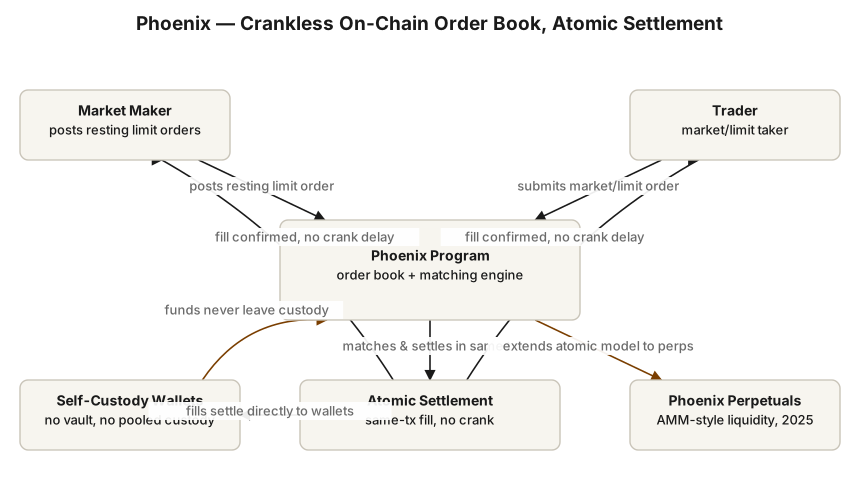
Phoenix is a fully on-chain, non-custodial central limit order book (CLOB) exchange built on Solana by Ellipsis Labs, founded by Jarry Xiao and Eugene Chen (both with backgrounds in high-frequency trading). Launched into beta in February 2023, Phoenix set out to prove that a "real" order book — with continuous limit and market orders, price-time priority matching, and atomic settlement — could run entirely on-chain without the "crank" mechanisms (external bots that had to periodically trigger settlement) that plagued earlier Solana order book DEXs like Serum. Trades are matched and settled inside the same transaction that submits the order, meaning fills are final the moment the transaction lands, with no separate crank step and no custodial intermediary holding user funds.
Design (Mechanism)
Phoenix's core innovation is architectural rather than economic: it packs the order book data structure, matching engine, and settlement logic into a single Solana program (PhoeNiXZ8ByJGLkxNfZRnkUfjvmuYqLR89jjFHGqdXY) such that placing an order, matching against resting liquidity, and settling the resulting trade all happen atomically within one transaction. This removed the "crank" — a permissionless but externally-triggered bot process that earlier Solana CLOBs (notably Serum/OpenBook) relied on to process queued trade events after the fact, which introduced latency, extra fees, and a point of centralization risk if no one ran the crank. Orders rest in program state and are matched by price-time priority, the same convention used by traditional exchange order books, giving market makers a mechanism they already understand from TradFi. Because settlement is atomic and on-chain, users retain custody of their assets in their own wallets at all times; there is no vault or pooled custody model as in many AMM designs. The design specifically targeted professional/HFT-style market makers, who could quote tight two-sided markets without needing liquidity-mining token incentives, betting that genuine competitive quoting (rather than subsidized liquidity) would produce better execution, especially for large orders where AMM slippage is highest. Phoenix later added "Phoenix Perpetuals" (unveiled at Solana Breakpoint 2025), extending the atomic-settlement, low-latency philosophy from spot order books to perpetual futures with a proprietary AMM-style liquidity structure layered on top, aiming for roughly 5 basis points of price impact versus roughly 15 bps typical of other on-chain perps venues (per Ellipsis Labs' own blog claims — not independently verified here).
Outcome
Phoenix shipped and has operated continuously since its February 2023 beta launch. By Ellipsis Labs' own figures it has processed over $75 billion in cumulative spot trading volume, and the protocol raised a $20 million Series A led by Paradigm (with Haun Ventures and others participating) in April 2024, followed by additional raises (reported as $21M from Haun Ventures) in late 2024 to fund a new "verifiable finance" layer-2 called Atlas — indicating Ellipsis Labs expanded well beyond the original Phoenix product. At times Phoenix has ranked among the larger Solana DEXs by volume, though DefiLlama and Blockworks data show its TVL has been modest relative to top Solana AMMs (tens of millions of dollars in TVL versus hundreds of millions for leading pools), reflecting the order-book model's lower capital requirement per unit of liquidity depth versus AMMs. Phoenix Perpetuals launched in late 2025 as a bid to compete more directly with dominant perp venues.
Why it worked
Phoenix succeeded on its core technical thesis: it demonstrated that atomic, crankless on-chain order book settlement was achievable on Solana at scale, directly addressing the crank-latency problem that had made prior Solana CLOBs (Serum, OpenBook) clunky. This attracted serious market makers and other DeFi protocols who wanted an on-chain order book primitive (rather than an AMM) to build on top of, and the design earned it credibility (and top-tier venture funding) as core Solana market-structure infrastructure rather than a retail trading app.
Where the design broke
Despite processing large cumulative volume, Phoenix never became the dominant Solana DEX by TVL or daily active users, remaining well behind leading AMMs (e.g., Raydium, Orca) in retail mindshare — order books require professional market makers to bootstrap liquidity, and Phoenix's no-incentive philosophy meant liquidity depth in less-liquid pairs could be thin compared to incentivized AMM pools. Order book UX is also less familiar to average retail DeFi users than swap-style AMM interfaces, limiting mainstream adoption of the "Phoenix Legacy" spot product even as sophisticated traders used it via integrations.
Lessons
- Solving a real technical bottleneck (the crank) can win credibility and funding even without matching incumbent AMMs on TVL or retail volume.
- Order book models depend on professional market maker participation to work; removing token incentives is a legitimate bet on quote competition, but it also caps how fast retail-facing liquidity can bootstrap versus incentivized AMM pools.
- Infrastructure-style DeFi primitives (order books, matching engines) often find their biggest value as building blocks for other protocols and integrators rather than as standalone consumer-facing apps — Phoenix's raises and expansion into Atlas suggest the team ultimately pursued that broader infrastructure thesis rather than doubling down purely on spot DEX market share.
Redesign (EDITORIAL)
EDITORIAL — hypothesis, not fact. A version of Phoenix that paired its atomic-settlement CLOB architecture with a thin, optional incentive layer — e.g., protocol-owned or rebate-funded market-making for newly listed or thin pairs only, phased out once organic depth reached a threshold — might have captured more retail volume during its bootstrapping phase without abandoning the "no subsidized liquidity" philosophy for established pairs. Similarly, exposing the order book as a public good with a simple aggregator-friendly API earlier (so AMM-style swap UIs could route through Phoenix transparently) could have let Phoenix capture retail flow indirectly while keeping its own interface professional-grade.
Sources
- GitHub - Ellipsis-Labs/phoenix-v1: On-chain order book that atomically settles trades — primary (code repository)
- Ellipsis Labs official site — primary (official site)
- Ellipsis Labs | Phoenix: On-chain Perpetuals on Solana — primary (official blog)
- Paradigm leads $20 million Series A round for DEX developer Ellipsis Labs (news)
- Ellipsis Labs Raises $21M to Launch 'Verifiable Finance Blockchain' Atlas (news)
- Phoenix TVL, Fees, Revenue & Volume - DefiLlama (analytics)
Related experiments
Last verified: 2026-07-27 · Spot an error? Suggest a correction