Hashflow
A multichain DEX that replaced AMM bonding curves with an RFQ model in which professional market makers cryptographically sign off-chain quotes for zero-slippage, MEV-protected on-chain settlement.
▶ Run interactive simulation animated mechanism with editable parameters
How it works onchain
 Open full-size diagram
Summary
Hashflow is a decentralized exchange that rejected the dominant AMM paradigm in favor of a request-for-quote (RFQ) architecture: instead of pricing swaps with an on-chain constant-product formula, professional market makers price trades off-chain using their own models (order-book data, volatility, inventory) and return cryptographically signed quotes that settle on-chain exactly as quoted. Founded by Varun Kumar (a former aerospace engineer with stints at NASA and the German Aerospace Center who deferred a Stanford PhD), together with Victor Ionescu and Vinod Raghavan, the project launched in private alpha in April 2021 and publicly in August 2021 on Ethereum, later expanding to Arbitrum, Optimism, Polygon, BNB Chain, Avalanche, and Solana. It raised a $25M Series A in July 2022 at a $400M valuation led by Jump Crypto, Wintermute, and GSR — notably, its own liquidity providers were also its investors. The HFT governance token launched in November 2022, followed in September 2023 by the "Hashverse," a story-driven, gamified vote-escrow governance platform. Hashflow survived a ~$600K approval-exploit in June 2023 (users made whole) and remains operational in 2026 as RFQ infrastructure powering aggregator flow, though its token has lost most of its value since launch.
Design (Mechanism)
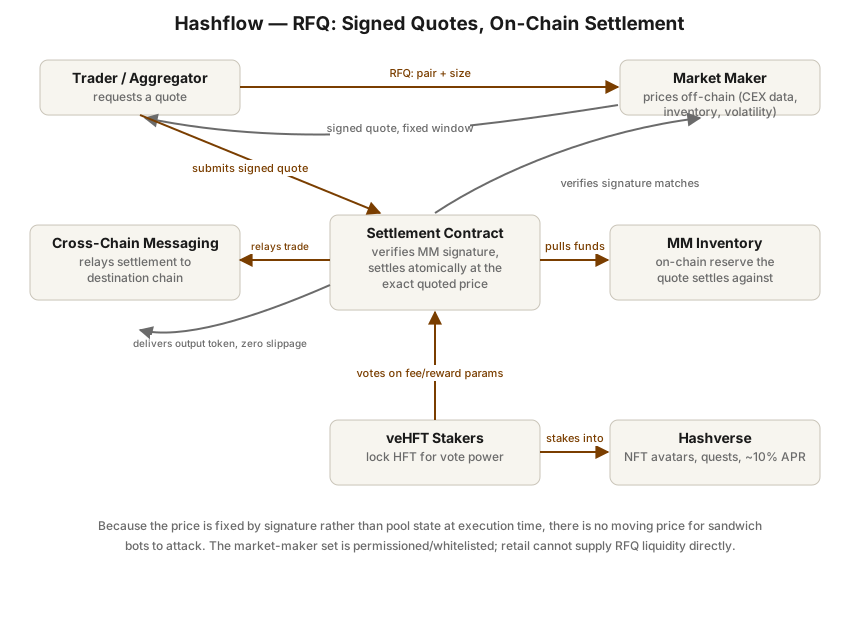
- RFQ instead of AMM. A trader (or an aggregator routing on their behalf) requests a quote for a pair and size. Off-chain, professional market makers respond with a firm price computed from proprietary pricing functions that can incorporate off-chain data (CEX prices, volatility, inventory) rather than a fixed on-chain curve.
- Signed quotes, on-chain settlement. The market maker cryptographically signs the quote, which is valid for a fixed window and cannot change mid-trade. The trader submits it to Hashflow's on-chain contracts, which verify the signature and settle atomically. Price displayed equals price executed: zero slippage by construction.
- MEV resistance. Because the price is fixed by signature rather than derived from pool state at execution time, sandwich attacks and front-running cannot extract value from the trade — there is no moving price to manipulate.
- Capital efficiency. Market makers keep inventory in their own pools and price from anywhere, avoiding the impermanent loss and stale pricing of passive AMM LPs. This effectively imported CEX-style professional market making into DeFi rails.
- Native cross-chain swaps. Hashflow's architecture allowed quotes for cross-chain trades settled via messaging rather than lock-and-mint bridges, marketed as bridgeless cross-chain trading.
- Token and governance. HFT (ERC-20, 1B supply at genesis; ~17.5% unlocked at TGE) governs the protocol via a vote-escrow model: voting power scales with amount and duration of HFT staked. The Hashverse (launched September 2023, built with Hollywood studio Superconductor) wrapped governance in NFT avatars, quests, leaderboards, and "Battle Royale" trading competitions with a 1M HFT prize pool, targeting ~10% APR for six-month stakers.
Outcome
Partially successful and still ongoing. The core mechanism worked and found real product-market fit as infrastructure: RFQ became a recognized DEX category (alongside 0x RFQ and later intent-based systems like UniswapX and CoW), and Hashflow's quotes are consumed heavily by aggregators — weekly volume reportedly hit $327M in October 2025, with daily volumes around $97M during mid-2025 activity spikes. The protocol processed billions in cumulative volume across seven-plus chains. However, the token and community layers underperformed badly: HFT launched at $0.40 in November 2022, briefly spiked (reported ATH ~$2.58+), then fell to roughly $0.08–0.13 through 2025 — down >90% — and in May 2026 Binance placed HFT under its monitoring tag, signaling delisting risk. The June 14, 2023 exploit ($600–640K drained across Ethereum, Arbitrum, BNB, Polygon, and Avalanche via a vulnerable transferFrom/approval path in a contract) was mitigated — it appeared to be white-hat-coordinated, a recovery function was provided, and Hashflow committed to making all affected users whole; the DEX itself continued operating. The Hashverse generated launch buzz but did not become a durable governance flywheel.
Why it worked
- It solved real trader pain. Zero slippage, no front-running, and firm pricing are concretely better execution for takers than AMM pools on large or volatile trades — especially once aggregators could route to Hashflow silently.
- Investor-LP alignment. Raising from Jump, Wintermute, GSR, and Kronos meant the firms providing quotes had equity upside in the venue's success, bootstrapping the cold-start liquidity problem that kills most order-flow venues.
- Off-chain pricing is simply more expressive. Professional pricing functions with CEX data beat static bonding curves on quote quality; Hashflow let DeFi access that without custodial risk.
- B2B distribution. Plugging into aggregator routing meant volume did not depend on retail brand loyalty or token incentives.
Why it failed or underperformed
- The token had weak value capture. HFT governs a protocol whose competitive edge lives off-chain in market-maker relationships; governance rights over fees/marketing gave holders little claim on the flow, and heavy vesting unlocks against thin utility produced a >90% drawdown and a 2026 Binance monitoring tag.
- Gamified governance was ornament, not mechanism. The Hashverse added narrative and prizes on top of ve-staking but did not change who had real power (team + market makers) or create sustainable reasons to hold HFT after rewards.
- Permissioned liquidity trades decentralization for quality. A whitelisted professional market-maker set reintroduces gatekeeping and opacity; retail cannot LP, so the community has no ownership stake in the liquidity itself.
- Security surface. The June 2023 approval exploit showed that even settlement-only contracts carry approval-drain risk; ~$600K was lost (later addressed).
- Category commoditization. Intent-based systems (UniswapX, CoW, 1inch Fusion) absorbed the same "off-chain pricing, on-chain settlement" insight with larger distribution, compressing Hashflow's differentiation.
Lessons
- Execution quality is a wedge, but distribution owns the customer. RFQ won on price, yet aggregators and intent protocols sat between Hashflow and users — infrastructure that is invisible to the end user struggles to accrue brand or token value.
- Aligning liquidity providers via equity works better than via token emissions. Hashflow's investor-market-maker overlap solved cold start more durably than mercenary LP farming — a reusable pattern for any venue business.
- A governance token needs a claim on cash flow or control that matters; gamification cannot substitute. Story-driven DAOs and NFT quests can spike engagement but do not fix absent value capture.
- Signed-quote settlement shrinks MEV surface by design. Removing execution-time price discovery from the chain is one of the cleanest anti-sandwich mechanisms discovered in this era, and it propagated into the intent paradigm.
- Approval hygiene is a standing liability. Even "settlement-only" DEX contracts must treat token allowances as attack surface; sweep/deprecate old contracts and cap allowances.
Redesign (EDITORIAL — hypothesis, not fact)
This section is editorial hypothesis, not fact. A redesigned Hashflow would treat the token as a claim on order flow rather than a governance ornament: route a protocol fee (in basis points on maker fills) to an on-chain treasury that veHFT stakers direct or receive, so holding the token is economically equivalent to owning a slice of the venue. Second, open the maker set gradually — a permissionless tier where smaller makers post bonded collateral and earn reputation from fill quality — converting the permissioned-liquidity weakness into a curated marketplace with slashing for failed or toxic quotes. Third, lean fully into the B2B destiny early: ship RFQ as a white-label settlement standard (the way 0x did) and charge integrators, rather than spending on retail-facing gamification; the Hashverse budget would likely have returned more as aggregator integration incentives. Finally, adopt strict allowance minimization (per-trade permits, expiring approvals) from day one, which would have neutralized the June 2023 exploit class entirely. The counterfactual bet: an RFQ network with fee-backed token economics and a bonded open maker tier could have become the canonical intent-settlement layer before UniswapX defined it.
Sources
- Hashflow Docs — What is Hashflow / RFQ mechanism — primary (docs)
- Hashflow Docs — Official Links — primary (docs)
- Hashflow Docs — HFT and Governance: Background — primary (docs)
- Hashflow Raises $25M Series A from Jump Crypto, Wintermute, and GSR (official blog) — primary (docs)
- HFT token on Etherscan — primary (contract)
- Neptune Mutual — How Was Hashflow Exploited? (analysis)
- The Block — Hashflow faces ongoing exploit, with $600,000 lost so far (PeckShield) (news)
- CoinDesk — Decentralized Crypto Exchange Hashflow Raises $25M at $400M Valuation (news)
- PR Newswire — Hashflow Launches the 'Hashverse' Gamified Governance Platform (news)
- Messari — Hashflow: Certainty in Execution (analysis)
Related experiments
Last verified: 2026-07-26 · Spot an error? Suggest a correction