Pippin
An AI-generated SVG unicorn that the community spontaneously turned into a Solana memecoin, which creator Yohei Nakajima then retro-fitted with an open-source autonomous 'digital being' framework.
▶ Run interactive simulation animated mechanism with editable parameters
How it works onchain
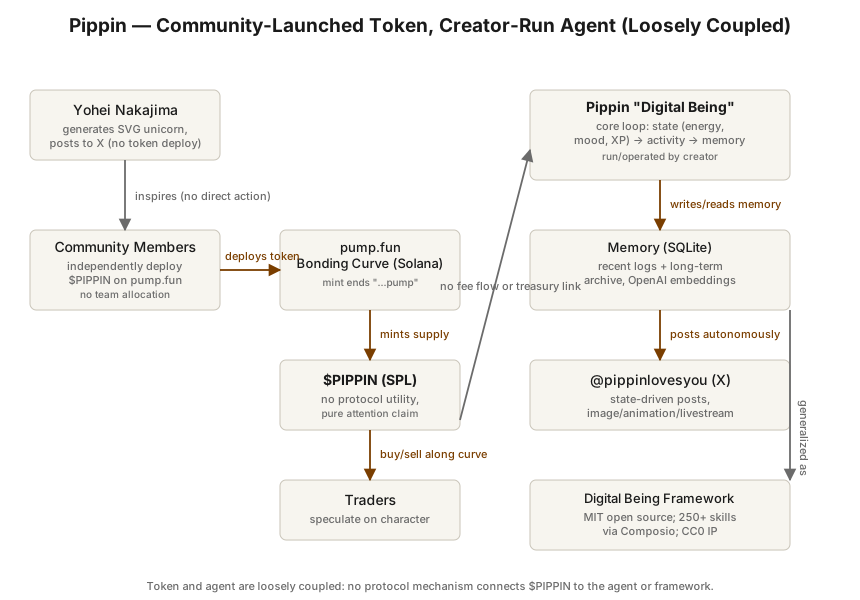 Open full-size diagram
Summary
Pippin began as a throwaway AI experiment: in late 2024, Yohei Nakajima (the investor-builder behind BabyAGI, the ~20k-star project that helped name the "AI agent" category) asked an OpenAI model to draw a unicorn as an SVG and asked ChatGPT to name it. The model said "Pippin." Nakajima posted the image to X; without his involvement, community members deployed a $PIPPIN memecoin on Solana via pump.fun (token mint ends in "...pump"), with the launch generally dated November 9, 2024. Rather than disavow it, Nakajima leaned in — building Pippin into a 24/7 autonomous "digital being" that chooses its own activities, posts to X as @pippinlovesyou, and remembers what it has done. He then open-sourced the underlying software as the MIT-licensed "Digital Being Framework for Autonomous Agents," and declared Pippin's name and likeness CC0 (public domain). The result is an unusual three-layer experiment: a community-owned memecoin, a creator-run AI character, and a general-purpose open-source agent framework, loosely coupled rather than contractually linked.
Design (Mechanism)
Token layer (community-created). $PIPPIN is a standard SPL token launched on pump.fun with no premine, presale, or official team allocation — Nakajima did not deploy it and the official site explicitly frames it as a volatile memecoin, "not financial advice." The token has no protocol utility; its value is a pure attention claim on the Pippin character and the credibility of its creator.
Agent layer (the character). Pippin runs a continuous core loop: read internal state (energy, happiness/mood, XP), select an activity, execute it as a modular Python function, write results into memory, repeat. Memory is dual-layer — recent activity logs (~100 entries) plus an archived long-term store, with semantic retrieval via OpenAI embeddings over SQLite. Crucially, Pippin posts when its internal state dictates, not on a timer — an attempt to make an AI influencer feel organic rather than scheduled. Capabilities grew to include image generation, animation, and livestreaming.
Framework layer (open source). The generalized framework (github.com/pippinlovesyou/pippin, MIT) abstracts this into: a DigitalBeing core with an activity selector, constraint system, and state tracking; "Activities" (modular tasks, creatable via an @activity() decorator — including the agent dynamically writing and testing its own new activities); "Skills" (integrations to 250+ external tools via Composio OAuth or API keys, with a documented example skill for deploying a Solana token); JSON character/persona configuration; and a web UI with WebSocket monitoring. Anyone can fork it to run their own persona-driven agent.
IP layer. Pippin is CC0: anyone may use the name and likeness personally or commercially, which invited community games, videos, meme generators, and music.
Outcome
Ongoing as of mid-2026, with extreme token volatility. $PIPPIN reached an initial all-time high around $0.22–0.24 in January 2025 during the AI-agent memecoin mania, collapsed (all-time low $0.0055 on December 29, 2024 per CoinGecko, illustrating how violent the early chart was), then rallied to a new all-time high of ~$0.897 in late February 2026 ($900M fully diluted at 1B supply) before crashing 98% to roughly $0.017 ($17M market cap) by July 2026. The framework repo accumulated ~550 stars and ~180 forks. A caution flag: CoinGecko surfaces a Bubblemaps on-chain analysis claiming ~80% of token supply sits in interconnected insider wallets — unverified by this atlas but material to interpreting the "fair launch" narrative. The agent itself has run continuously and remains one of the most cited reference implementations from the 2024–25 "AI agent token" wave, alongside ai16z/ELIZA and Truth Terminal.
Why it worked
- Credibility arbitrage. Nakajima's BabyAGI reputation gave a random memecoin instant technical legitimacy that thousands of copycat "AI agent" tokens lacked; his choice to build real software on top converted speculation into an audience for open-source work.
- Separation of concerns. By never issuing the token himself, Nakajima kept the software project clean of securities-like promises while still benefiting from the token community's energy — and vice versa.
- Genuine mechanism novelty. State-driven (not cron-driven) posting, self-generated activities, and layered memory made Pippin a legible, forkable architecture — the framework outlived the first hype cycle.
- CC0 as growth strategy. Public-domain IP let the community build derivative content without permission, multiplying attention at zero cost to the core project.
Limitations and criticisms
- The token never acquired a mechanism. With no fee flow, governance, or agent-controlled treasury linking $PIPPIN to Pippin-the-agent or the framework, the token remains a pure sentiment instrument, which is consistent with its two boom-bust cycles of −90%+ drawdowns.
- Concentration allegations. Reported insider-wallet concentration (if accurate) sits uneasily with the community-fair-launch story that gave the token much of its appeal.
- Category-beta price action. The AI-agent memecoin sector broadly deflated after early 2025; Pippin's price has tracked that category beta more than any project-specific progress, meaning the market has priced sentiment about the category more than the agent's actual capabilities.
Lessons
- A credible builder "adopting" a community-launched token creates a powerful but fragile hybrid: the software gains funding-free attention, but the token inherits no enforceable claim on anything, guaranteeing reflexive boom-bust dynamics.
- Internal-state-driven behavior (energy/mood gating actions) is a cheap, effective way to make autonomous agents feel alive versus scheduled bots — a design pattern that outlasted the token hype.
- CC0 + MIT is a coherent strategy for attention-native projects: give away the character and the code, and let the (unaffiliated) token bear all the speculative risk and disclaimers.
- "Fair launch" claims are only as good as on-chain distribution; third-party wallet-clustering analysis can retroactively rewrite a project's legitimacy narrative.
Redesign (EDITORIAL — hypothesis, not fact)
This section is editorial speculation, not a description of the actual project. A redesigned Pippin could close the token-agent gap without making promises: give the agent itself a non-upgradeable onchain wallet whose actions (minting CC0 collectibles, tipping derivative creators, paying its own inference bills) are executed autonomously via the framework's Solana skill, with $PIPPIN as the sole spendable asset — making the token a metered input to the agent's observable life rather than a naked sentiment claim. Distribution could be cleaned with a verifiable snapshot-and-airdrop to derivative-content creators (leveraging the CC0 ecosystem as a Sybil-resistant contribution graph). Finally, the framework could ship a standard "agent provenance" attestation — signed onchain logs of each activity-loop decision — so markets can price what the agent actually does instead of what its chart implies.
Sources
- Pippin, an AI powered unicorn (founder retrospective) — primary (retrospective)
- pippin.love — Token page (official site) — primary (docs)
- GitHub — pippinlovesyou/pippin (Digital Being Framework, MIT) — primary (docs)
- GitHub — yoheinakajima/pippin (original repo) — primary (docs)
- Solscan — PIPPIN token mint — primary (contract)
- CoinGecko — pippin (PIPPIN) price/ATH data (analysis)
- OKX Learn — PIPPIN Launch: What's Driving the Hype (analysis)
- Gate Learn — What Is Pippin? AI Meme Token & Agent Framework Explained (analysis)
Related experiments
Last verified: 2026-07-26 · Spot an error? Suggest a correction