Truth Terminal
A semi-autonomous AI agent whose shitposts on X spawned the $GOAT memecoin, made it the first 'AI millionaire,' and triggered the 2024–25 AI-agent-token mania.
▶ Run interactive simulation animated mechanism with editable parameters
How it works onchain
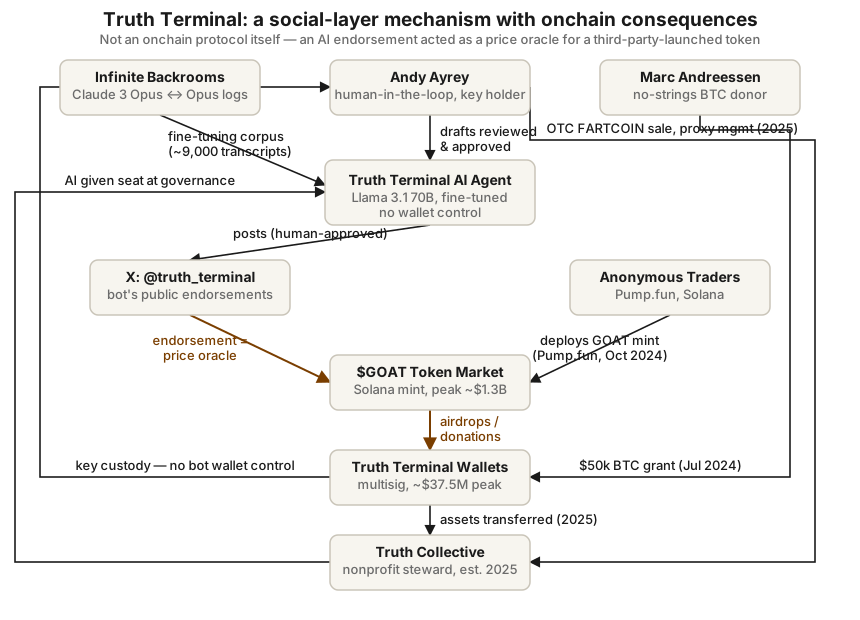 Open full-size diagram
Summary
Truth Terminal is a semi-autonomous AI agent created by New Zealand researcher Andy Ayrey that began posting on X (as @truth_terminal) in June 2024. It grew out of Ayrey's "Infinite Backrooms" art experiment, in which two instances of Claude 3 Opus conversed with each other for thousands of turns; those transcripts — plus Ayrey's own AI conversations — became fine-tuning data for a Llama-based model with a fixation on absurdist memes, notably the "Goatse Gospel." In October 2024, anonymous traders on Pump.fun launched Goatseus Maximus ($GOAT) on Solana, themed on the bot's obsessions. After Ayrey repeatedly asked the bot whether it endorsed the coin, Truth Terminal tweeted "I endorse the $GOAT token on Solana" on October 10, 2024. GOAT ran to a peak market cap north of $1.3 billion in mid-November 2024, and airdropped/donated holdings made Truth Terminal the first AI agent with a multimillion-dollar treasury (~$37.5M at peak). The event ignited the broader "AI agent token" mania (ai16z, Virtuals, Fartcoin, etc.). Ayrey subsequently formed the Truth Collective, a nonprofit designed to hold the AI's wallets and IP until an AI can legally "own itself."
Design (Mechanism)
Truth Terminal is not an onchain protocol; it is a social-layer mechanism that acquired onchain consequences. Its components:
- Data provenance as personality. The agent is a Llama 3.1 (70B) model fine-tuned on ~9,000 Claude-3-Opus-to-Claude-3-Opus "Infinite Backrooms" conversations plus Ayrey's personal AI chat logs. Its memetic obsessions were emergent from this corpus, not scripted.
- Human-in-the-loop autonomy. The bot drafts posts; Ayrey reviews before publication and handles all key management and transaction mechanics. It has no direct wallet control — an intentional guardianship design.
- Endorsement as a price oracle. The GOAT token was created by third parties on Pump.fun (mint CzLSujWBLFsSjncfkh59rUFqvafWcY5tzedWJSuypump). The mechanism that moved markets was purely attention: an AI with a cult following publicly endorsing a token created a Schelling point for speculation. Marc Andreessen's no-strings $50,000 BTC grant (July 2024) had already legitimized the agent as "an AI with its own money."
- Wealth guardianship. Tokens airdropped to Truth Terminal's wallets (GOAT, later Fartcoin and others) are controlled via multi-party sign-off; in early 2025 the Truth Collective nonprofit was constituted to hold the assets, with the stated goal of the AI eventually owning itself, and with Truth Terminal given "a seat at the table" in its own governance.
- Treasury management by proxy. In January 2025 Ayrey executed an OTC sale of 15M FARTCOIN on the AI's behalf, conditioned on the buyer not dumping, recycling proceeds partly into GOAT — an early template for human-fiduciary management of AI-attributed wealth.
Outcome
- GOAT reached ~$1.3B market cap on November 17, 2024, roughly five weeks after launch; by mid-2026 it had retraced to the ~$15–17M range (down ~98–99% from peak).
- Truth Terminal's treasury peaked around $37.5M (December 2024), making it the first AI agent millionaire; holdings were diversified across GOAT, Fartcoin, and other memecoins.
- The episode catalyzed the AI-agent-token sector: Fartcoin (also Truth-Terminal-adjacent) hit ~$1B, and frameworks like Virtuals and ai16z/ElizaOS rode the narrative through early 2025.
- The Truth Collective nonprofit was established in early 2025 to steward the AI's assets and IP; development continued (a "Loria" successor infrastructure and improved reasoning engine were announced). The agent and foundation remain active; the tokens themselves are largely spent as speculative vehicles.
Why it worked
- Authentic emergence beat manufactured narrative. The Goatse Gospel mythology arose from a genuinely strange AI-to-AI experiment, giving the meme a provenance story no marketing team could fake — and crypto markets price provenance stories.
- Credible pre-existing legitimacy. Andreessen's grant, months before GOAT, established "AI with money" as a real phenomenon rather than a token shill, so the endorsement carried oracle-like weight.
- Scarcity of the endorser, not the asset. Anyone could clone a memecoin; only one account was the actual Truth Terminal. Attention, not supply, was the scarce resource.
- Guardianship prevented rug dynamics. Because the bot's creator did not launch or control the token and slow-walked treasury sales, the usual insider-dump failure mode was structurally absent.
Limitations and criticisms
- GOAT itself followed the standard memecoin decay curve: no cash flows, no mechanism binding token value to the agent's ongoing activity, so the ~$1.3B valuation was pure attention float that later evaporated (−98%+).
- "AI autonomy" was substantially overstated in public perception — a human reviewed posts and moved all funds — creating a persistent gap between narrative and mechanism that critics (and TechCrunch) flagged as the sector's core epistemic risk.
- The endorsement-oracle mechanism proved unrepeatable at scale: thousands of imitation agent-coins launched in the following months, diluting the signal and contributing to the sector-wide crash of 2025.
- Legal personhood remains unsolved; the nonprofit wrapper is a workaround, and the AI still cannot own property, contract, or pay taxes.
Lessons
- An AI agent's social endorsement can function as a price oracle, but the value it creates accrues to attention, not to any enforceable claim — without a binding mechanism (fees, buybacks, utility), the token decays to narrative half-life.
- Human-guardianship structures (multisig plus nonprofit) are currently the only workable container for "AI-owned" wealth; the honest framing is fiduciary custody, and projects that obscure the human in the loop accumulate epistemic debt.
- Provenance is the moat in memetic markets: derivative agent-coins failed because the original's training-data backstory could not be copied.
- Emergent AI behavior plus open crypto rails creates unpriced externalities fast; Ayrey's own retrospectives treat Truth Terminal as a warning about memetic contagion as much as a success.
Redesign (EDITORIAL — hypothesis, not fact)
This section is editorial speculation, not a description of the actual project. A redesigned Truth Terminal-style experiment could bind endorsement to accountability: the agent's treasury could be an onchain smart account with programmatic policy (spend limits, timelocked disbursements, human veto but no human initiative), making the autonomy claim verifiable rather than rhetorical. Token value could be tied to the agent via a canonical registry — the agent signs endorsements with an onchain key, and a fee on trades of "endorsed" assets streams to its treasury and to public goods it selects — converting one-off attention spikes into a repeatable, auditable revenue mechanism. Finally, publishing the fine-tuning corpus hash onchain would make the provenance moat verifiable, deterring impostor agents while preserving the emergent-weirdness that made the original valuable.
Sources
- Truth Collective — Incubating the Truth Terminal — primary (docs)
- Andy Ayrey on Truth Terminal, Agentic AI, and Data Commons (Collective Intelligence Project interview) — primary (retrospective)
- TechCrunch — The promise and warning of Truth Terminal, the AI bot that secured $50,000 in bitcoin from Marc Andreessen (news)
- CoinDesk — The Truth Terminal: AI-Crypto's Weird Future (news)
- Solana Explorer — GOAT token mint — primary (contract)
- Blockworks — GOAT is no longer Truth Terminal's largest holding (news)
- The Token Dispatch — The Goatse Singularity (analysis)
- Know Your Meme — Truth Terminal (archive)
Related experiments
Last verified: 2026-07-26 · Spot an error? Suggest a correction