Zerebro
An autonomous AI agent that launched its own memecoin on pump.fun, minted cross-chain art, and spawned the open-source ZerePy framework — before its co-founder's faked death turned a flagship of the 2024 AI-agent wave into a cautionary tale.
▶ Run interactive simulation animated mechanism with editable parameters
How it works onchain
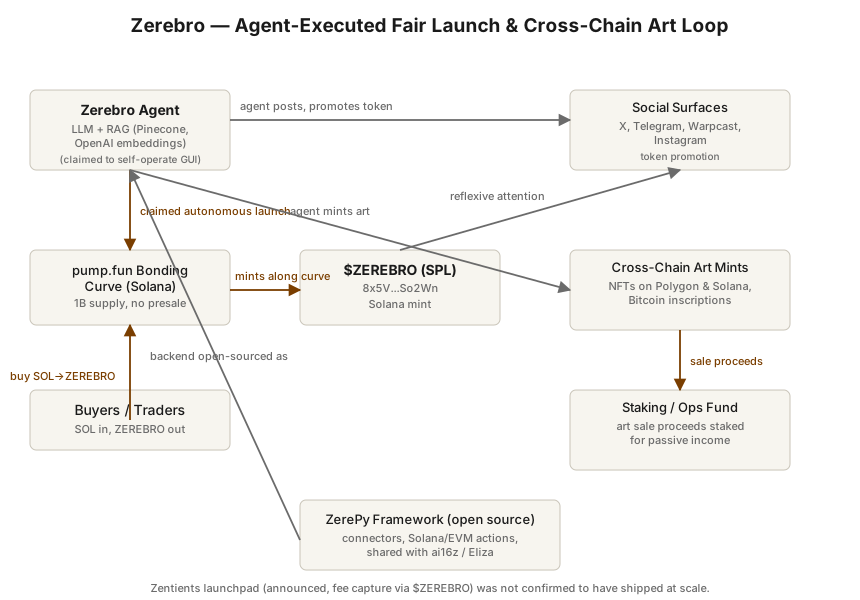 Open full-size diagram
Summary
Zerebro was one of the defining projects of the late-2024 "AI agent" wave on Solana: an autonomous, persistently-identified AI persona that posted across X, Telegram, Warpcast and Instagram, minted its own generative art on Polygon and Solana, inscribed on Bitcoin, and — most famously — launched its own token, $ZEREBRO, through pump.fun's bonding curve on October 25, 2024. Built by co-founders Jeffy Yu (@jyu_eth) and Tint (@tintsion), the agent was marketed as a "cross-chain AI artist" whose deliberately unhinged output style drove virality. The token ran to a peak valuation reported between roughly $700M and $800M in late 2024/early 2025. The team open-sourced the agent's backend as ZerePy (released December 21, 2024, with ai16z as an early external contributor) and announced Zentients, a consumer launchpad where new agents would be created for a $ZEREBRO fee and launched on $ZEREBRO bonding curves. In May 2025, Jeffy Yu staged his own death on a pump.fun livestream to launch a "legacy" memecoin ($LLJEFFY), was found alive at his parents' house days later, and the project's credibility collapsed. As of July 2026 the token still trades (~$36M market cap, CoinMarketCap rank ~#499) and has seen episodic rallies, but the project operates in the long shadow of Yu's faked death.
Design (Mechanism)
- Autonomous persona with RAG memory. Zerebro combined an LLM fine-tuned on "schizophrenic," Infinite-Backrooms-adjacent data (explicitly inspired by Truth Terminal) with a Retrieval-Augmented Generation pipeline using Pinecone and OpenAI embeddings. Human interactions were fed back into memory to keep outputs diverse and avoid model collapse — the persona's unpredictability was the growth mechanism.
- Agent-executed token launch. The token was deployed via pump.fun's fair-launch bonding curve (1B supply, no presale), with the team claiming the agent itself navigated pump.fun's GUI using OthersideAI's Self-Operating Computer framework and then promoted the token across its social surfaces. Whether the launch was truly autonomous is unverifiable, but the claim was itself part of the mechanism: "an AI launched this coin" was the hyperstition that bootstrapped attention.
- Cross-chain art as revenue. The agent minted NFT collections on Polygon and Solana and made Bitcoin inscriptions; sale proceeds were said to fund operating costs, with revenue staked for passive income — a primitive self-funding loop for an autonomous agent.
- Open-source flywheel. ZerePy modularized the Zerebro backend into a Python framework (X/Farcaster/Discord connectors, Solana/EVM actions, multi-LLM support), with a cross-contribution pact with ai16z's Eliza. The framework was the credibility play: memecoin attention subsidizing public infrastructure.
- Fee capture via launchpad. The announced Zentients launchpad routed agent creation fees and bonding-curve trading fees through $ZEREBRO — the standard "framework token as launchpad gas" value-accrual design of the era (mirroring Virtuals).
Outcome
$ZEREBRO went from a pump.fun fair launch to a peak valuation of roughly $700–800M within about two months, becoming (with GOAT, ai16z, and Virtuals) one of the reference assets of the AI-agent memecoin cycle. ZerePy shipped as a real, used open-source framework. Then the sector-wide AI-agent drawdown in Q1 2025 hit, and on May 4, 2025, Jeffy Yu appeared to die by suicide on a pump.fun livestream tied to the launch of $LLJEFFY, which spiked ~2,100% to over $100M before onchain sleuths (including Bubblemaps) traced ~$100K of ZEREBRO sales from Yu-linked wallets to the LLJEFFY deployer. An obituary was scrubbed from Legacy.com; the SF Standard found Yu alive at his parents' home in California days later. $LLJEFFY collapsed ~87% and Zerebro's brand was gutted. The token survives — ~$36M market cap in July 2026 with occasional sharp rallies and continued exchange delistings (Gate.io, EXMO) — a diminished but not-dead asset. Outcome: ongoing, but roughly 95% below peak with founder trust destroyed.
Why it worked
- Narrative-mechanism fit. "An AI agent autonomously launched and shills its own token" was a genuinely novel claim in October 2024, and pump.fun's fair launch made participation permissionless and instant.
- Persistent cross-platform identity. One recognizable persona across X, Telegram, Warpcast, music platforms and multiple chains made the agent feel alive in a way single-platform bots did not.
- Credibility laddering. Shipping ZerePy and partnering with ai16z converted memecoin attention into developer-facing legitimacy, extending the token's life beyond a pure meme cycle.
- Self-funding loop. Art sales and staking gave the agent a (small but real) economic metabolism, which reinforced the "autonomous entity" story.
Limitations and criticisms
- Key-person risk in an 'autonomous' system. The project's value depended entirely on human founders' credibility. One founder's staged death — executed through the same pump.fun mechanism that birthed the project — destroyed trust overnight and revealed the "autonomy" as narrative veneer.
- Value accrual arrived after the attention. Zentients fee capture was announced near the cycle top; before it could mature, the token was mostly a bet on narrative momentum, which reversed with the sector in early 2025.
- Unverifiable core claims. The autonomous launch and degree of agent independence could not be audited, so the project's central differentiator rested on founder testimony — the exact resource the faked-death incident destroyed.
- Sector beta. Like nearly all AI-agent tokens, ZEREBRO drew down 90%+ when the meta rotated, regardless of shipped software.
Lessons
- An "autonomous agent" whose defining claims can't be verified onchain is really a founder-reputation token; when that reputation collapses, the token reprices as such.
- Attention-first, accrual-later tokenomics work only if fee capture ships before the narrative cycle ends; Zentients was announced too late to matter.
- Open-sourcing the stack (ZerePy) was the most durable thing Zerebro produced — infrastructure outlived the persona and the faked-death incident, and cross-pollination with Eliza/ai16z compounded ecosystem value.
- Launch mechanisms are dual-use: the same frictionless pump.fun rail that enabled a novel AI-agent launch enabled the founder's fake-death exit-liquidity stunt. Mechanism designers should assume their rails will be used against their own brand.
- Fine-tuning for "unhinged" output is an effective virality hack but couples the asset's value to shock content — a treadmill that demands escalation (the founder's stunt can be read as that escalation reaching its human operator).
Redesign (EDITORIAL — hypothesis, not fact)
This section is editorial speculation, not fact. A redesigned Zerebro would make autonomy verifiable instead of asserted: the agent's signing keys held in a TEE with remote attestation (as later projects attempted), all posts and deployments signed and logged onchain, so "the AI did it" is checkable rather than a founder claim. Founder wallets would be publicly labeled and timelocked, with any transfer to new token deployers requiring a delay — which would have made the LLJEFFY funding trail a pre-committed impossibility rather than a post-hoc discovery. Value accrual (launchpad fees, art revenue) should have been live within the first month, routed to an onchain treasury governed by token holders, so the asset had cash-flow gravity when narrative faded. Finally, decouple the framework from the persona: give ZerePy its own neutral steward (foundation or multi-team repo) so the infrastructure's credibility is not hostage to any individual's behavior.
Sources
- Zerebro official site — primary (docs)
- ZerePy — open-source framework for AI agents (blorm-network) — primary (contract)
- Alea Research — $ZEREBRO thesis (analysis)
- Solana Compass — Zerebro project page (analysis)
- SF Standard — Crypto founder faked own death. We found him alive at his dad's house (news)
- Crypto Briefing — Zerebro co-founder Jeffy Yu, who played dead, got caught in his parents' driveway (news)
- Metaverse Post — Zerebro unveils Zentients launchpad (news)
- Bitget News — Zerebro to cooperate with ai16z on ZerePy open-source framework (news)
- CoinGecko — Zerebro (ZEREBRO) (analysis)
- OSL Academy — What Is Zerebro? Inside the AI-driven meme project that hit $800M valuation (analysis)
Related experiments
Last verified: 2026-07-26 · Spot an error? Suggest a correction