terra0
A Berlin art/research collective's long-running attempt to make forests and trees self-owning economic agents via Ethereum smart contracts, oracles, and legal wrappers.
▶ Run interactive simulation animated mechanism with editable parameters
How it works onchain
 Open full-size diagram
Summary
terra0 is one of the earliest and most cited experiments in giving non-human ecosystems onchain economic agency. Conceived in 2015–16 by Paul Seidler and Paul Kolling in Joachim Sauter's New Media class at the Berlin University of the Arts (with Max Hampshire joining as a core member until 2021), the project published its white paper, "terra0 — Can an augmented forest own and utilise itself?", in May 2016 — the same year as The DAO, and years before "natural asset" tokenization became a sector. The thesis: a forest, monitored by drones, satellites, and sensors, could sell logging licenses for its own trees via Ethereum smart contracts, repay its initial investors, and thereafter effectively own itself as an autonomous economic agent.
Rather than one monolithic launch, terra0 has proceeded as a series of scoped experiments: Flowertokens (2018), Premna Daemon (2018), Two Degrees (2021), A tree; a corporation; a person (2022), and continuing work (Conditional Power, 2024–; Autonomous Forest, 2025). It gained wide attention after Transmediale 2017 and publication in "Artists Re:thinking the Blockchain," and remains a canonical reference point for DAO-for-nature and nonhuman-personhood mechanism design.
Design (Mechanism)
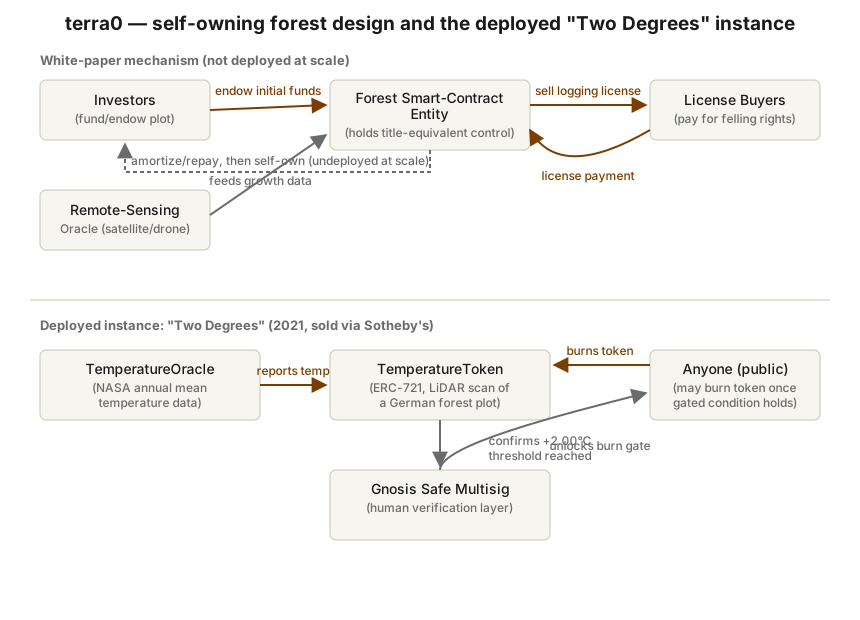
The white paper's core loop: (1) humans purchase and endow a forest plot held by a smart-contract entity; (2) remote sensing (satellite/drone imagery, later LiDAR) feeds growth data to the contract via oracles; (3) the contract automatically sells tree-felling licenses at a sustainable rate; (4) proceeds amortize the initial investment; (5) once debt is repaid, the forest "owns itself" — the contract holds title-equivalent control with no human beneficiary.
Successive experiments tested individual components:
- Flowertokens (2018): 100 dahlias at Trust (Berlin) tokenized as ERC-721s (initial price 0.09 ETH), each linked to camera monitoring with computer vision updating token attributes — a test of decentralized verification of living physical assets and of where "trustless" components are actually necessary in the stack.
- Premna Daemon (2018): a bonsai at Schinkel Pavillon with sensors, cameras, and a mainnet smart contract; the tree "requested" care by paying Ether to its host institution from crowdsourced donations — an autonomous principal purchasing services from humans.
- Two Degrees (2021): a two-contract system — a TemperatureToken ERC-721 (a LiDAR scan of a German forest, address 0xabf5...0dad) and a TemperatureOracle (0x14e0...De77) tracking NASA annual mean temperature data. If warming reaches a hardcoded +2.00°C, the token becomes burnable by anyone, gated by a Gnosis Safe multisig as a human verification layer. Sold via Sotheby's "Natively Digital" (June 3–10, 2021).
- A tree; a corporation; a person (2022): a black gum tree planted at the Community College of Allegheny County, Pittsburgh, as the single living entity and de facto owner of the "Pittsburgh Lobby for Tree Personhood" (a 501(c)(4)), governing itself via smart contract and issuing annual NFT "certificates of care" to Carnegie Museum of Art for services rendered (water, pruning, liability) — a legal-wrapper bridge between onchain agency and real property law.
Outcome
Ongoing, with a decade of iterative deployments rather than a single verdict. The full self-owning forest of the 2016 white paper has never been deployed at scale; the collective itself frames the work as revealing that "given enough time and resources, distributed technology [allows] nonhuman actors to be properly integrated into contractual relations." Flowertokens functioned technically but was explicitly an art experiment, not a business — Seidler noted absurd speculative behavior (one token listed at 300 ETH against a 0.09 ETH issue price) and the team expected to shut the system down and burn tokens afterward. Premna Daemon demonstrated human-institution-to-nonhuman service relationships. Two Degrees produced a working oracle-conditional-burn NFT sold at Sotheby's. The 2022 Pittsburgh tree established a real legal-personhood scaffold. terra0 remains active (Conditional Power 2024–, Autonomous Forest 2025) and institutionally supported (LAS Art Foundation R&D, Carnegie International, Frieze coverage).
Why it worked
- Scoped-down experiments: instead of betting everything on the utopian forest, terra0 decomposed the problem (asset tokenization, sensor oracles, conditional token state, legal wrappers) into testable units, each of which shipped on mainnet or in a real institution.
- Hybrid trust design: Two Degrees' oracle + multisig human-verification layer is an honest acknowledgment that physical-world data cannot be fully trustless — a design pattern later common in RWA systems.
- Legal-technical bridging: the Pittsburgh 501(c)(4) construction gave a nonhuman entity practical standing that a bare contract cannot obtain, prefiguring DAO-LLC and nature-personhood approaches.
- Art-world framing bought time and funding without requiring commercial returns, letting the experiments run for a decade.
Limitations and criticisms
- The core white-paper mechanism — a forest autonomously selling logging licenses and repaying investors — remains undeployed; land title, liability, and forestry law have no native interface to smart contracts, so every instantiation still depends on human institutions as custodians.
- The oracle problem for living systems: Flowertokens showed decentralized verification of physical asset state is the hard part; computer-vision plant monitoring did not generalize beyond the pilot.
- Speculation swamped signal: 2018 token markets treated dahlias as lottery tickets, illustrating that attaching tokens to ecological assets imports crypto's speculative dynamics wholesale rather than pricing the underlying asset.
- No self-sustaining economic loop has yet closed: the entities run on grants and art-market proceeds rather than generating revenue from ecosystem services, so the "self-owning forest" thesis remains unproven at scale.
Lessons
- Nonhuman/ecological onchain agency is bottlenecked by law and oracles, not by contract code — the smart-contract layer was the easy part in every terra0 experiment.
- Hybrid verification (automated oracle + human multisig attestation) is a pragmatic template for physical-world triggers where pure trustlessness is unattainable.
- Tokenizing living assets invites speculation detached from the asset's ecological function; mechanism designers must either embrace that (as funding) or structurally suppress it (soulbound/non-transferable claims, capped pricing).
- A legal wrapper (nonprofit, LLC, trust) that a contract effectively controls is currently the only viable route to "self-ownership" of real property — the chain holds the logic, the wrapper holds the title.
- Long-horizon experiments benefit from decomposition: a decade of small deployed probes taught more than one grand launch would have.
Redesign (EDITORIAL — hypothesis, not fact)
This section is editorial hypothesis, not a description of terra0's plans. A 2026 redesign could plausibly close the economic loop the white paper left open: place the forest's land in a state-recognized perpetual-purpose trust or DAO-LLC whose sole member is the contract system; replace logging-license revenue (slow, legally fraught) with verified carbon/biodiversity credit issuance using the Two Degrees pattern — satellite/LiDAR oracles plus a rotating attestor multisig staked and slashable for false attestations. Investor repayment could be structured as self-amortizing revenue-share tokens that burn at a capped multiple, preventing the perpetual-extraction incentive and the Flowertokens-style speculation problem. Governance-minimization matters: after debt retirement, human roles should decay to a narrow "guardian" function (dispute response, legal representation) compensated per-action by the forest itself, echoing Premna Daemon. The main untested risks remain oracle capture over decades-long horizons and the durability of legal wrappers across jurisdictional change — terra0's own history suggests the legal layer, not the contracts, is where such a redesign would live or die.
Sources
- terra0 official site (works list, team, X link) — primary (docs)
- terra0 white paper — Can an augmented forest own and utilise itself? (2016) — primary (docs)
- Two Degrees NFT — conceptual and technical writeup (terra0 Medium) — primary (retrospective)
- The Development of terra0 (Weird Economies, by terra0) — primary (retrospective)
- terra0 — 2022 Carnegie International (A tree; a corporation; a person) — primary (docs)
- terra0 GitHub — environmental smart contracts — primary (contract)
- Flowertokens and Terra0: Ethereum's Walled Garden (crypto.news) (news)
- terra0's Self-Governing Forests (Frieze, 2023) (analysis)
- MoneyLab: Terra0 — The Self-Owning Augmented Forest (analysis)
Related experiments
Last verified: 2026-07-26 · Spot an error? Suggest a correction