Post Tech
Arbitrum-based friend.tech clone that let users trade bonding-curve shares of X profiles — and individual posts — with fee dividends for holders and a points-for-airdrop $POST token, briefly hitting millions in daily volume before activity and the token collapsed to near zero.
▶ Run interactive simulation animated mechanism with editable parameters
How it works onchain
 Open full-size diagram
Summary
Post Tech (post.tech) was a SocialFi application on Arbitrum that launched in the immediate wake of friend.tech's August 2023 explosion on Base. Like friend.tech, it let users link an X (Twitter) account and sell bonding-curve-priced "shares" of their profile for ETH; unlike friend.tech, it also let users buy and sell individual posts as tradable assets, paid a slice of trading fees to shareholders (not just profile owners), and made token-gated group chats visible to all channel members. Layered on top was a points system with timed "epochs" feeding a $POST token airdrop, with $100,000 in Epoch #1 rewards. The app briefly became one of the most active dapps on Arbitrum — roughly $1.8M–$3M in daily volume and ~11,000 daily active wallets in late September 2023 — before following the entire first-wave SocialFi cohort into steep decline. By 2024 activity had evaporated; the POST token now trades at fractions of a hundredth of a cent with effectively zero volume. The team was never publicly identified.
Design (Mechanism)
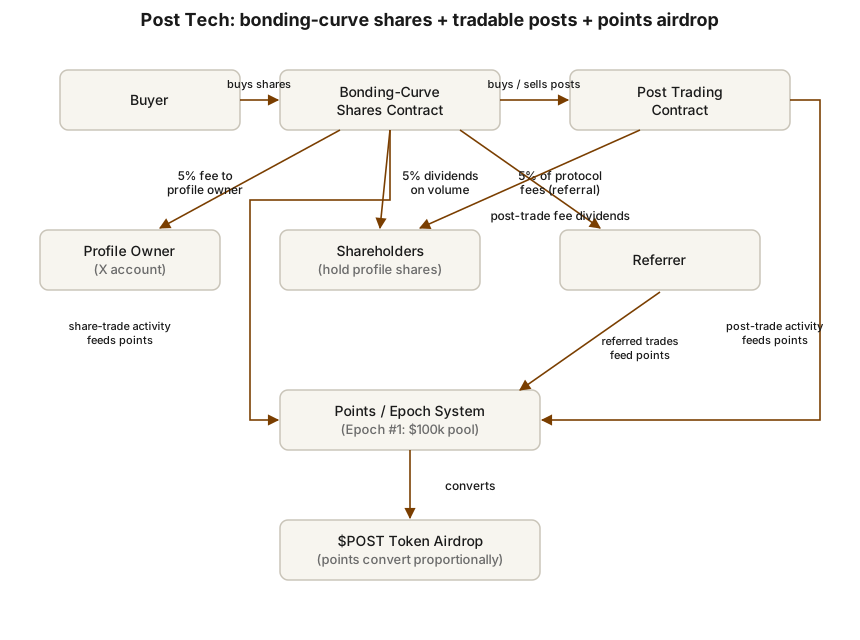
- Profile shares on a bonding curve. Users connected an X account and their profile became a tradable asset priced on a bonding curve (friend.tech-style: price rises deterministically with supply). Buyers paid ETH on Arbitrum, chosen for low fees versus mainnet.
- Post trading. The signature differentiator: individual posts could be bought and sold, effectively converting tweets into speculative assets — an attempt to price content, not just access to a person.
- Fee split with holder dividends. Trades carried a ~10% fee: 5% to the platform and 5% to the profile owner, and — distinctly from friend.tech, where only the subject of the shares earned fees — shareholders received 5% dividends on trading volume generated by the shares they held. Referrers earned 5% of protocol fees on referred users' trades. Claims had a 0.003 ETH minimum.
- Open group chats. Buying a share gated entry to a channel, but all members could read all messages (friend.tech initially showed messages only to the key owner), pushing the product toward group community rather than 1-to-1 access.
- Points, epochs, and the $POST airdrop. Activity (posting, engagement, referrals, share trading) accrued points across epochs; Epoch #1 (Sept 7–22, 2023) shared $100,000 of rewards, and points converted proportionally into a $POST token airdrop. The POST token was deployed on Arbitrum (Arbiscan-labeled contract above).
Outcome
Post Tech spiked hard and faded fast. In the week after its mid-September 2023 launch push, DappRadar-tracked volume jumped thousands of percent; The Block reported ~$1.8M in 24-hour volume, ~87,000 daily transactions, and 11,000+ unique active wallets on September 21, 2023, with other outlets reporting peaks near $2.4M–$3M/day. BeInCrypto noted a visible bump in new Arbitrum wallet creation attributable to the launch. But the platform tracked the same curve as friend.tech, Stars Arena, and the rest of the 2023 SocialFi wave: volume collapsed within months as points farmers rotated out and speculative flywheel demand disappeared. The POST token subsequently lost essentially all value — trading around $0.0000055 with ~$0 daily volume as of recent trackers — and the project shows no signs of ongoing development or communication. No exploit or formal shutdown announcement was found; it is best classified as abandoned. Founders: Unknown / not found (never publicly doxxed in any source located).
Why it worked
- Fast-follow timing on a proven mechanic. It cloned friend.tech's bonding-curve share model at the exact peak of SocialFi mania and captured the Arbitrum-native audience friend.tech (on Base) hadn't served.
- Better-aligned fee design on paper. Paying dividends to shareholders — not just profile owners — gave buyers an ongoing cash-flow reason to hold, and referral fees recruited an aggressive growth army.
- Aggressive incentive stacking. Cash rewards, points, epochs, and an explicit airdrop promise generated enormous short-term volume and wallet activity — exactly what those instruments are designed to do.
Where the design broke
- Mercenary demand, no organic product. The volume was dominated by airdrop farmers and speculators; when Epoch rewards ended and the meta cooled, there was no residual social product people wanted to use daily.
- Bonding-curve shares price by order of entry. As with friend.tech, the curve prices shares by arrival order, and the ~10% round-trip fee means an entrant's position only clears above cost if new buyers keep arriving behind them — a mechanism that depends on continuous inflow and unwinds quickly once new demand stops.
- Derivative positioning. As a clone, its fate was tied to the category leader; when friend.tech's own revenue fell ~90% and it eventually ceded contract control in 2024, second-tier clones had no independent thesis to fall back on.
- No accountable exit mechanism. With no identified founders and no formal wind-down process, there was no structural path for returning value to holders once volume stopped — the token had no offramp when activity ended.
Lessons
- Fee dividends to holders improve alignment but cannot rescue a mechanism whose core demand is speculative rotation; cash-flow sharing only matters if there are durable cash flows.
- Points/epoch/airdrop campaigns buy volume, not retention — metrics earned this way are almost pure noise for judging product-market fit.
- Financializing content itself (tradable posts) went further than friend.tech's access-trading, but pricing individual tweets attracted even less durable demand than pricing people; novelty of the tradable object doesn't fix the flywheel.
- Fast-followers inherit the category leader's downside beta: when the original mechanism was revealed as unsustainable, every clone repriced with it.
Redesign (EDITORIAL — hypothesis, not fact)
This section is editorial speculation, not historical fact. A more durable version would invert the priority: build a subscription-like, flat-priced (non-bonding-curve) creator access product first, so pricing reflects willingness-to-pay for content rather than expected resale value, and route the holder-dividend idea into revenue-sharing on actual creator earnings (e.g., holders of a creator pass earn a capped share of subscription revenue). Post trading could survive as a collectible mint (fixed-price editions of posts, like Zora-style content coins with no curve) rather than a speculative curve. Airdrop epochs should reward retained cohorts (weeks of consecutive activity, chat participation) rather than raw volume, and the team should be doxxed or the contracts governed by a multisig with a published wind-down policy — the absence of any accountable exit was as damaging as the mechanism itself.
Sources
- Friend.Tech rival Post.Tech activity picks up with $1.8 million in daily volume (news)
- What Is Post Tech? Friend Tech Rival Records $2.4M Trading Volume in 24 Hours (Metaverse Post) (analysis)
- Post.Tech generates $3m in daily volume on L2 Arbitrum (crypto.news) (news)
- Will Post.Tech Launch Trigger Arbitrum (ARB) Price Rally? (BeInCrypto) (news)
- Post.Tech Token (POST) Token Tracker — Arbiscan — primary (contract)
- post.tech Token (POST) live price — Livecoinwatch (post-collapse price/volume) (analysis)
- The rise and fall of SocialFi (DL News) (analysis)
- Post.Tech Airdrop — Airdrop Alert (epoch/airdrop mechanics) (archive)
Related experiments
Last verified: 2026-07-26 · Spot an error? Suggest a correction