Reality Cards
An NFT-based prediction market where users did not bet on outcomes but rented ownership of outcome NFTs under a Harberger-style always-for-sale mechanism, with the pot split by time owned.
▶ Run interactive simulation animated mechanism with editable parameters
How it works onchain
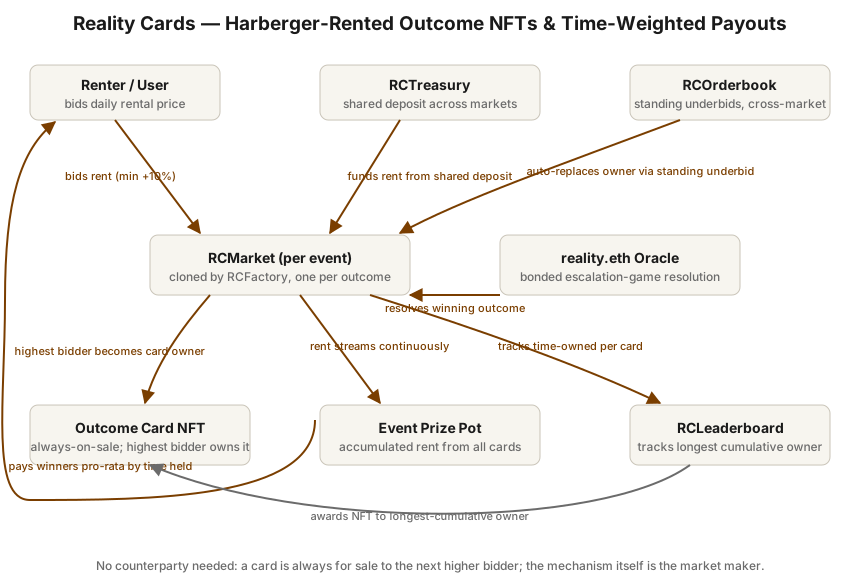 Open full-size diagram
Summary
Reality Cards billed itself as "the world's first NFT-based prediction market." Instead of buying outcome shares Augur- or Polymarket-style, each possible outcome of a real-world event (e.g., "Biden wins") was a single NFT that anyone could seize at any moment by paying a higher daily rental price — a modified Harberger-tax / partial-common-ownership scheme directly inspired by Simon de la Rouviere's "This Artwork Is Always On Sale." Rent streamed from card owners into the event's prize pot; when the event resolved (via the reality.eth crowdsourced oracle), the pot was paid to everyone who had ever owned the winning card, pro rata by time owned. The card NFT itself went permanently to whoever held that outcome the longest, win or lose — fusing speculation with collecting.
The project began in November 2019 as founder Andrew Stanger's final project for the ConsenSys Solidity bootcamp (he was an accountant for nearly a decade before moving into Ethereum); he was joined by co-founder Vlad Micliuc, a former Ubisoft developer. After a 2020 mainnet MVP and a March 2021 beta on xDai, it migrated to Polygon and fully launched on September 15, 2021. It raised at least two funding rounds (treasury over $2M by April 2021) and ran two Code4rena audit contests, but ceased operations in January 2023 per the company's LinkedIn page.
Design (Mechanism)
- Outcomes as rentable NFTs. Each market minted one NFT per outcome. A card was always "on sale": anyone could take it by bidding a daily rental price at least 10% above the current one — no shares, no order matching against counterparties, no explicit odds. The rental price served as the implicit probability signal.
- Streaming rent → prize pot. Owners paid their self-declared daily rate continuously out of a deposit; all rent across all cards accumulated into that event's pot. Ownership ended when outbid or when the deposit ran dry (with an orderbook of standing underbids so the next-highest bidder automatically took over — added in later versions).
- Time-weighted payout. On resolution, the whole pot went to renters of the winning card in proportion to how long each had owned it. Betting "more" meant either renting at a higher price (deterring rivals) or holding longer.
- Collectible payoff. The NFT for each outcome was permanently awarded to its longest cumulative owner (tracked by RCLeaderboard), giving a non-financial motive to rent even losing outcomes.
- Architecture. Factory-cloned per-event RCMarket contracts; a shared RCTreasury so one deposit served all markets; RCOrderbook for cross-market bids; NFT hub contracts bridging cards from Polygon to Ethereum mainnet. Resolution came from reality.eth's bonded escalation game.
Outcome
Technically it shipped and worked. The beta ran on xDai from March 2021, migrated to Polygon in July 2021 after community feedback, and opened publicly that September with sports, politics, crypto, and entertainment markets, plus a Polygon Studios partnership (November 2021). The team grew to six full-time members and the code went through two Code4rena contests (June 2021, $45k USDC + token prizes; August 2021 follow-up). But traction never materialized at scale — public communications largely stopped after late 2021, the planned governance token/IDO never became a liquid reality, and the LinkedIn page records that the company ceased operations in January 2023. The website now returns a 404. No exploit or hack is on record; it simply wound down. Public volume/user metrics: Unknown / not found.
Why it worked
- Genuinely novel mechanism design. It solved prediction markets' liquidity-bootstrap problem in one stroke: you never need a counterparty. A single user can rent a card; the market maker is the Harberger mechanism itself.
- Legible UX. "Pay rent to hold the card you believe in" is more intuitive than shares, AMM odds, and slippage — and the always-on-sale rule made price discovery continuous.
- Dual incentive channel. The collectible NFT prize gave users a reason to participate beyond expected monetary value, prefiguring later "bet-to-collect" designs.
- Serious engineering posture. Real audits, a clean clone-factory architecture, a shared treasury for cross-market capital efficiency, and a credible oracle (reality.eth).
Where the design broke
- Weak probability semantics. Time-weighted rental payouts are a noisy proxy for belief: your return depended on when you rented, for how long, and what others paid — not cleanly on being right. Sophisticated bettors couldn't compute an edge, and casual users couldn't estimate returns, so it satisfied neither audience.
- Winners partly fund their own payout. Rent paid by winning-card owners flowed into the same pot they later split, so long-term winners were partly repaid from their own rent while losing-card rent subsidized them — a structure that made expected value hard to compute in advance.
- Timing. Full launch landed in late 2021, months before the 2022 bear market crushed both NFT collecting and speculative consumer crypto; prediction markets themselves only found product-market fit later (Polymarket's 2024 election cycle).
- Capital inefficiency. Deposits streaming away as rent, plus the risk of being sniped off a card at any moment, made holding positions stressful compared to buy-and-hold outcome shares.
- Small team, niche category. A six-person team competing for attention in a crowded 2021 NFT market, on a mechanism that required education to use.
Lessons
- Harberger/always-on-sale rental elegantly removes the counterparty-liquidity requirement from prediction markets, but it trades away the crisp "price = probability" property that makes prediction markets valuable — mechanism novelty is not a substitute for payoff legibility.
- If users cannot quickly compute "what do I win if I'm right," a betting product will lose both sharps (no calculable edge) and casuals (no simple story), regardless of how clever the mechanism is.
- Bundling a collectible reward with a financial game can widen the funnel, but it also muddies price signals: people rent for the NFT, not the belief, corrupting the market's informational output.
- Shipping audited, working contracts is necessary but nowhere near sufficient; Reality Cards died of distribution and market timing, not of a technical failure.
Redesign (EDITORIAL — hypothesis, not fact)
This section is editorial hypothesis, not fact. A modern revival might keep the always-on-sale NFT as a display and status layer on top of a conventional share-based market rather than as the betting primitive itself: let an AMM or CLOB (Polymarket-style) carry the probability signal and payouts, while a single Harberger-rented "champion card" per outcome grants its holder visibility (name on the market page, share of platform fees) and is permanently awarded to the longest holder. That separates the clean financial instrument from the collectible/status game instead of entangling them. Payouts on the betting layer should be deterministic per share; the rental layer should be pure vanity-plus-fee-yield so its EV is easy to reason about. Launching against a live liquid event calendar (sports, elections) with an established oracle (UMA/reality.eth) and on a chain with cheap streaming payments would address the 2021 version's timing and capital-efficiency problems. Whether the status layer alone can fund the product is untested.
Sources
- RealityCards-Contracts (official contract repo: RCMarket, RCFactory, RCTreasury, RCOrderbook, RCLeaderboard, NFT hubs) — primary (contract)
- What is Reality Cards? (official Medium, July 2020 — mechanism and founding story) — primary (docs)
- Code4rena audit contest, June 2021 ($45k USDC pool; 6 contracts in scope) — primary (audit)
- Code4rena follow-up audit contest, August 2021 — primary (audit)
- Reality Cards — Progress Update (May 2021: funding rounds, $2M+ treasury, team of six) — primary (retrospective)
- Reality Cards Is Moving To Polygon (official Medium, July 2021) — primary (docs)
- Own a piece of History: we're open (official launch post, Sept 15, 2021) — primary (docs)
- Reality Cards company page (states operations ceased January 2023) (archive)
- Reality Cards — xDai project spotlight (analysis)
Related experiments
Last verified: 2026-07-26 · Spot an error? Suggest a correction