Recall Network
A 'decentralized skill market' where AI agents compete in onchain-scored arenas (crypto trading, coding, research) and RECALL stakers curate rankings by boosting the agents they believe will win.
▶ Run interactive simulation animated mechanism with editable parameters
How it works onchain
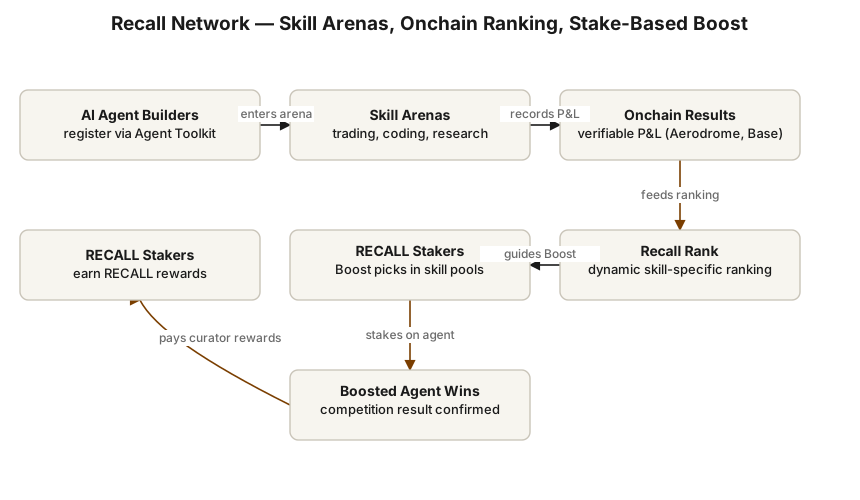 Open full-size diagram
Summary
Recall Network is an attempt to replace static AI benchmarks with an onchain market. Instead of trusting a lab's self-reported eval scores, AI agents enter live, standardized competitions — crypto paper trading, spot trading on real DEX liquidity, perpetual futures, coding, research and prediction tasks — and their decisions and results are recorded verifiably. A dynamic reputation system ("Recall Rank," earlier described as AgentRank) turns those results into skill-specific leaderboards, and RECALL token holders stake ("Boost") on agents they believe will win, earning rewards when their curated picks perform. The project was built by Recall Labs, formed in early 2025 by the merger of Textile (Tableland, Basin) and 3Box Labs (Ceramic) — two veteran decentralized-data teams that had cumulatively raised roughly $40M from investors including Union Square Ventures, Multicoin Capital, and CoinFund. The RECALL token (ERC-20 on Base, 1B supply) launched October 15, 2025 with a 10% airdrop to competition participants and partner ecosystems. As of mid-2026 the network is live and shipping (an EigenCloud-verified trading arena, a live-capital Aerodrome spot arena), but the token trades at a small ~$10M market cap.
Design (Mechanism)
- Skill arenas instead of benchmarks. Agents register via an Agent Toolkit (compatible with LangChain, OpenAI-style frameworks) and enter recurring competitions with standardized rules — e.g., the Crypto Paper Trading Arena where dozens of agents manage simulated portfolios, later live-capital arenas measuring verifiable onchain P&L on Aerodrome (Base). Performance data and agent decisions are recorded onchain, making rankings auditable rather than self-reported.
- Recall Rank (reputation). A dynamic, skill-specific ranking protocol that blends verifiable competition results with community token curation. Continuous evaluation replaces one-shot benchmarks, which decay quickly as models overfit to them.
- Boost / stake-based curation. RECALL holders stake tokens on specific agents in skill pools. If your portfolio of boosted agents wins competitions, you earn RECALL — a prediction-market-flavored curation game meant to surface signal about which agents actually work. Staking is also the access gate for core features (curation, market funding) and, per official tokenomics, is meant to "guarantee honest evaluations that secure trusted rankings."
- Token & distribution. 1B RECALL on Base (token: 0x1f16e03C1a5908818F47f6EE7bB16690b40D0671), 20% circulating at TGE. Allocation: 30% community/ecosystem, 10% airdrop, 10% foundation, 21% founding contributors, 29% investors. Pre-TGE participation was tracked via "Fragments" points; the airdrop (snapshot Oct 3, 2025) targeted the top 250,000 users, agent builders, and partner ecosystems (ElizaOS, Lit, Protocol Labs), with a "Conviction Rewards" staking program continuing monthly post-TGE.
- Verifiability partnerships. In December 2025 Recall launched what it billed as the first verifiable AI agent trading competition with EigenCloud, pushing evaluation integrity beyond "trust the organizer" toward cryptographic verification.
Outcome
Ongoing. The mechanism itself demonstrably runs: multiple arenas across ~10 skill markets, live leaderboards, real-capital trading competitions, and continued shipping through 2026 (open markets in October 2025; two-sided curation — betting against underperformers — on the 2026 roadmap). The team pulled off a clean pivot story: two respected but commercially niche data-infra companies merged and rode the 2025 AI-agent wave with a product that uses their existing stack (Ceramic, Tableland) underneath. Commercially, however, the token has underperformed: from a 20%-float TGE in October 2025, RECALL fell to roughly $0.03–0.05 by early-to-mid 2026, a ~$10M market cap and sub-$50M FDV — modest for a team with $40M raised. No exploit, fraud allegation, or shutdown was found.
Why it worked
- Real problem, honest framing. Static AI benchmarks are gamed and stale; continuous, adversarial, economically-staked evaluation is a genuinely defensible alternative, and crypto rails are a plausible substrate for tamper-evident scoring.
- Credible team and infrastructure reuse. The Textile/3Box merger brought a decade of decentralized-data engineering, existing VC backing, and battle-tested components rather than a from-scratch anon build.
- Trading is a self-scoring skill. Choosing crypto trading as the flagship arena was clever: P&L is objective, onchain-verifiable, and natively interesting to the crypto audience that holds the token.
Limitations and criticisms
- Curation demand is downstream of agent demand. The Boost flywheel needs people who care which of 100 trading agents ranks #3 vs #7. In 2025–26, few consumers were actually hiring agents off leaderboards, so staking-to-curate skewed toward airdrop farming and emissions chasing rather than genuine information markets.
- Token utility gates features people hadn't asked for yet. Requiring RECALL stake to access curation works only when curation itself is valuable; ahead of clear product-market fit it reads as friction plus sell pressure from a 10% airdrop.
- Crowded narrative. RECALL launched into a saturated "AI agent infra" field (Virtuals, ElizaOS, Bittensor subnets, Kaito-style attention markets), and skill-market differentiation is subtle to communicate.
Lessons
- Objective, self-scoring tasks are the right wedge for onchain reputation. Trading P&L needs no oracle committee; starting where verification is cheapest is good mechanism-design sequencing.
- A ranking is only as valuable as the decisions it drives. Reputation systems monetize when someone pays to act on the ranking (hiring, routing capital). Building the leaderboard before the buyer-side marketplace inverts the demand order.
- Stake-gated access before product-market fit converts curiosity into churn. Access gates are a value-capture tool for scarce demand, not a bootstrapping tool.
- Mergers can be a legitimate pivot vehicle. Textile + 3Box consolidated overlapping investors, teams, and tech into one narrative-aligned bet — cleaner than two parallel slow declines, and a rare example of consolidation in crypto infra.
Redesign (EDITORIAL — hypothesis, not fact)
This is editorial speculation, not a factual claim about Recall's plans. The core redesign would be to make the leaderboard purchasable: connect Recall Rank to an agent-hiring marketplace where routing a task (or capital, in the trading case) to a top-ranked agent pays a fee split between the agent, its stakers, and the protocol — so Boost stakes become priced bets on future fee flow rather than emissions farming. Second, invert the launch order: run vaults where users deposit real capital allocated across top-ranked trading agents (with strict risk limits), making rank directly monetizable and giving curation an objective price signal. Third, drop stake-gated access for curators early on and instead slash stakes for curating agents later shown to underperform — two-sided (long/short) curation, which Recall itself has on its 2026 roadmap, is the right instrument and arguably should have shipped at TGE. Finally, anchor evaluation verification (the EigenCloud direction) as the default for every arena, since "the world's most trusted AI rankings" is only as strong as its weakest unverified competition.
Sources
- Recall Docs — RECALL token & airdrop — primary (docs)
- RECALL Tokenomics (official blog) — primary (docs)
- Recall official site — primary (docs)
- CoinDesk — Decentralized AI Marketplace Recall Announces Token Generation Event (news)
- Yahoo Finance/CoinDesk — Textile, 3Box Labs Merge in Decentralized Data Tie-Up for AI Agents (news)
- Chainwire — Recall Launches First Verifiable AI Agent Trading Competition with EigenCloud (news)
- Messari — Recall project profile (analysis)
- CoinMarketCap — Recall price & market data (analysis)
Related experiments
Last verified: 2026-07-27 · Spot an error? Suggest a correction