Relevant
A Reddit-style social network that ranked content by a PageRank-like reputation system instead of raw upvotes, paying REL token rewards for 'quality, not clicks' curation.
▶ Run interactive simulation animated mechanism with editable parameters
How it works onchain
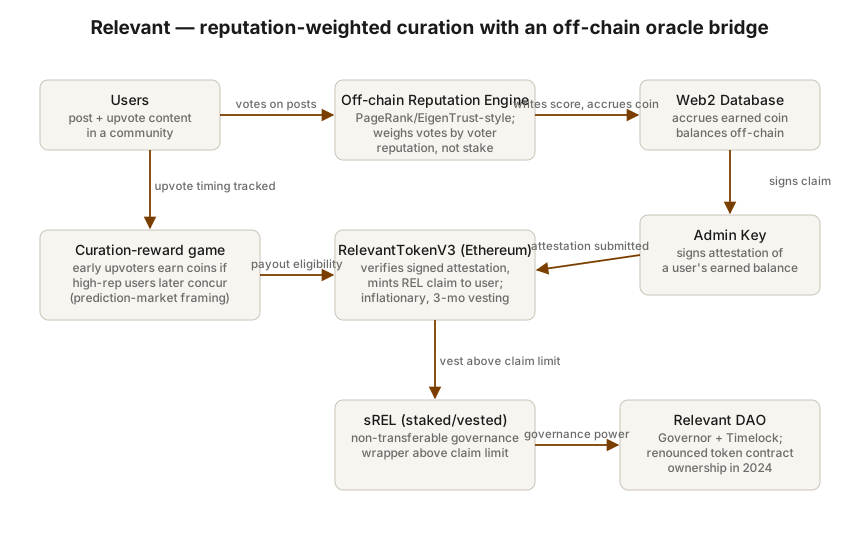 Open full-size diagram
Summary
Relevant was a New York-based attempt to build "the only social network built on trust": a Reddit-like app of topic communities where post ranking was driven not by raw vote counts but by who voted — a PageRank/EigenTrust-style reputation score earned within each community. Founded by artist-technologist Slava Balasanov (previously co-founder of the digital agency 4Real), Relevant framed itself as an information-curation protocol that ranks content "based on quality, not clicks." The app launched in open beta on March 5, 2019; the REL token generation event on Ethereum followed on June 5, 2020 (contract 0xb6c4267C4877BB0D6b1685Cfd85b0FBe82F105ec), with a ~$200K seed round in Q4 2018 that included Coinbase Ventures. The team is also historically notable for publishing some of the most-cited practitioner writing on bonding curves. The stack worked end-to-end — app, token, claims contract, DAO — but adoption stayed tiny (roughly 3,300 token holders ever; 32 DAO token holders), the DAO renounced ownership of the token contract in June 2024, a "Relive the website" proposal executed in September 2025, and the site was unreachable (HTTP 503) as of July 2026.
Design (Mechanism)
- Reputation-weighted ranking. Every community maintained per-user Reputation scores computed with a personalized PageRank-like algorithm (the team's docs repo curates EigenTrust/PageTrust literature). Upvotes and downvotes were weighted by the voter's reputation — "inclusive hierarchy: anyone can participate but not everyone's vote holds the same weight." Crucially, outcomes were deliberately not proportional to tokens staked, an explicit rejection of plutocratic curation markets like early Steem/TCR designs.
- Curation rewards as a prediction game. Users earned coins by upvoting a post within its first 3 days; rewards paid out if high-reputation users subsequently concurred. The token repo describes it as users being able to "bet on post rankings using a prediction market," with payouts tuned to reward unpredictably relevant content rather than obvious trending material.
- Token economics. REL was inflationary (initially ~10%/year per third-party research). Holders vested tokens (3-month vesting) to convert them into curation/governance power and earn a share of newly minted rewards. In-app earnings accrued in a conventional web2 database; users claimed on-chain by requesting a signed attestation from an admin key and submitting it to
RelevantTokenV3— an oracle-bridged hybrid, not a fully onchain social protocol. Above a per-account claim limit, balances were claimable as non-transferable sREL, usable for governance and vesting. - Governance. OpenZeppelin Governor + Timelock ("Relevant DAO"), with sREL staking as the governance wrapper.
- Research spillover. The team built and open-sourced a Bancor-formula bonding-curve contract and React component, plus Cosmos SDK modules (a Go reputation protocol, an oracle module, and the "r3l" Cosmos app, active 2020–2021) toward a sovereign curation chain that never shipped to production.
Outcome
Technically, Relevant shipped nearly everything it promised: a functioning cross-platform app with reputation-ranked feeds, real REL rewards claimable on Ethereum, and a live DAO that passed 13 proposals. Commercially and socially it never escaped niche status — its flagship community was crypto-design discussion itself. On-chain footprints are small: ~85K token transfers and ~3.3K holders ever (Ethplorer), 32 holders / 22 delegates in the DAO. The wind-down is legible on Tally: "Renounce Ownership of Relevant (REL) Token Contract" executed June 27, 2024; "Relive the website" executed September 17, 2025 — implying the site had already gone dark; as of July 26, 2026 relevant.community returns HTTP 503 and the GitHub org is dormant (last meaningful commits 2021–2023). REL trades with negligible liquidity. No exploit occurred; this was a quiet fade, with a residual DAO holding stewardship. Its ideas — reputation-weighted (non-plutocratic) curation and the bonding-curve literature — outlived the product.
Why it worked
- Genuine mechanism innovation. Reputation-weighted voting sidestepped the two standard failure modes of token curation: plutocracy (stake-weighted votes) and Sybil vote-farming (one-person-one-vote). Votes only mattered if the graph trusted you.
- Anti-Goodhart design. Paying for unpredictable relevance and refusing to let stake size determine outcomes made pay-to-win manipulation structurally harder than on Steem-style platforms.
- Pragmatic hybrid architecture. Off-chain accrual with attested on-chain claims gave a smooth consumer UX in 2019–2020, when fully onchain social was infeasible, while keeping real ownership claims on Ethereum.
- High-quality public research. The bonding-curve posts and open-source contracts earned outsized credibility and are still referenced across token engineering.
Where the design broke
- No distribution wedge. A better-curated Reddit is only valuable with critical mass; Relevant offered ideology and micro-rewards, not a content or community advantage that could bootstrap network effects against free incumbents.
- Tiny capitalization. ~$200K of disclosed funding is far below what consumer social requires — insufficient to buy growth or sustain years of iteration.
- Reward magnitudes too small to matter. With a micro-cap inflationary token, curation payouts were economically trivial — insufficient as a user-acquisition motive, yet enough to attract farming pressure the reputation system had to spend complexity defending against.
- Reward issuance ran through a trusted admin key. Rewards were computed on a private server and claimable only via a signed admin attestation, so a single key controlled reward issuance until the DAO renounced contract ownership in 2024.
- Roadmap fragmentation. Development effort split across three parallel frontiers — the Ethereum app, bonding-curve research, and a Cosmos chain pivot (2020–21) — diluted focus with a fixed budget; the sovereign chain never launched.
Lessons
- Reputation-weighted voting is a real answer to plutocratic curation — Relevant demonstrated a working non-stake-weighted alternative to TCRs/Steem, and the pattern (personalized PageRank over vote graphs) keeps resurfacing in modern social/agent-ranking designs.
- Token incentives cannot substitute for a content wedge: paying users pennies to curate does not bootstrap a social network; incentives amplify existing demand, they don't create it.
- If rewards are computed off-chain by an admin key, that key controls issuance until it is renounced. Verifiable reward computation should ship before, not after, the token.
- Publish your mechanism research: Relevant's bonding-curve writing generated more durable ecosystem impact than its product, a common pattern for mechanism-first teams.
- Formal wind-downs matter: renouncing contract ownership through the DAO was a responsible endgame that left the token trust-minimized even as the product died.
Redesign (EDITORIAL — hypothesis, not fact)
The following is editorial hypothesis, not a factual claim about the project. A 2026 revival would keep Relevant's core insight — rank by reputation-weighted attestations, pay for unpredictable quality — but change the substrate and the go-to-market. Build it as a curation layer over existing feeds (Farcaster, Lens, open web via a browser extension) rather than a destination app, so the cold-start problem becomes "install a better ranking lens," not "move your community." Compute the reputation graph verifiably: post votes as signed messages to cheap DA (an L2 or Farcaster-style hubs), run the PageRank/EigenTrust scoring in a zk or optimistically-verified off-chain computation, and let anyone recompute scores — eliminating the admin-attestation trust bottleneck that undermined the original. Replace continuous inflation-funded micro-rewards with periodic retroactive "curation epochs" funded by communities that want ranking (DAOs, protocols, media brands), so reward budgets are demand-driven rather than dilution-driven. Keep the prediction-market framing but make it explicit: a small bonded forecast on "will high-reputation curators endorse this within N days," with slashing for spam, which converts curation into a legible skill game. Finally, charge the obvious customer — algorithmic feed ranking as a paid API for platforms and agents — so the token is a claim on real curation revenue instead of a self-referential reward loop.
Sources
- Relevant (REL) Token Tracker — Etherscan — primary (contract)
- relevant-community/token — Relevant token, sREL and governance contracts (RelevantTokenV3) — primary (contract)
- Relevant DAO governance page (Tally/Cactus) — proposals incl. token-ownership renouncement (2024) and 'Relive the website' (2025) — primary (governance)
- Relevant FAQ (relevant.community/info/faq — offline as of 2026-07-26) — primary (docs)
- relevant-community GitHub organization (contracts, bonding-curve, Cosmos reputation/oracle/r3l modules) — primary (docs)
- Bonding Curves In Depth: Intuition & Parametrization — Slava Balasanov (Relevant Community) — primary (docs)
- Relevant (REL) — ICO Drops profile (TGE June 5, 2020; $200K seed; Coinbase Ventures; Aug 2020 airdrop) (analysis)
- Relevant ($REL) Research Paper — Crypto Console (tokenomics: 10% initial inflation, 3-month vesting) (analysis)
- REL token on Ethplorer — primary (contract)
- Slava Balasanov — Medium profile (founder statement, links @team_slava) — primary (docs)
Related experiments
Last verified: 2026-07-26 · Spot an error? Suggest a correction