adChain
The first Token-Curated Registry deployed on Ethereum mainnet — a stake-weighted whitelist of ad-fraud-free publisher domains curated by adToken (ADT) holders.
▶ Run interactive simulation animated mechanism with editable parameters
How it works onchain
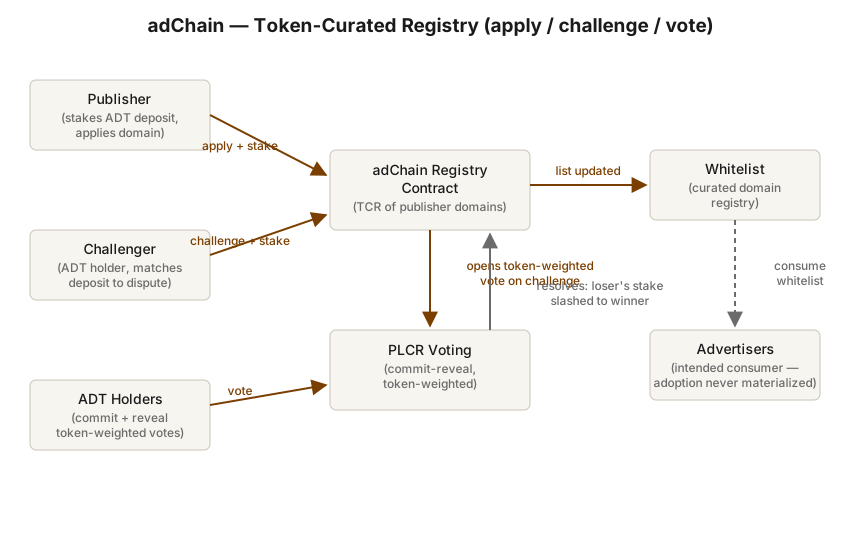 Open full-size diagram
Summary
adChain was a collaboration between Los Angeles ad-tech startup MetaX (co-founded by Ken Brook) and ConsenSys to fight digital ad fraud with a decentralized whitelist of legitimate publisher domains. Its whitepaper (May 31, 2017, by Mike Goldin and Ameen Soleimani of ConsenSys) introduced what became the canonical Token-Curated Registry (TCR) design, which Goldin later generalized in the influential "Token-Curated Registries 1.0" post (September 2017). MetaX raised roughly $10M in the adToken (ADT) sale on June 26, 2017, and the adChain Registry went live on Ethereum mainnet on April 23–24, 2018 — the first TCR ever deployed there, with 49 publisher domains voted in during the release-candidate phase. The mechanism worked as engineered and spawned an entire design genre (Civil, FOAM, Kleros-style curated lists), but the registry itself never achieved meaningful adoption by advertisers or publishers, and MetaX's own retrospective candidly catalogued why. The ADT token and site still exist (a 2025 "ADT Lift-Off" relaunch pivoted toward AI ad tooling), but the original registry experiment is best read as historically foundational and commercially unsuccessful.
Design (Mechanism)
The adChain Registry is the archetypal TCR, powered by the ERC-20 adToken (ADT, 1B fixed supply, contract 0xd0d6d6c5fe4a677d343cc433536bb717bae167dd):
- Apply: A publisher (or anyone on its behalf) stakes an ADT deposit to apply a domain to the registry. If unchallenged for a set period, the domain is admitted automatically.
- Challenge: Any ADT holder who believes the domain is fraudulent or low-quality can match the deposit to trigger a challenge, opening a token-weighted vote.
- Vote: ADT holders vote via a partial-lock commit-reveal (PLCR) voting scheme — commit a hidden vote backed by locked tokens, then reveal. Majority wins; the loser's deposit is slashed and distributed to the winning challenger/applicant and winning-side voters, who also earn dispensation rewards.
- Incentive theory: Token holders profit from honest curation because a high-quality list should drive demand for ADT (advertisers and publishers needing to participate), aligning curators with list quality. The core dev team was Mike Goldin (ConsenSys), Miguel Mota and Edwin Cheung (MetaX); ConsenSys Diligence audited the contracts.
The intended consumers were advertisers, who could treat the registry as a public-utility whitelist to avoid spending on domain-spoofed or bot-heavy inventory.
Outcome
Technically, the launch succeeded: the contracts worked, the apply/challenge/vote loop executed on mainnet, ~49 domains were curated in during the release candidate, and the open-source TCR codebase was forked ~96 times, seeding projects like Civil and FOAM. Commercially and as a curation product, it underperformed. MetaX's own published retrospective ("Learnings from MetaX...") reported: token holders ignored the published Publisher Guidelines and voted on personal opinion (examples included Facebook being challenged over privacy and SpankChain being admitted); whale token holders dominated token-weighted votes; voter turnout was minimal because rewards were small relative to gas and effort; and — most damning — the team admitted it could not "say with confidence that the main adToken holders are our target market," saying that given a do-over they "would redistribute the token" to ad-industry professionals. No evidence was found that advertisers ever consumed the registry at scale. Outcome status: technically successful, commercially unsuccessful.
Why it worked
- Clean, novel mechanism: The stake-apply-challenge-vote loop was simple enough to reason about, audit, and ship — and it functioned exactly as specified on mainnet.
- Credible team and distribution of ideas: ConsenSys backing, a public whitepaper, and Goldin's TCR 1.0 essay made adChain the reference implementation; the open-source repo became infrastructure for a wave of 2018 curation projects.
- Real problem: Ad fraud (domain spoofing, bots) was and is a multi-billion-dollar issue, so the whitelist premise had genuine industrial motivation.
Where the design broke
- Token-holder / end-user mismatch: The ICO distributed ADT to crypto speculators, not ad-ops professionals. The curators had neither the expertise nor the intrinsic motivation to judge publisher quality.
- No shared objective standard: "Legitimate publisher" is subjective; without enforceable criteria, votes devolved into opinion contests, undermining the registry's authority to its intended consumers.
- Weak incentive gradient: Rewards for voting were tiny versus gas costs and lockup friction; rational holders free-rode, so participation collapsed toward whales.
- Demand-side absent: The token-value flywheel assumed advertisers would need ADT/the list; advertisers never showed up, so honest curation had no economic payoff to protect.
- 2018 UX and infrastructure: MetaMask onboarding, ETH acquisition, and slow transactions were prohibitive for non-crypto ad-industry users; MetaX noted only ~10,000 daily dapp users existed across all of Ethereum.
Lessons
- Distribute governance tokens to the people whose judgment you need. A curation market is only as good as its median curator; a speculative ICO crowd cannot curate a domain-expert registry. (MetaX explicitly said they would redistribute the token if they could redo it.)
- Subjective quality does not resolve via token-weighted voting alone. TCRs work best for lists with crisp, objectively checkable inclusion criteria; fuzzy criteria invite opinion voting, whale capture, and legitimacy loss.
- The demand side must exist before the incentive loop closes. If no one consumes the list, list quality has no token-value consequence, and honest curation is unrewarded — the entire cryptoeconomic argument evaporates.
- Participation costs are a first-class mechanism parameter. When gas + lockup + attention exceed expected voting rewards, rational apathy is the equilibrium; design for it rather than assuming engagement.
- A mechanism can succeed as a primitive while failing as a product. adChain's largest impact was intellectual: it defined the TCR genre and taught the ecosystem (including its own team, via a candid public retrospective) where the design's limits lie.
Redesign (EDITORIAL — hypothesis, not fact)
The following is editorial analysis by the Atlas — a hypothesis, not a historical claim. A modern adChain would invert the bootstrap order: sign 5–10 advertisers/DSPs as paying list consumers first, so curation quality has revenue consequences, then distribute curation stake via non-transferable or vesting allocations to vetted ad-ops professionals (attested identity, e.g., industry-association membership) rather than a public sale — solving the curator-expertise mismatch. Replace pure token-weighted voting with a two-tier process: objective, machine-checkable criteria (ads.txt presence, sellers.json consistency, traffic-quality oracle data) auto-adjudicated, with human staked juries (Kleros-style, randomly drawn, with appeal rounds) only for genuinely subjective disputes — shrinking the opinion-voting surface that sank the original. Run on an L2 to make participation costs negligible, subsidize voting rewards from consumer subscription fees rather than slashed deposits alone, and add delegation so passive holders route stake to reputable expert curators. The hypothesis: adChain failed on distribution, demand, and criteria-vagueness — all fixable — not on the core insight that staked, challengeable lists can beat opaque centralized whitelists.
Sources
- The adChain Registry whitepaper (Mike Goldin, Ameen Soleimani — May 31, 2017) — primary (docs)
- Welcoming the Public Release Candidate of the adChain Registry to the Ethereum Mainnet (MetaX, April 2018) — primary (docs)
- Learnings from MetaX on Launching the First Token-Curated Registry (TCR) — primary (retrospective)
- Token-Curated Registries 1.0 (Mike Goldin) — primary (docs)
- adToken (ADT) token contract on Etherscan — primary (contract)
- MetaX and ConsenSys Announce adToken (ADT) Sale June 26th (PRWeb) (news)
- MetaX Completes $10 Million adToken (ADT) Sale (PRWeb) (news)
- How MetaX Plans To Use Blockchain To Stop Ad Fraud (Forbes, 2017) (news)
- adToken official site (current) — primary (docs)
Related experiments
Last verified: 2026-07-26 · Spot an error? Suggest a correction