SourceCred
An open-source, PageRank-based reputation algorithm ('Cred') plus payout token ('Grain') that tried to let communities algorithmically measure and pay for contributions — dogfooded in the CredSperiment and trialed by MakerDAO and 1Hive before the organization wound down in 2022.
▶ Run interactive simulation animated mechanism with editable parameters
How it works onchain
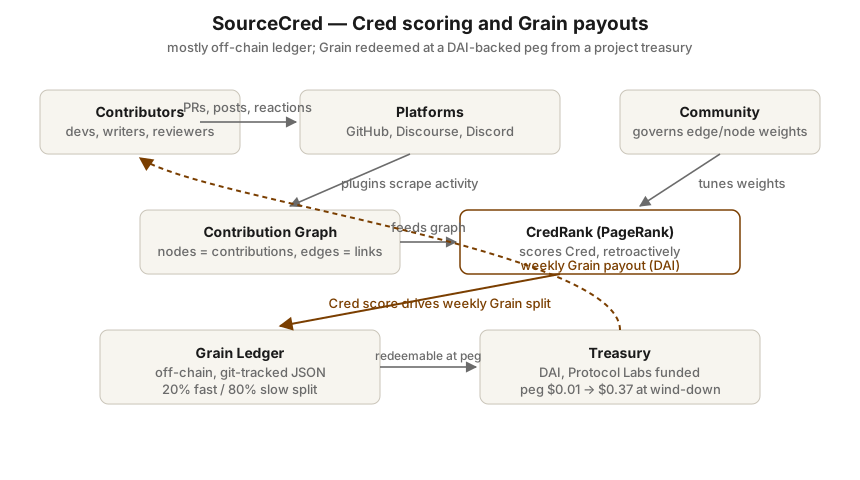 Open full-size diagram
Summary
SourceCred was an open-source "algorithmic social system" for valuing and paying for contributions to a community. Founded around 2018 by Dandelion Mané after they left Google's TensorBoard team, and funded and supported by Protocol Labs, it ingested activity from GitHub, Discourse, Discord, and other platforms into a contribution graph, then ran a PageRank-derived algorithm to compute a reputation score called Cred for every contribution and contributor. Cred in turn drove weekly distributions of Grain, a project-specific payout unit redeemable for money (in SourceCred's own case, pegged redemption backed by Protocol Labs funding). SourceCred famously dogfooded itself in the "CredSperiment" (announced August 2019), paying its own contributors by its own algorithm, and was trialed by MakerDAO (June–September 2020, then extended) and adopted by DAOs such as 1Hive on xDai. The core organization announced it was winding down on March 28, 2022, leaving the software as unmaintained open source. Note: the system was mostly off-chain infrastructure feeding on-chain (or fiat) payouts — it is canonical to DAO history rather than a smart-contract protocol per se.
Design (Mechanism)
- Contribution graph: plugins scraped platforms (GitHub PRs/issues/reviews, Discourse posts/likes/replies, Discord reactions) into a graph whose nodes are contributions and contributors and whose edges are relationships (authorship, references, replies, reactions).
- Cred scoring (PageRank → CredRank): importance propagated across weighted edges, treated as a Markov chain with a seed node and (later) weekly "epoch nodes" so cred could be attributed to contributors per time period. Crucially, cred kept flowing retroactively: if an old contribution was referenced or built upon later, its author earned more cred — an early articulation of retroactive rewards.
- Community-tunable weights: communities could adjust node/edge weights (e.g., how much a like on Discourse is worth vs. a merged PR) so scores "reflect our values," making the algorithm a governed object rather than a fixed oracle.
- Grain payouts: a fixed budget of Grain (e.g., 15,000¤/week in the CredSperiment era) was split roughly 20% "fast grain" (recent-cred based, rewarding activity now) and 80% "slow grain" (paid toward lifetime cred underpayment, rewarding long-term/retroactive value). Grain was redeemable at a peg ($0.01 early; $0.37 at wind-down) from the project treasury; the ledger was a git-tracked file, not a smart contract, though an ERC-20 wrapper was discussed.
- Deployments: SourceCred itself (CredSperiment), MakerDAO's forum trial paying DAI to forum contributors, 1Hive (Gnosis/xDai), MetaGame, and other DAO instances.
Outcome
Abandoned as an organization; influential as an idea. The MakerDAO trial's final report called the trial "a success" on engagement metrics (forum posts +120%, topics +88%, daily engaged users +70%, subjective community-impact rating 6.6/10) while cautioning that causation was unclear amid DeFi-summer noise, and flagged worries that volume was rewarded over quality; it was extended but never became a permanent MKR-governed system. The CredSperiment ran weekly payouts for over two years. On March 28, 2022, remaining contributors announced the organization was "winding down" / being "composted": the treasury would be emptied by May 1, 2022, grain redeemed at $0.37, tithing projects asked to stop, and the product left to unpaid open-source stewardship. Active development largely ceased thereafter. No token launch, no exploit — the org simply ran out of collective will and structure.
Why it worked
- It genuinely measured something real: graph-based scoring surfaced quiet, structural contributors (reviewers, forum synthesizers) that flat activity counts miss, and the retroactive cred flow rewarded durable work rather than only recent noise.
- Dogfooding built legitimacy: paying its own contributors with its own algorithm for years was an honest, high-information experiment, unusually well-documented on its public Discourse.
- Community-tunable weights turned "the algorithm" into a governable policy surface, prefiguring later DAO debates about compensation legitimacy.
- Measurable engagement lift: in MakerDAO's trial, objective forum-engagement metrics rose sharply and no systematic gaming was detected during the trial window.
Why it failed or underperformed
- Goodhart pressure: tying weekly pay tightly to cred encouraged short-term, volume-oriented contribution ("produce something every week") and raised persistent quality-vs-quantity concerns; likes/reactions were cheap signals to farm.
- Legibility bias: the algorithm could only value what platforms emitted as data — mentorship, care work, and off-platform labor were undercounted, ironically the very labor SourceCred's culture prized.
- Complexity and UX: CredRank tuning, ledger maintenance, and instance operation were heavy for adopting DAOs; MakerDAO never graduated the trial into protocol-level adoption.
- Organizational fragility: SourceCred depended on Protocol Labs funding rather than sustainable revenue; the 2022 wind-down post cites a shrunken team, broken onboarding, and contributors no longer wanting to work on the product — the social layer failed before the algorithm did.
- Off-chain trust: the grain ledger and peg redemption relied on a trusted operator and treasury, limiting the "credibly neutral" story.
Lessons
- Any metric that pays becomes a target: reputation-to-cash coupling must be loose (vesting, retro windows, human review) or contributors optimize the graph, not the mission.
- Retroactive value flow is the durable idea: cred flowing backward to foundational work directly prefigured retroactive public-goods funding (e.g., Optimism RetroPGF); the atlas should treat SourceCred as its ancestor.
- Algorithms don't fix governance: weight-tuning meetings simply relocated compensation politics; a scoring system needs a legitimate human process wrapped around it, not instead of it.
- Measure only what you can see, and say so: platform-scraped graphs systematically undervalue illegible labor; publish the blind spots or the system loses the trust of exactly the contributors it misses.
- Tool orgs need a business model: grant-subsidized infrastructure with a redeemable internal token dies when the grant ends; sustainability must be designed in from the start.
Redesign (EDITORIAL — hypothesis, not fact)
This section is editorial hypothesis, not historical fact. A modern SourceCred would separate its three coupled loops. (1) Scoring: keep the contribution graph and CredRank, but run it as an open, reproducible pipeline with attestations (e.g., EAS) so scores are portable across DAOs and auditable — reputation as a public good, not an app. (2) Payment: replace tight weekly cred→cash coupling with epoch-based retroactive rounds: the algorithm produces a proposed distribution, a randomly selected contributor jury adjusts it within bounds, and payouts stream with vesting — dampening Goodhart while preserving algorithmic legibility. (3) Sustainability: charge adopting DAOs per-instance fees into a protocol treasury (SaaS-style), rather than depending on a single benefactor, and put the weight configuration itself under onchain governance with a published changelog so "what we value" is versioned. Finally, add an explicit "illegible work" budget (peer-nominated, off-graph) sized at 10–20% of each epoch, acknowledging in-protocol what the graph cannot see. The hypothesis: SourceCred's algorithm was ahead of its time, and its failure was organizational and incentive-topological, not conceptual — a claim the RetroPGF lineage weakly supports but does not prove.
Sources
- Introduction to SourceCred (Dandelion Mané, May 2019) — primary (docs)
- SourceCred GitHub monorepo — primary (contract)
- Introducing the CredSperiment (SourceCred Discourse, 2019) — primary (governance)
- SourceCred (The Organization) Is Winding Down (Discourse, Mar 28, 2022) — primary (retrospective)
- SourceCred: An Introduction to Calculating Cred and Grain (Protocol Labs Research, Mar 2020) — primary (docs)
- SourceCred Trial — Final Report (MakerDAO forum, archived on Sky forum) — primary (governance)
- An ethnography of SourceCred's CredSperiment (Ellie Rennie) (analysis)
- Founder thread: leaving Google/TensorBoard to build SourceCred (@decentralion, June 2018) — primary (archive)
Related experiments
Last verified: 2026-07-26 · Spot an error? Suggest a correction