Hidden Hand
A multi-protocol 'bribe' (vote-incentive) marketplace by Redacted Cartel/Dinero that let projects pay vote-escrow token holders for gauge votes, generalizing the Curve Wars playbook before winding down in mid-2026.
▶ Run interactive simulation animated mechanism with editable parameters
How it works onchain
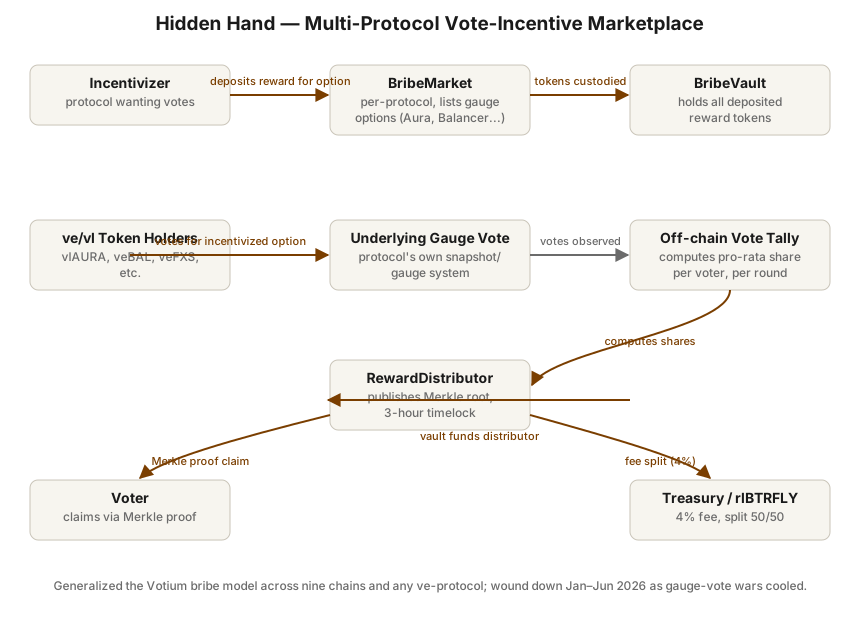 Open full-size diagram
Summary
Hidden Hand was a generalized "governance incentives" (bribe) marketplace built by Redacted Cartel — the OlympusDAO-incubated meta-governance protocol behind BTRFLY, later rebranded to Dinero. Where Votium served only Curve/Convex, Hidden Hand aimed to be the neutral venue for any vote-escrow (ve) protocol: projects deposited rewards to sway gauge-weight votes, and ve-token holders who voted for incentivized options claimed those rewards pro rata. It emerged from Redacted's acquisition of Votemak (a Tokemak bribe market), was announced in January 2022, and soft-launched around April 2022 with markets for protocols such as Tokemak, Balancer, Frax, Ribbon, and later Aura, expanding across nine EVM chains. A v2 rewrite (July 2023, Spearbit-audited) made market creation more permissionless. The platform charged a 4% fee on incoming bribes, split between the Redacted/Dinero treasury and rlBTRFLY (later sDINERO) lockers. After roughly four years of operation, the team announced a wind-down: new markets through December 31, 2025, claims-only mode from January 1 to June 30, 2026, citing declining platform activity and rising infrastructure costs.
Design (Mechanism)
Hidden Hand ran epoch-based incentive rounds aligned with each partner protocol's voting cadence (typically biweekly gauge-weight votes):
- Markets per protocol. Each supported protocol (Aura/vlAURA, Balancer/veBAL, Frax/veFXS, Tokemak, Ribbon, FloorDAO, etc.) had its own
BribeMarketcontract listing active proposals (usually gauge options). Anyone could deposit whitelisted reward tokens against a specific option. - Custody and accounting. All deposited tokens flowed immediately to a central
BribeVault; the market contract held no funds and only recorded identifiers mapping deposits to proposals and rounds. - Voting and settlement. Holders voted in the underlying protocol's own snapshot/gauge system. After the round closed, off-chain infrastructure computed each voter's share of each incentive, and a
RewardDistributorpublished Merkle roots per reward token; voters claimed with Merkle proofs. A three-hour timelock on the distributor served as a security buffer against bad root submission. - Vote optimization. For users who delegated, Hidden Hand auto-selected the vote distribution that maximized dollar value of rewards per vote — an explicit price-discovery layer on emissions ("$1 of bribe should buy the most emissions possible").
- Fees. 4% of all incoming bribes, split 50/50 between the treasury and locked-token holders (rlBTRFLY, later the sDINERO rewards pool) — making Hidden Hand a core cash-flow engine for Redacted's real-yield token model.
- v2 (July 2023). Rewrote markets for flexibility and permissionless deployment, added a
RewardHarvesterletting users auto-swap claims into a single token; audited by Spearbit.
Outcome
Hidden Hand became, alongside Votium and Paladin's Quest, one of the main venues of the post-Curve-Wars vote-incentive economy. By September 2022 it had processed roughly $3.2M in bribes across six markets (Balancer ~$2.3M, Aura ~$851K, Tokemak ~$674K, per Multifarm's analysis), and at its peak epochs generated roughly $10K–$13K in fees per two-week epoch for rlBTRFLY lockers (DeSpread). It expanded to nine chains and outlived most 2021-era Olympus-fork products, with its Aura/Balancer markets becoming standard infrastructure in the "Aura Wars." Lifetime cumulative volume figures were not verifiable from available sources (DefiLlama page inaccessible at research time): Unknown / not found. However, activity declined with the broader deflation of ve-token emissions wars, and the team (by then Dinero, which itself pivoted to pxETH/institutional staking) announced an orderly sunset: no new markets after December 31, 2025, claims-only until June 30, 2026. Status: partial_success — years of genuine product-market fit and real revenue, but the underlying market shrank until operation no longer justified costs.
Why it worked
- It productized an existing gray market. Bribes were already happening informally (Votium, Votemak, OTC deals); Hidden Hand offered escrow, pro-rata settlement, and Merkle-verified claims, cutting counterparty risk for both sides.
- Generalization was the right bet initially. Being protocol-agnostic let it capture the Balancer/Aura ecosystem just as veBAL wars ignited in 2022, rather than competing head-on with Votium's entrenched Curve position.
- Aligned fee flywheel. Routing 50% of fees to rlBTRFLY lockers tied the marketplace to a token with real yield, giving Redacted a durable revenue story through the bear market.
- Emissions price discovery is genuinely useful. Protocols could rent liquidity at a measurable $-per-$-of-emissions rate instead of running their own liquidity mining, often at 20–40% effective discounts.
Where the design broke
- Derivative demand. Hidden Hand's revenue was a second-order function of ve-token emissions wars. As Curve/Balancer-style emissions lost value and protocols shifted to other liquidity models (concentrated liquidity, points, restaking), bribe volume structurally declined.
- Thin-margin infrastructure. A 4% take on a shrinking volume base, minus multi-chain infrastructure, off-chain vote computation, and Merkle-root operations, eventually turned negative — the stated reason for the wind-down.
- Parent-company pivot. Redacted's rebrand to Dinero and focus on pxETH/staking left Hidden Hand as a legacy product rather than a growth priority.
- Governance-legitimacy headwinds. "Bribes" normalized plutocratic emissions capture; several ecosystems designed later tokenomics specifically to avoid gauge-bribe dynamics, capping the addressable market.
Lessons
- Marketplaces built on another protocol's incentive mechanism inherit that mechanism's lifecycle. When ve-emissions wars cooled, every bribe market cooled with them; platform risk includes the meta-game going out of fashion.
- Formalizing an informal market is a real moat — briefly. Escrow + verifiable settlement beat OTC bribes, but the offering was replicable (Votium, Quest, Votemarket), keeping fees compressed near 4%.
- Off-chain settlement with Merkle claims scales but centralizes. Voters trusted Hidden Hand's off-chain computation of shares; the 3-hour timelock mitigated but did not remove operator trust — a recurring pattern in incentive-distribution design.
- An orderly, pre-announced sunset (claims-only window) is itself good mechanism design. Compared to protocols that rug or silently rot, Hidden Hand's phased wind-down preserved user funds and reputation for the parent brand.
Redesign (EDITORIAL — hypothesis, not fact)
This section is editorial analysis — a hypothesis, not fact. A revived Hidden Hand might survive its market's decay by (1) settling fully on-chain via storage-proof-based vote accounting (as Votemarket v2 later explored), eliminating the trusted off-chain computation and its operating cost — the stated killer; (2) charging fees as a percentage of realized emissions value delivered rather than bribes posted, aligning revenue with buyer outcomes and defending margin against copycats; (3) generalizing beyond gauge votes to any verifiable on-chain vote (treasury allocation, delegate markets, L2 sequencer-fee routing), so the platform is not a single-meta bet; and (4) constitutionalizing legitimacy — letting host protocols set enforceable rules (caps, eligibility, disclosure) in the market contract, converting "bribery" into sanctioned, transparent incentive auctions that host DAOs would defend rather than design against.
Sources
- Hidden Hand documentation (learn.hiddenhand.finance) — Overview, Mechanics, FAQ, Reward Forwarding — primary (docs)
- dinero-protocol/hidden-hand-contracts (Hidden Hand v2 smart contracts, Spearbit audit referenced) — primary (contract)
- Hidden Hand Soft-Launch — Redacted (Mirror) — primary (governance)
- Hidden Hand V2 Launch — Redacted (Mirror, July 6, 2023) — primary (governance)
- Introducing The Hidden Hand Marketplace — @redactedcartel announcement tweet (Jan 2022) — primary (archive)
- DeFi Project Spotlight: Redacted Cartel, DeFi's Meta-Governance Protocol — Crypto Briefing (analysis)
- Hidden Hand by Redacted Cartel — Multifarm.fi deep dive (Sept 2022 market data) (analysis)
- Redacted Cartel — The Hidden Hand of the DeFi World — DeSpread Research (analysis)
- Hidden Hand — DefiLlama protocol page (analysis)
- How to earn governance bribes — Bankless (analysis)
Related experiments
Last verified: 2026-07-26 · Spot an error? Suggest a correction