Notional
Fixed-rate, fixed-term lending and borrowing on Ethereum via fCash — paired future-cash-flow tokens traded on a maturity-aware AMM — which ran for five years before weak fixed-rate demand and a third-party (Balancer V2) hack led to V3's wind-down and a pivot to leveraged yield.
▶ Run interactive simulation animated mechanism with editable parameters
How it works onchain
 Open full-size diagram
Summary
Notional Finance was the flagship attempt to bring fixed-rate, fixed-term lending — the dominant form of debt in traditional finance — fully on-chain. Founded by Teddy Woodward (ex-Barclays interest-rate trading) and Jeff Wu, it came out of stealth in October 2020 and launched its V1 on Ethereum mainnet in January 2021, followed by a $10M Series A led by Pantera Capital in April 2021. Its core primitive, fCash, represents a claim on (or obligation to pay) a fixed amount of currency at a specific future date, traded against cash on a purpose-built interest-rate AMM. V2 (November 2021) briefly pushed TVL near $1B; V3 (2023) added variable rates and leveraged vaults on Arbitrum. But organic fixed-rate demand never scaled. In mid-2025 the team announced a pivot to a leveraged-yield product ("Notional Exponent"), and on November 3, 2025 the Balancer V2 hack destroyed collateral in five Notional leveraged vaults, forcing a full wind-down of Notional V3 with haircut distributions to lenders. Exponent went live in January 2026. Notional's mechanism worked as designed for five years; the market it served proved too small, and its terminal loss came from third-party infrastructure, not its own code.
Design (Mechanism)
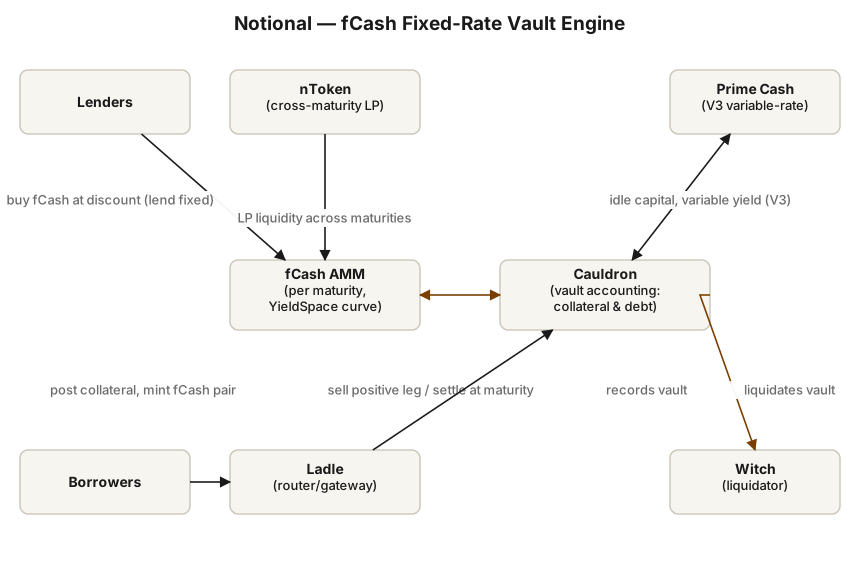
- fCash: The atomic unit is a pair of offsetting tokens — positive fCash (a claim to receive, e.g., 100 USDC at maturity) and negative fCash (an obligation to pay it). Pairs are minted in equal and opposite amounts, so system-wide fCash always nets to zero. Lending = buying positive fCash at a discount to face value; the discount implies the fixed rate. Borrowing = minting a pair, selling the positive leg for cash, and carrying the negative leg against collateral.
- Maturity-aware AMM: fCash trades against cash in liquidity pools whose pricing curve is parameterized in interest-rate space, designed so the exchange rate converges toward par as maturity approaches and rates stay within sensible bounds — a deliberate departure from constant-product curves, which price rates poorly.
- nTokens (V2): An LP wrapper that automatically provides liquidity across all active maturities of a currency, giving passive LPs a single fungible position and deepening every tenor at once. Underlying cash was held as interest-bearing Compound cTokens in V2; V3 replaced this with an internal "prime cash" variable-rate market, enabling both variable- and fixed-rate lending/borrowing plus idle-capital yield.
- Settlement and risk: At maturity, fCash settles at face value into cash balances. Undercollateralized accounts are liquidated by keepers. V3 added leveraged vaults: whitelisted strategies (largely LST/LRT pools on Balancer, Curve, etc.) against which users could borrow from Notional at fixed or variable rates to lever yield.
- Governance/token: The NOTE token (launched with V2) governed parameters and paid liquidity incentives; upgrades ran through NIPs on the governance forum. The main protocol lives behind a single upgradeable proxy (nProxy) on Ethereum and Arbitrum.
Outcome
- V2 launched November 1, 2021 and TVL peaked around $977M on November 21, 2021 (per Messari/DefiLlama), then declined through the 2022 bear market (~$380M by end of Q1 2022, far lower thereafter).
- V3 went live on Arbitrum on November 6, 2023 with variable rates and an expanded leveraged-vault suite; TVL peaked around March 2024 and trended down (order of tens of millions, not the 2021 hundreds).
- June–July 2025: Woodward publicly announced the pivot — fixed-rate lending "didn't drive growth" despite competitive APYs; NOTE incentives would wind to zero by end of 2025; the team would build Notional Exponent, a dedicated leveraged-yield protocol.
- November 3, 2025: the Balancer V2 exploit zeroed out collateral in five Notional leveraged vaults (three on Arbitrum, two on mainnet), creating 632.8 ETH of bad debt on mainnet and 80.2 ETH on Arbitrum. ETH lenders took haircuts of ~56% (mainnet) and ~19% (Arbitrum). The team concluded V3 could not be returned to production, wound it down, distributed remaining assets (topping up distributions with ~118 ETH of treasury reserves), and migrated cross-currency borrowers to Aave.
- Notional Exponent launched January 29, 2026. Verdict: the fixed-rate experiment itself is over; classified technically successful but commercially unsuccessful (the terminal exploit was in a dependency, not Notional's contracts).
Why it worked
- fCash was a genuinely elegant primitive: zero-sum paired mint/burn made solvency accounting clean, and cash flows settled deterministically at maturity — no oracle needed for the rate itself.
- The rate-space AMM solved a real problem (constant-product curves are terrible for instruments that converge to par), and it operated through multiple market cycles without a core-protocol pricing failure.
- nTokens lowered the LP coordination cost of seeding many maturities simultaneously — a real innovation for term-structure liquidity.
- The team shipped and audited continuously for five years, handled the 2025 crisis with transparent accounting, and used treasury reserves to soften lender losses — a credible-exit case study.
Where the design broke
- Demand asymmetry: crypto-native borrowers are levered traders who prefer cheap variable rates and short horizons; the natural fixed-rate constituency (long-horizon, liability-matching institutions) largely never arrived on-chain during Notional's lifetime.
- Liquidity cost of term structure: every maturity fragments liquidity, and LPs bear rate risk; incentives (NOTE emissions) masked, rather than fixed, thin organic demand.
- Complexity creep: by the team's own retrospective, the product surface grew from three products (2021) to nine (2024); constant shipping of new vault code made conservative lenders — the exact target user — warier, and the lack of on-chain governance/timelocks compounded that.
- Dependency risk: the fatal blow came from Balancer V2, whose pools backed Notional's leveraged vaults. Composability transmitted a third-party exploit directly into lender principal.
- Incumbent variable-rate money markets (Aave, Compound) had deeper network effects; fixed rates were a feature they could ignore, not a moat.
Lessons
- A mechanism can be correct and still lose: fixed-rate DeFi lending repeatedly proved technically feasible (Notional, Yield Protocol — also wound down) while overestimating on-chain demand for rate certainty.
- Term markets multiply liquidity requirements; without natural two-sided flow at each maturity, you are paying emissions to simulate a yield curve, and the curve disappears when emissions do.
- Your risk surface is the union of every protocol your collateral touches. Leveraged-yield vaults built on external AMMs import those AMMs' bugs into your lenders' principal.
- Conservative capital reads shipping velocity as risk. Products for risk-averse lenders need governance minimalism (timelocks, immutability, small surface area), not feature breadth.
- Wind-downs are a design requirement: Notional's ability to settle, distribute, subsidize haircuts from reserves, and migrate borrowers shows the value of planning for orderly exit.
Redesign (EDITORIAL — hypothesis, not fact)
This section is editorial hypothesis, not fact. A revived fixed-rate protocol should probably invert Notional's structure: instead of a standalone term-market competing with Aave for borrowers, build fCash-style term instruments on top of the incumbent variable-rate markets — fixed rates as a hedging layer (interest-rate swaps against Aave's variable rate) rather than a separate borrowing venue, so it inherits rather than fights the incumbents' liquidity. Restrict maturities aggressively (one or two tenors) to concentrate liquidity, and make the core contracts immutable with an explicitly enumerated, timelocked collateral list — no externally-managed strategy vaults sharing a solvency pool with lenders. If leveraged yield is the real revenue engine (as Notional's own pivot suggests), isolate it in a separate silo whose failure cannot haircut fixed-rate lenders. Finally, target the actual fixed-rate constituency — DAO treasuries and tokenized-RWA desks with liability schedules — before spending emissions on mercenary TVL.
Sources
- About Notional (official docs) — primary (docs)
- Notional V3 contracts (GitHub) — primary (contract)
- Notional nProxy contract, Etherscan — primary (contract)
- Notional Exponent: Doubling Down on Leveraged Yield (Teddy Woodward) — primary (retrospective)
- Balancer Hack Response (Notional blog, Nov 2025) — primary (retrospective)
- Notional V3 is Live on Arbitrum (Notional blog) — primary (governance)
- Q1 2022 Notional Finance Treasury Report — primary (governance)
- Notional Launches Out of Stealth to Bring Fixed-Rate Lending to DeFi (CoinDesk, Oct 26 2020) (news)
- Notional Finance: Borrowing and Lending at Fixed Rates… in Crypto?! (Messari) (analysis)
- Notional V3 TVL (DefiLlama) (analysis)
Related experiments
Last verified: 2026-07-26 · Spot an error? Suggest a correction