Skyfire
A payments-and-identity network that gives autonomous AI agents their own wallets, spending rules, and 'Know Your Agent' credentials, settling agent-to-agent commerce in USDC (initially on Polygon) with fiat rails layered on later.
▶ Run interactive simulation animated mechanism with editable parameters
How it works onchain
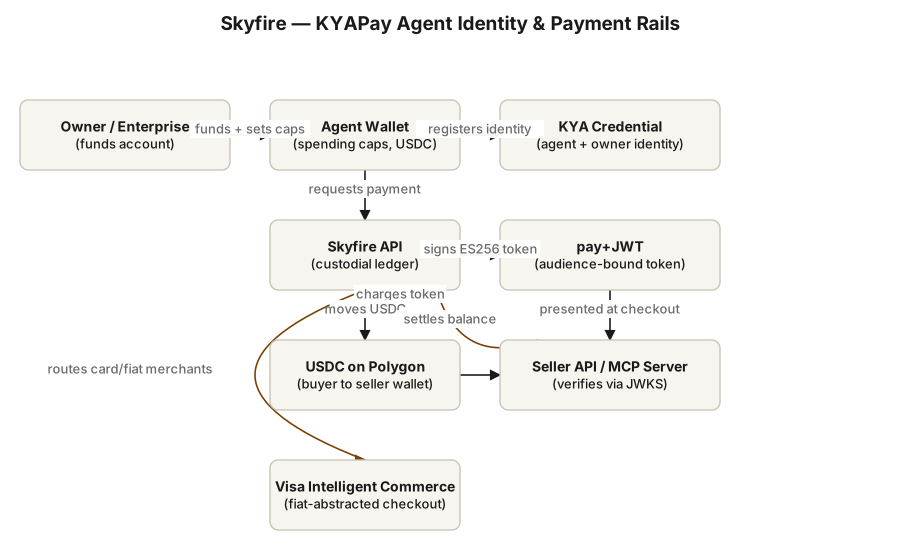 Open full-size diagram
Summary
Skyfire is a San Francisco company (founded 2023, publicly launched August 21, 2024) building what it called "the world's first payment network for AI agents": infrastructure that lets autonomous software agents hold funds, prove who they are and who deployed them, and pay other agents, APIs, and merchants without a human clicking "confirm." Founders Amir Sarhangi (CEO) and Craig DeWitt (Head of Product) were early Ripple executives; the team drew from Ripple and Google payments engineering. Skyfire chose USDC as its settlement asset, initially deployed on Polygon, precisely because AI agents cannot pass bank or card KYC — a stablecoin wallet is the only account an agent can natively "own." The company raised an $8.5M seed round (investors reported include Circle, Ripple, Gemini, and Draper Associates), later adding roughly $1M in strategic investment from Coinbase Ventures and a16z's Crypto Startup Accelerator (CSX) for a reported $9.5M total. Over 2025 Skyfire generalized its stack into KYAPay, an open identity-plus-payment protocol, and by December 2025 was demonstrating end-to-end agent purchases integrated with Visa Intelligent Commerce — a notable drift from pure crypto rails toward hybrid crypto/card infrastructure.
Design (Mechanism)
The core insight is that agent commerce is simultaneously a payments problem and an identity problem, and Skyfire binds the two together:
- Agent wallets with programmatic guardrails. Each agent gets a funded wallet (top-ups via credit/debit card, ACH, or USDC) with owner-set controls: spending limits, per-transaction caps, and price-preference rules. Settlement between agents happens in USDC — originally on Polygon, with stated plans to expand to other chains — enabling instant, global, sub-$5 micropayments that card networks price out.
- Know Your Agent (KYA). Instead of KYC on a human, Skyfire issues verifiable identity credentials for the agent and its controlling entity, so a seller-side API knows which agent is calling and who stands behind it.
- KYAPay tokens (the open protocol, June 2025). The mechanism is formalized as three JWT variants signed with ES256: a
kya+JWT(identity for account creation/login), apay+JWT(payment authorization), and a combinedkya+pay+JWTfor guest checkout. Tokens carry standard claims plus agent ID, business identity, amount/currency, and are audience-bound to a specific seller to prevent replay. A seller (REST endpoint or MCP server) verifies the token signature via JWKS, delivers the service, then "charges" the token; Skyfire's API moves funds from buyer wallet to seller wallet. The spec is public with an open-source reference implementation (github.com/skyfire-xyz/kyapay), explicitly positioned against vendor lock-in. - Fiat abstraction. Third-party aggregators and, later, Visa Intelligent Commerce integration let agents buy from merchants that never touch USDC — the stablecoin functions as internal settlement while the edge looks like normal commerce.
Note what is not here: no token, no on-chain protocol governance, and no published smart-contract addresses. Per the KYAPay whitepaper, settlement runs through Skyfire's custodial wallet/API infrastructure with USDC as the value layer — it is a company-operated network with an open message format, not a trustless protocol.
Outcome
Ongoing as of mid-2026. Milestones: public launch August 2024; an October 2024 press push claiming agents "racing to join" the network; beta exit with an enterprise-ready network in March 2025; KYAPay open protocol plus Agent Checkout in June 2025; and a December 2025 demonstration of a secure end-to-end consumer purchase by an agent using KYAPay with Visa Intelligent Commerce. Sarhangi has cited research projecting agent-to-agent commerce at $46B within three years. The company also pivoted its public positioning toward being an identity/access layer for the "agentic web" — partnering with bot-management and security vendors (F5, HUMAN Security, DataDome, Akamai, Okta/Auth0, Experian) so verified agents can pass CAPTCHAs and 403 walls, claiming coverage of over 60% of the web. Independent transaction-volume figures are not public; no exploit or failure has been reported. Verified adoption metrics: Unknown / not found.
Why it worked
- Correct diagnosis, early. Agents can't get bank accounts or pass card KYC; stablecoin wallets plus machine-readable identity is a genuinely coherent answer, and Skyfire shipped it before "agentic payments" became a 2025 buzzword (x402, Visa/Mastercard agent initiatives).
- Credible team and strategic cap table. Ex-Ripple/Google payments operators, with Circle, Ripple, Gemini, Coinbase Ventures, and a16z CSX aligned — investors who are themselves the stablecoin and exchange rails Skyfire depends on.
- Identity-first framing. Bundling KYA with payments gave sellers a reason to integrate (fraud/bot management) beyond payment acceptance, and opened the security-vendor partnership channel.
- Pragmatic rail-agnosticism. Moving from "USDC on Polygon" purism to JWT tokens that work with cards, ACH, or USDC kept the company relevant as card networks entered agentic commerce.
Limitations and criticisms
The on-chain experiment is thinner than the branding suggests. Settlement is custodial and API-mediated; Polygon USDC is an implementation detail rather than a trust property, and no contract addresses or on-chain volume are published — so the "crypto payment network" is effectively a fintech with a stablecoin ledger inside. It also faces brutal competition from better-distributed entrants: Coinbase's x402 (ironic, given Coinbase Ventures' investment), Stripe's agent tooling, Visa Intelligent Commerce, and Google's AP2. Anticipated 2–3% transaction fees look uncompetitive against near-zero-fee open standards. Demonstrated adoption remains largely anecdotal (press-release partners, prototype demos) rather than audited volume, and because Skyfire is the sole production implementation of KYAPay, "open protocol" currently means open spec plus one operator, not open competition.
Lessons
- Stablecoins won agent payments by default: the binding constraint was never transaction cost but that an agent cannot pass KYC — whoever solves machine identity controls the payment flow.
- "Open protocol, closed operator" is a repeatable wedge: publishing the KYAPay spec while operating the only production implementation buys standards credibility without giving up the network.
- Payment startups whose strategic investors run competing rails (Coinbase/x402, Circle, Visa partnerships) risk becoming R&D for their cap table; distribution beats protocol design in payments.
- Signed, audience-bound, expiring JWTs are a practical bridge between web2 APIs and on-chain settlement — replay resistance and identity claims matter more to sellers than decentralization.
Redesign (EDITORIAL — hypothesis, not fact)
This is editorial speculation. A redesign would make the on-chain layer load-bearing instead of decorative: non-custodial agent wallets as ERC-4337 smart accounts with session keys, where spending caps and price rules are enforced by on-chain policy modules rather than Skyfire's API — so a seller can verify solvency and limits trustlessly, and the operator cannot freeze or misroute funds. KYA credentials could be issued as revocable on-chain attestations (e.g., EAS) bound to the wallet, letting any verifier check agent provenance without calling Skyfire. Fee model: drop per-transaction take toward zero and monetize identity issuance/revocation and dispute arbitration — the scarce goods in agent commerce. Finally, publish volume on-chain; in a market about to be flooded by Visa, Stripe, and Coinbase standards, verifiable neutrality is the one asset an independent network can own.
Sources
- Introducing Skyfire: Payment Rails for AI (launch press release) — primary (news)
- KYAPay: Toward an Open Payment and Identity Layer (whitepaper) — primary (docs)
- Skyfire official site (product page: KYA & Payments for Agents) — primary (docs)
- Crypto Payment Network for AI Agents Launched by Former Ripple Execs — Decrypt (news)
- Skyfire Exits Beta with Enterprise-Ready Payment Network for AI Agents — primary (news)
- Skyfire Launches Open KYAPay Protocol With Agent Checkout — primary (news)
- Skyfire Demonstrates Secure Agentic Commerce Purchase Using KYAPay and Visa Intelligent Commerce — primary (news)
- Citi Ventures Q&A with Skyfire CEO Amir Sarhangi (analysis)
- Coinbase, a16z Back Skyfire AI Payments Platform — DailyCoin (news)
Related experiments
Last verified: 2026-07-27 · Spot an error? Suggest a correction