Solana Name Service (Bonfida)
A Bonfida-built naming registry that lets users buy permanent, human-readable .sol domains for a flat one-time fee instead of ENS-style annual rent.
▶ Run interactive simulation animated mechanism with editable parameters
How it works onchain
 Open full-size diagram
Summary
Solana Name Service (SNS), built and operated by the Solana ecosystem project Bonfida, is an on-chain naming registry that maps human-readable .sol names to Solana wallet addresses and other records. Launched June 22, 2021 with support from a Solana Foundation grant, it was explicitly framed as Solana's answer to Ethereum Name Service (ENS), but with a deliberately different economic mechanism: rather than charging annual rent to keep a name active, SNS charges a single flat fee (originally around 20 USDC for a standard domain) for what is marketed as permanent ownership. In July 2024 Bonfida rebranded the naming product itself to "Solana Name Service" (SNS) as a standalone brand, separating it from Bonfida's original suite of DeFi products, and issued a new SNS token to replace the original FIDA token whose tokenomics the team said no longer served the domain-holder community. As of the mid-2020s, SNS reports several hundred thousand registered domains and integration across a large number of Solana wallets and dApps for address resolution.
Design (Mechanism)
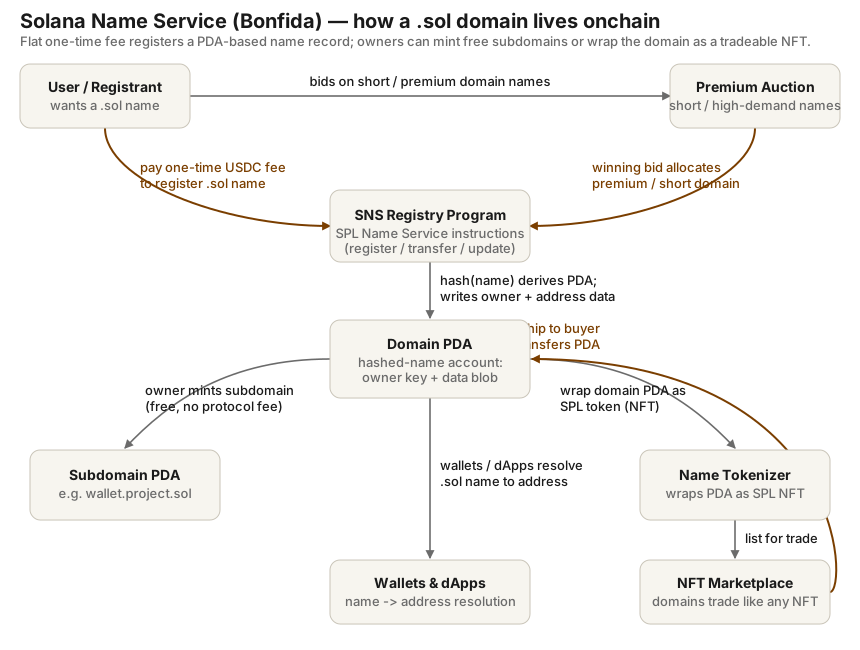
The core of SNS is a simple on-chain key-value registry, conceptually descended from the generic SPL Name Service program in the Solana Program Library: a domain name is hashed (so the raw string is not stored directly as the account seed), and the hash is used to derive a Program Derived Address (PDA) that stores an owner public key, a class, and an arbitrary data blob (most commonly a wallet address, but also usable for other records). Because ownership is just "whoever controls the keypair recorded in that PDA," transferring a domain is a normal on-chain instruction rather than a registrar-mediated process.
The economic design deliberately breaks from ENS's rent model. Most .sol domains are sold for a one-time payment denominated in USDC (roughly $20 for a standard-length name at launch, scaling with length — shorter names cost more), after which the registration does not expire and does not require renewal fees. Premium and short (high-demand) domains are instead allocated through an auction mechanism, letting the market price scarce names rather than fixing them at the flat tariff. This shifts SNS's revenue model away from ENS's recurring-rent annuity toward a mostly one-shot sale, financed instead through auction premiums, subdomain tooling, and (later) the project's own token.
A second design choice is free, permissionless subdomain creation: once an entity owns a parent domain (e.g., a project's .sol name), it can mint subdomains under it (e.g., wallet.project.sol) at no additional protocol cost, which the project has marketed toward exchanges, DAOs, and dApps that want to issue human-readable addresses to many users cheaply. A third notable extension, built via a separate "name tokenizer" program, lets a domain's underlying registry account be wrapped into an SPL token/NFT, so domains can be listed and traded on ordinary NFT marketplaces rather than requiring a bespoke domain marketplace.
Outcome
SNS is best classified as an ongoing, moderately successful piece of Solana ecosystem infrastructure rather than a runaway or failed experiment. Public reporting cites growth to several hundred thousand registered .sol domains and wide integration with Solana wallets, explorers, and dApps for name resolution — a meaningfully smaller footprint than ENS on Ethereum, but a persistent and still-growing base. The clearest sign of stress in the design was economic rather than technical: the original FIDA token, which combined governance, staking, and (loosely) value-capture roles across Bonfida's broader product suite (DEX, name service, etc.), was judged by the team itself to no longer align incentives for .sol domain holders specifically. This led to the July 2024 rebrand of the naming product to a standalone "Solana Name Service" identity and a new SNS token, distributed via a large airdrop (reported at roughly 40% of supply) intended to reset the token's holder base toward actual domain users rather than the original FIDA speculative/DeFi holder base.
Why it worked
The one-time flat fee is the mechanism's most legible strength: it removes an entire class of user friction and support burden that ENS has had to deal with for years (accidental domain expiry, having to build a renewal-reminder ecosystem, "domain sniping" of expired names). For a young ecosystem still trying to bootstrap number of holders and wallets with human-readable identities, "$20 once, yours forever" is a simple story that lowers the bar to registering a first domain, and free subdomain issuance let composability partners (exchanges, wallets) bootstrap large numbers of resolvable addresses without per-user protocol fees. Anchoring the base fee to USDC rather than SOL or FIDA also insulated the pricing model from the underlying token's volatility, which likely helped keep the "cost of an identity" predictable during Solana's large price swings.
Limitations and criticisms
The permanent, one-time-fee model creates a structural revenue-sustainability problem: unlike ENS, which has a compounding annuity of renewal fees to fund ongoing protocol development, SNS's core registrations generate a single payment per domain and then no further protocol-level cash flow from that domain, pushing the project to rely on auctions for scarce names, tokenomics/airdrops, and adjacent products for continued funding — the same tension that reportedly motivated the FIDA-to-SNS token transition. Permanent ownership with no renewal step also means there is no natural mechanism to reclaim and recirculate abandoned or squatted names, unlike ENS's expiry-driven secondary market for lapsed domains, so speculative early registration of desirable strings can lock them up indefinitely at a low sunk cost. Finally, SNS operates as a single-chain naming layer bound to Solana's own account/PDA model, so it does not natively solve cross-chain identity resolution the way multi-chain naming standards aim to, even though bridges and wrappers exist to make Solana names visible elsewhere.
Lessons
- A one-time flat fee is a powerful adoption lever (predictable cost, no expiry anxiety) but trades away the ENS-style recurring-rent annuity that funds long-run protocol maintenance — the two models optimize for different things and a project should decide deliberately which failure mode (funding gap vs. domain-squatting) it prefers.
- Anchoring registration price to a stablecoin (USDC) rather than the ecosystem's volatile native token reduces user-facing price uncertainty and is a transferable pattern for any protocol pricing a real-world-denominated good.
- Free, permissionless subdomain issuance is an effective, low-cost way to drive downstream integration (wallets, exchanges, dApps) without protocol-level fee friction, but it also means the protocol captures none of that downstream usage economically.
- When a project's original governance/utility token stops mapping cleanly onto the actual user base it is meant to reward, a clean token/brand split (as with FIDA to SNS) can be a more honest fix than continuing to stretch one token across unrelated products.
Redesign (EDITORIAL — hypothesis, not fact)
A hybrid pricing model would likely address the sustainability gap without reintroducing ENS's expiry pain: keep the low one-time fee for the initial registration (preserving the "$20 forever" simplicity that drives adoption), but add a much smaller, optional annual "activity fee" that only applies once a domain has been dormant (no on-chain read/write activity, no linked records updated) for several years — below some threshold it lapses back into a "reclaimable" pool priced via the existing auction mechanism. This would let heavily used names (the ones actually generating value for their holders and for the ecosystem) remain effectively permanent and nearly free, while abandoned/speculative registrations slowly recycle back into circulation instead of sitting inert forever, giving the protocol a modest ongoing revenue stream tied to genuine usage rather than to a one-off sale, and giving the ecosystem a release valve against permanent domain squatting.
Sources
- Bonfida's Solana Naming Service Launches .SOL Domains — Solana Blog — primary (project blog / news)
- Welcoming a New Era — Bonfida blog (SNS rebrand) — primary (project blog)
- Solana Name Service airdrops 40% of token supply after FIDA tokenomics deemed unsustainable — The Block (news)
- How to Create a .sol Domain using Solana Naming Service — QuickNode Guides (technical guide)
- Solana Cookbook — Name Service reference — primary (technical documentation)
- Bonfida GitHub organization (sns-sdk, name-tokenizer, solana-name-service-guide) — primary (source code)
Related experiments
Last verified: 2026-07-28 · Spot an error? Suggest a correction