Superstate (USTB)
Robert Leshner's SEC-registered-adviser tokenized Treasury fund that issues fund shares as an allowlisted, yield-accruing ERC-20 with continuous on-chain NAV pricing and atomic USDC subscription/redemption.
▶ Run interactive simulation animated mechanism with editable parameters
How it works onchain
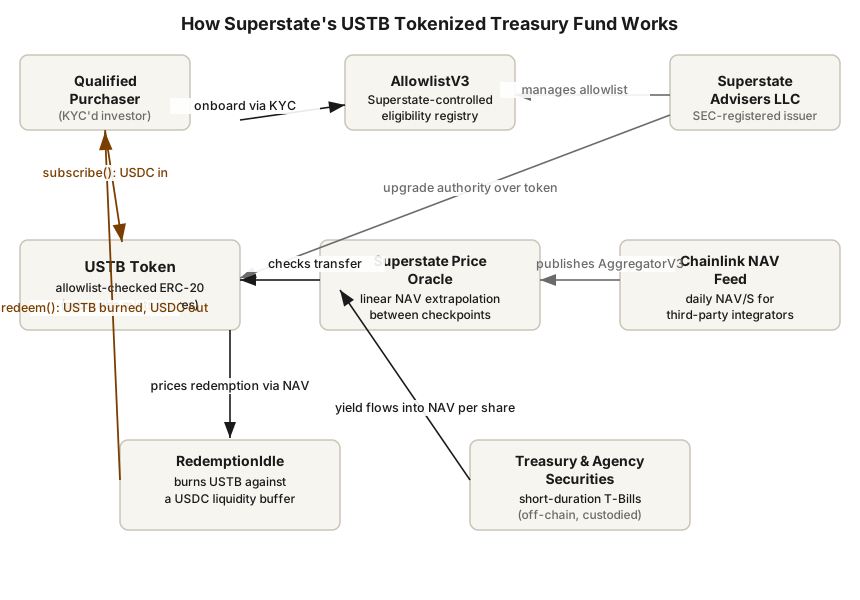 Open full-size diagram
Summary
USTB — the Superstate Short Duration U.S. Government Securities Fund — is a tokenized private fund launched on February 1, 2024 by Superstate, the firm founded by Compound creator Robert Leshner and Jim Hiltner. The fund holds short-duration U.S. Treasury Bills and Agency securities, targets a return in line with the federal funds rate, charges a 0.15% management fee, and issues its shares either in traditional book-entry form or as a yield-bearing, transfer-restricted ERC-20 token on Ethereum (later also on Solana and Plume). It is open to U.S. "qualified purchasers" under the Investment Company Act of 1940, with subscriptions and redemptions available in USDC. USTB grew into one of the largest tokenized Treasury funds (over $950 million AUM by 2026, 150+ institutional investors), and in early 2026 Invesco became the fund's investment manager — the first independent asset manager to run a fund on Superstate's tokenization rails.
Design (Mechanism)
The core design bet is that a fund share and an ERC-20 balance can be the same legal object, with compliance enforced at the token layer rather than the venue layer.
- Permissioned token. USTB is an upgradeable OpenZeppelin-style ERC-20 modified so that every transfer checks both sender and receiver against a Superstate-controlled Allowlist contract (the token calls
isAddressAllowedForPrivateInstrumenton AllowlistV3). Addresses join the allowlist only after KYC/onboarding as qualified purchasers; within that set, USTB is freely transferable peer-to-peer. On Solana, the equivalent is a Token-2022 mint using freeze authority with a permissionless "thaw" instruction, a construction chosen to keep DeFi integrations possible. - Atomic subscription and redemption. Investors call a
subscribefunction that atomically swaps USDC for newly minted USTB, and aredeemfunction on the RedemptionIdle contract that burns USTB against a USDC liquidity buffer — currently fee-free. This replaces the T+1 wire-transfer loop of traditional fund subscription with a single transaction. - Continuous NAV pricing. Introduced in October 2024, Superstate's price oracle linearly extrapolates net asset value per share from the two most recent NAV checkpoints, so the token's redemption price updates continuously rather than once per business day; investors accrue yield from the moment of subscription. Chainlink publishes daily NAV/S via a standard AggregatorV3 feed for third-party integrations.
- Regulated wrapper. The fund is managed by an SEC-registered investment adviser (Superstate Advisers LLC), with a traditional fund administrator and custodian behind the token — the token is the share register interface, not a synthetic claim.
Contracts have been audited (Superstate cites reports from Certora and Macro, per its documentation/site materials).
Outcome
USTB launched February 1, 2024 and reached roughly $93M AUM within months, with FalconX executing the first trade using USTB as prime-brokerage collateral. By the October 2024 continuous-pricing launch it held ~$145M; by 2025–2026 it exceeded $950M AUM across 150+ institutional investors, placing it among the top five tokenized U.S. Treasury products alongside BlackRock's BUIDL and Franklin Templeton's BENJI. Superstate expanded USTB to Solana and Plume, launched a second fund (USCC, a crypto carry fund), and generalized the stack into "FundOS" and the "Opening Bell" tokenized-equity platform. In early 2026, Invesco took over as USTB's investment manager — Leshner called the arrangement "the blueprint for how funds and ETFs will come onchain" — and Coinbase and Invesco announced further tokenized fund share classes on Superstate rails. The experiment is ongoing and, so far, commercially and technically successful.
Why it worked
- Credibility arbitrage. Leshner's Compound track record gave crypto-native institutions confidence, while the SEC-registered-adviser structure gave compliance teams a familiar wrapper. USTB sold to both sides simultaneously.
- Timing. 2024's high fed-funds rates made tokenized T-bill yield the obvious "risk-free leg" for crypto treasuries, DAOs, and market makers sitting in zero-yield stablecoins.
- Token-layer compliance instead of walled gardens. Enforcing eligibility in the transfer hook let USTB remain a real ERC-20 — composable as collateral (FalconX) and integrable with oracles — rather than an entry in a closed transfer-agent database.
- Continuous NAV as a genuine product improvement. Instant yield accrual and atomic USDC subscribe/redeem are things a traditional money-market fund literally cannot do; the blockchain rail improved the TradFi product rather than merely mirroring it.
Limitations and criticisms
The qualified-purchaser allowlist caps the addressable market to a small institutional set, so USTB cannot capture retail stablecoin-yield demand the way permissionless competitors (e.g., yield-bearing stablecoin wrappers) can. The token is upgradeable and admin-controlled — Superstate can change the allowlist and contract logic — so holders carry issuer trust assumptions closer to a fund than to a bearer asset. Redemption liquidity depends on the USDC buffer in RedemptionIdle plus USDC itself, layering Circle risk onto Treasury exposure. And the category is commoditizing fast: BlackRock's BUIDL out-scaled USTB, compressing the differentiation to infrastructure — which is arguably why Superstate pivoted its own brand toward FundOS/Opening Bell and handed fund management to Invesco.
Lessons
- Put compliance in the transfer hook, not in the venue. An allowlist-checked ERC-20 keeps a regulated security composable with DeFi collateral systems and oracles, which is where most of the token's incremental value comes from.
- Tokenization wins when it improves the product, not just the wrapper. Continuous NAV accrual and atomic subscribe/redeem in USDC are capabilities traditional fund rails lack; features like these, not "blockchain" per se, drove adoption.
- In commoditizing RWA categories, the durable business is the rails. As giant issuers entered tokenized Treasuries, Superstate's pilot fund mattered less than the platform it validated — culminating in Invesco running the fund on Superstate infrastructure.
- Regulated tokenization inherits stacked trust assumptions. Holders bear adviser risk, upgradeable-contract risk, allowlist-admin risk, and stablecoin (USDC) risk on top of the underlying Treasuries; honest accounting of that stack is part of the design.
Redesign (EDITORIAL — hypothesis, not fact)
This section is editorial speculation. If redesigning USTB today: (1) publish a time-locked, on-chain-governed upgrade path (e.g., 7-day timelock on token/allowlist upgrades with a public guardian) so institutional holders can exit before any logic change — converting issuer trust into monitorable trust. (2) Add a permissionless secondary "wrapped" tranche: a non-transferable-to-unverified-addresses receipt that DeFi protocols can hold under a standing protocol-level attestation, widening composability without widening the investor base. (3) Diversify the redemption leg beyond USDC (multiple stablecoins plus an RTGS/FedNow fiat leg) to cut single-stablecoin dependency. (4) Push NAV attestation further: publish custodian holdings via a reserve-attestation oracle so the linear-extrapolation price is verifiably collateralized rather than adviser-reported. The strategic lesson — become the FundOS, let brand-name managers run the funds — is the move Superstate itself made; a redesign would simply start there.
Sources
- Superstate docs — Smart contracts — primary (docs)
- Superstate docs — USTB — primary (docs)
- superstateinc/ustb — USTB token and Permissionlist contracts (GitHub) — primary (contract)
- USTB token on Etherscan — primary (contract)
- Superstate — USTB fund page — primary (docs)
- The Block — Robert Leshner's Superstate introduces Ethereum-based tokenized fund (news)
- The Block — Superstate introduces real-time 'continuous pricing' for USTB (news)
- PR Newswire — Invesco and Superstate Advance Institutional Tokenization Through USTB Partnership (news)
- FalconX — Creating More Efficient Markets with Tokenized Assets (first USTB collateral trade) (analysis)
Related experiments
Last verified: 2026-07-27 · Spot an error? Suggest a correction