THORChain
A Cosmos-SDK appchain that lets users swap native (unwrapped) BTC, ETH, and other L1 assets via RUNE-paired liquidity pools secured by bonded, anonymous validator nodes and threshold-signature vaults.
▶ Run interactive simulation animated mechanism with editable parameters
How it works onchain
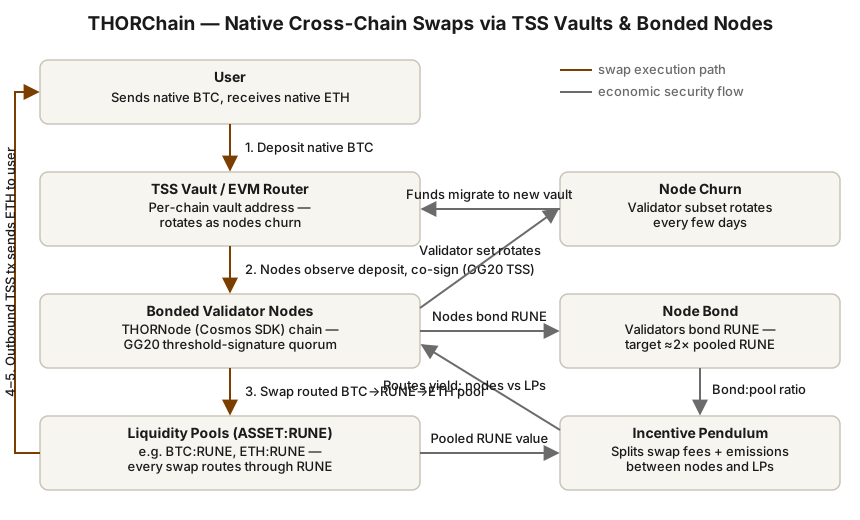 Open full-size diagram
Summary
THORChain is the longest-running attempt to build a decentralized exchange for native Layer-1 assets — swapping real BTC for real ETH with no wrapped tokens, no bridges in the conventional sense, and no centralized custodian. Started in 2018–2019 by an Australian team led by John-Paul "JP" Thorbjornsen (who initially operated behind the pseudonym "Leena" and revealed his identity later), it launched a single-chain proof of concept (BEPSwap, on Binance Chain) in 2020 and its multichain "Chaosnet" mainnet in April 2021. The protocol is its own Cosmos-SDK appchain (THORNode, developed openly on GitLab since July 2019) whose validators collectively custody user assets in threshold-signature (TSS GG20) vaults across Bitcoin, Ethereum, and other chains. Its native token RUNE is the mandatory settlement asset in every liquidity pool. THORChain has survived multiple exploits (two in July 2021, ~$5M in 2022–23 near-misses, a $10.8M TSS exploit in May 2026), a ~$200M lending/savers insolvency in January 2025, and a reputation crisis as North Korea's Lazarus Group laundered hundreds of millions of the Bybit hack proceeds through it in 2025. It remains live and processing significant volume.
Design (Mechanism)
Continuous liquidity pools with RUNE as the universal pair. Every pool is ASSET:RUNE (BTC:RUNE, ETH:RUNE, etc.), so any swap routes through RUNE (BTC→RUNE→ETH). This creates deterministic pricing without oracles and ties RUNE's market cap arithmetically to pooled liquidity: a pool holding $100k of BTC must hold $100k of RUNE.
Bonded validators and the Incentive Pendulum. ~100 anonymous nodes bond RUNE to run the chain and co-sign vault transactions. The design target is that bonded RUNE should be roughly twice pooled RUNE (67%/33%), so that stealing the vaults would cost validators more in slashed bonds than they could gain. The "Incentive Pendulum" algorithmically splits system income (swap fees + block emissions) between node operators and LPs: if liquidity grows faster than bonds, yield shifts to nodes (security is scarce); if bonds outgrow liquidity, yield shifts to LPs (capital is idle).
TSS vaults and churn. User assets sit in vaults controlled by GG20 threshold signatures across node subsets; nodes "churn" in and out every few days, migrating funds to new vaults so no static committee persists. On EVM chains a router contract manages deposits; on UTXO chains vaults are TSS-derived addresses.
THORFi (Savers and Lending, 2022–2023). The team layered yield products on the base swap protocol: Savers offered single-sided native-asset yield via synthetic assets, and Lending offered BTC/ETH-collateralized, zero-interest, no-liquidation loans that burned RUNE on open and minted it on close — an explicitly reflexive design that transferred BTC/ETH price risk onto the RUNE supply.
Outcome
As a swap venue, THORChain proved the core thesis: billions in cumulative native cross-chain volume with user swap funds never lost at the pool level across five years. As a financial system, results were mixed to poor. July 2021 brought two Chaosnet exploits (roughly $7.6M and $8M, the second by a self-described whitehat repaid via bounty), forcing a months-long halt and a "harden then relaunch" period. THORFi's reflexive liabilities came due in January 2025: node operators voted to freeze Savers and Lending withdrawals facing ~$200M in liabilities ($97M lending, ~$102M savers/synths) that the protocol could not redeem without death-spiraling RUNE; RUNE fell ~75% that quarter. The approved restructuring (Proposal 6) unwound THORFi and converted claims into TCY, an equity-like token entitled to a share of protocol revenue — a genuinely novel on-chain bankruptcy. In February–March 2025 Lazarus Group pushed a large share of the $1.5B Bybit hack ($605M+ ETH in the first week, ~$2.9B volume over five days) through THORChain; a three-validator attempt to halt ETH trading was reverted within minutes, core developer "Pluto" resigned in protest, and the protocol earned millions in fees from the flows, drawing lasting censure. In May 2026 a malicious churned-in validator exploited the GG20 implementation to forge vault signatures and drain $10.8M of protocol-owned liquidity, pausing the network ~13 hours. Founder JP Thorbjornsen had stepped back to community governance in 2024 and was himself exploited for ~$1.35M in a 2025 social-engineering attack attributed to DPRK actors. The protocol is still operating: outcome "ongoing," with the base swap mechanism arguably a partial success and the leverage layer a failure.
Why it worked
- Real product-market fit for native swaps: no wrapped assets, no KYC, chain-abstracted BTC⇄ETH liquidity that centralized exchanges and bridge-based DEXs could not offer.
- Economic security was quantified, not assumed: the bond-vs-pool ratio and Incentive Pendulum gave an explicit, self-adjusting answer to "why won't validators steal the vaults."
- Antifragile operations: automatic halts, insurance-funded reimbursements, and open GitLab development let it absorb 2021's exploits and relaunch rather than die.
- RUNE's deterministic link to liquidity gave the token a defensible valuation floor narrative during growth phases and aligned LPs, nodes, and holders.
Limitations and criticisms
- Reflexivity was reintroduced at the product layer. Lending and Savers minted and burned RUNE against BTC/ETH liabilities — effectively the protocol shorting its own token against the assets it custodied. A bear market made those liabilities unpayable, forcing the January 2025 restructuring.
- Custodial attack surface is not zero. TSS vaults concentrate nine-figure sums behind a complex cryptographic implementation; the May 2026 GG20 key-leakage exploit showed a single malicious node could defeat the quorum assumption.
- Neutrality has real costs. Settling flows without discretion is consistent with THORChain's stated censorship-resistance, but it also means the network processes illicit flows (e.g., laundering proceeds), which has cost it developer, validator, and exchange goodwill.
- Governance is under-specified at the moment it matters most: an ad-hoc validator vote to block stolen funds was reversed within minutes, showing that neither a censorship nor a non-censorship policy was credibly settled in advance.
Lessons
- Keep the settlement/security token out of the liability side of yield products; minting the native token against exogenous debt converts market downturns into protocol insolvency.
- "Economically secure" TSS custody is only as strong as its cryptographic implementation — bond-slashing math cannot compensate for key-material leakage, so implementation audits and node-level attestation matter as much as incentive design.
- Neutrality is a policy choice that must be decided, documented, and defended before a crisis; deciding it live via a reversible validator vote destroys trust in both directions.
- On-chain restructuring is possible: converting defaulted claims into a revenue-sharing token (TCY) resolved a $200M default without formal bankruptcy — a genuine institutional innovation worth copying.
- An incentive pendulum (algorithmic yield routing between security providers and liquidity providers) is a reusable pattern for any protocol whose safety depends on a capital ratio.
Redesign (EDITORIAL — hypothesis, not fact)
This section is editorial speculation. A redesigned THORChain would (1) ship the swap protocol alone and constitutionally prohibit protocol-level products that mint RUNE against exogenous liabilities, moving lending/structured yield to segregated, third-party risk capital; (2) replace monolithic TSS vaults with many small, over-collateralized vaults capped so no single vault exceeds the slashable bond of its signers, plus mandatory reproducible-build attestation for signer software; (3) adopt an explicit, pre-committed sanctions/illicit-flow policy — either provable neutrality (no blocklist capability exists in the code, so no vote can be demanded) or a transparent, delay-based screening layer — rather than discretionary validator votes; and (4) formalize the TCY mechanism in advance as a standing "resolution regime," so any future shortfall converts to revenue-share claims by rule rather than by emergency governance.
Sources
- THORNode repository (Cosmos SDK state machine, GG20 TSS) — primary (contract)
- THORChain Docs — Economic Model / Incentive Pendulum — primary (docs)
- THORChain Docs — Lending FAQ (Deprecated) — primary (docs)
- Quadriga Initiative — ThorChain Chaosnet Exploit, July 2021 (~$7.6M) (analysis)
- Blockworks — THORChain halts withdrawals amid $200M insolvency (Jan 2025) (news)
- Messari — THORChain Q1 2025 Brief (Proposal 6 restructuring, RUNE -74.5% QoQ) (analysis)
- CoinDesk — Inside North Korea's Favorite Crypto Laundering Tool: THORChain (Apr 2025) (news)
- crypto.news — THORChain core dev leaves after failed vote to block hacker transactions (news)
- The Crypto Times — Inside the May 2026 $10.8M THORChain TSS exploit (news)
- Cointelegraph Magazine — THORChain founder JP Thor profile (analysis)
Related experiments
Last verified: 2026-07-27 · Spot an error? Suggest a correction