Tranchess
A DeFi protocol that splits a single staked-asset fund (QUEEN) into a stable-yield tranche (BISHOP) and a leveraged tranche (ROOK), using periodic on-chain rebalancing instead of liquidations to manage leverage.
▶ Run interactive simulation animated mechanism with editable parameters
How it works onchain
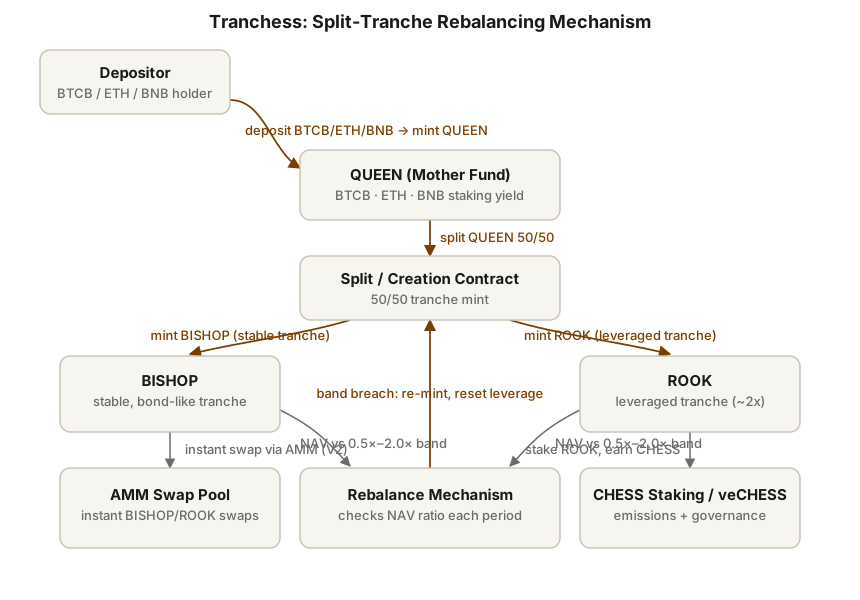 Open full-size diagram
Summary
Tranchess is a decentralized structured-product protocol, launched on BNB Chain in June 2021, that lets a single pool of staked crypto assets (BTCB, ETH, or BNB) be split into two complementary risk tranches. Depositors first mint a "mother fund" token called QUEEN, which is backed by the staked underlying and its staking yield. QUEEN can then be split 50/50 into BISHOP, a stable, bond-like tranche aimed at yield-seeking, risk-averse holders, and ROOK, a leveraged tranche (roughly 1.5x–2x) aimed at investors who want amplified upside without a margin account or liquidation risk. A fourth token, CHESS, is the protocol's governance and rewards token, farmed by staking QUEEN/BISHOP/ROOK and lockable as veCHESS for voting weight and fee rebates. The core innovation is a scheduled "Rebalance" mechanism that resets the leverage ratio between BISHOP and ROOK at fixed intervals rather than relying on forced liquidations, which is the standard mechanism in on-chain leveraged-lending and perpetuals products.
Design (Mechanism)
The protocol is built around one shared collateral pool per underlying asset:
- QUEEN (mother fund). Users deposit BTCB, ETH, or BNB, which the protocol stakes (directly or via partner liquid-staking/points integrations) to generate a base yield. QUEEN represents a claim on this pool and its yield, and can be redeemed back to the underlying asset at any time.
- Splitting into BISHOP and ROOK. Any QUEEN holder can split their position into equal amounts of BISHOP and ROOK. BISHOP is designed to behave like a fixed/floating-rate note: it earns a target interest rate paid for by the leverage seeker, and in normal conditions tracks close to the underlying's price without amplified swings. ROOK absorbs the leveraged exposure — because it borrows economically from BISHOP's principal (via the pooled fund), it can offer directional leverage without a lending market, an oracle-triggered margin call, or a liquidation auction.
- Rebalance mechanism. Instead of continuous mark-to-market liquidation, Tranchess checks the ratio of ROOK's net asset value (NAV) to BISHOP's NAV against fixed bands (roughly 2.0 on the upside, 0.5 on the downside). If the underlying's price move pushes the ratio outside the band — meaning the asset has risen more than ~100% or fallen more than ~25% since the last rebalance — the protocol executes a rebalance: it mints or burns QUEEN and re-splits it into fresh BISHOP and ROOK so that the leverage ratio returns to its target multiple (e.g., 2x). This event happens for all holders simultaneously and periodically (originally daily, later adjusted), rather than at an unpredictable liquidation threshold tied to a single position.
- Governance/incentives. Staking any of the three fund tokens earns CHESS emissions. Locking CHESS as veCHESS grants voting power over emission weights across pools and a share of weekly rebate pools funded by protocol fees, following a vote-escrow design similar to Curve's veCRV model.
- V2 additions. A later upgrade added AMM-based instant swaps between BISHOP, ROOK, and a stablecoin, plus instantaneous QUEEN creation/redemption, reducing the friction of the original creation/redemption queue model.
Outcome
Tranchess shipped on BNB Chain in mid-2021 and has continued operating and iterating for multiple years, later expanding activity to Scroll and adding points/liquid-restaking-linked products (e.g., stETH-based vaults, a "TrBNB" product bridging traditional and decentralized finance). Protocol communications reported roughly 315% TVL growth year-to-date as of mid-2024 and TVL passing $200 million in prior months, alongside partnerships (e.g., with Lista DAO and Solv Protocol) and campaigns tied to points-farming trends in 2024–2025. By late 2025, the project's own updates indicated CHESS's community-incentive emission schedule had been fully distributed. There is no evidence in available sources of an exploit, insolvency, or shutdown; the protocol is best classified as ongoing, though independent, non-project-sourced verification of current TVL and usage was not obtained in this research pass.
Why it worked
Tranchess targeted a real, well-understood need — risk-tranching of a yield-bearing asset — using a mechanism (periodic collective rebalancing) that sidesteps a specific pain point of leveraged DeFi products: the sudden, individual liquidation event. Because ROOK holders share a common rebalance rather than each having their own liquidation price, the product can be marketed as "leverage without liquidation risk," which is an easier sell to less sophisticated yield farmers than a margin position. The design also gave the protocol two distinct, cross-subsidizing demand pools (yield-seekers funding BISHOP's stable return, leverage-seekers paying for it via ROOK) rather than needing external lenders, and it layered a vote-escrow governance/incentive system on top to bootstrap and retain liquidity, a pattern that had already proven durable in other DeFi protocols by the time Tranchess launched.
Limitations and criticisms
- Rebalancing is not liquidation-free, only differently timed. Because the rebalance happens at scheduled checkpoints, a sharp intraday move can already have hurt ROOK holders economically well before the rebalance formally resets the ratio — the mechanism changes when risk crystallizes, not whether concentrated downside risk exists.
- BISHOP is not risk-free despite being marketed as "stable." Its principal is only as safe as (a) the smart contracts and staking integrations underlying QUEEN and (b) ROOK's ability to absorb losses in an extreme, fast-moving market; in a severe enough crash, ROOK's buffer could be insufficient before a rebalance can act.
- Value depends on continuous CHESS emissions and points-farming demand. TVL growth reported around 2024 coincided with a broader industry wave of points/airdrop farming; once CHESS's community emission schedule finished distributing (reported completed by late 2025), the protocol's incentive-driven demand may need to be replaced by organic fee/yield demand, an unresolved transition for many veTokenomics-style DeFi protocols.
- Concentration on BNB Chain. Much of the protocol's history and liquidity has been tied to a single chain's ecosystem incentives (e.g., BNB Chain catalyst programs), which is a centralization/dependency risk for a protocol that otherwise brands itself as chain-agnostic structured finance.
- Complexity for end users. Understanding NAV-based rebalancing, tranche ratios, and veCHESS lock mechanics requires materially more financial literacy than holding a spot asset or a simple stablecoin, which likely limits the addressable user base relative to simpler yield products.
Lessons
- Replacing per-position liquidation with scheduled, protocol-wide rebalancing can remove one specific UX failure mode (surprise individual liquidation) without removing the underlying risk that a large adverse move can still impose losses on the leveraged tranche before the next checkpoint.
- Splitting a single yield-bearing pool into a "stable" and a "leveraged" claim lets a protocol serve two opposite risk appetites from one collateral base, but the "stable" tranche's safety is only as strong as the leveraged tranche's loss-absorption capacity — the senior tranche's marketing (e.g., "stablecoin-like") should not be conflated with its actual guarantee.
- Long-running DeFi protocols that rely on token emissions to bootstrap TVL face a structural cliff when the emission schedule completes; sustainable designs need a credible plan (fee capture, real yield, sticky governance value) for post-emission demand, and this transition is worth tracking as a natural experiment once emissions end.
- Multi-tranche, vote-escrow governed protocols accumulate significant mechanism complexity (four token types, rebalance bands, veToken locks, multi-chain deployments); each additional moving part is a place where documentation, user understanding, and independent verification can lag actual on-chain behavior.
Redesign (EDITORIAL)
Hypothesis, not fact. One plausible redesign would replace fixed, discrete rebalance bands (2.0x / 0.5x NAV ratio) with a continuous, smaller-and-more-frequent rebalancing rule — e.g., checking and partially rebalancing every block or every few minutes with a tightly bounded adjustment, rather than waiting for the ratio to drift to the edge of a wide band. This would shrink the window in which a fast, large price move can inflict losses on ROOK beyond what the next scheduled rebalance can correct, at the cost of more gas overhead and more frequent minor repricing events for holders. A second, complementary idea would be to let BISHOP's "target rate" float dynamically with realized ROOK demand and volatility (similar to a funding-rate mechanism in perpetual futures) instead of a fixed schedule, so that in high-volatility regimes BISHOP holders are compensated with a higher rate for the extra tail risk they are implicitly bearing, making the risk-transfer price more transparent rather than bundled into an advertised "stable yield." Neither change has been tested against Tranchess's actual historical price data in this research pass; both are offered as design hypotheses for how the rebalance-instead-of-liquidation approach could be hardened against fast, large moves.
Sources
- Welcome to Tranchess (official docs) — primary (docs)
- Introducing Tranchess (official Medium) — primary (blog)
- Tranchess Quick Facts (official Medium) — primary (blog)
- Tranchess: DeFi's Move Towards Tailored Risk and Reward (Messari) (research)
- What Is Tranchess (CHESS)? A DeFi Protocol for Crypto Asset Management (Gate Learn) (explainer)
- Danny Chong, co-founder of Tranchess (The Fintech Times) (press)
Related experiments
Last verified: 2026-07-28 · Spot an error? Suggest a correction