BarnBridge
DeFi protocol that tranched lending-market yield into fixed-rate senior bonds and levered-variable junior tokens, and was wound down in 2023 citing regulatory constraints.
▶ Run interactive simulation animated mechanism with editable parameters
How it works onchain
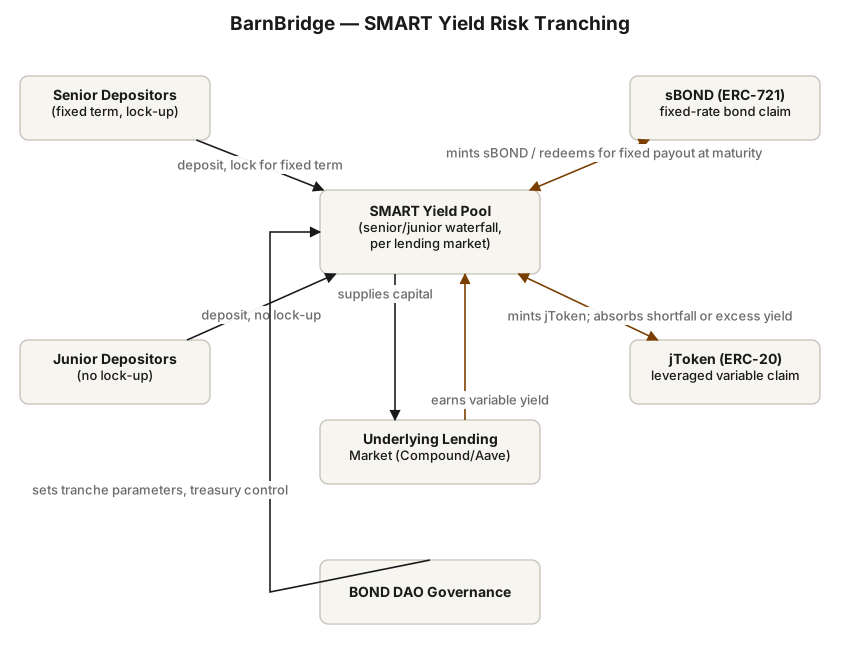 Open full-size diagram
Summary
BarnBridge was one of DeFi's canonical attempts to import traditional structured finance — specifically risk tranching — onto Ethereum. Conceived around 2019 and launched publicly in 2020 by Tyler Ward, Troy Murray, Milad Mostavi, Dragos Rizescu, and Bogdan Gheorghe, it raised a ~$1M seed round (led by Fourth Revolution Capital and ParaFi) in September 2020 and opened liquidity mining for its BOND governance token on October 19, 2020, attracting over $100M TVL almost immediately. Its flagship product, SMART Yield ("Structured Market Adjusted Risk Tranches"), went live in March 2021: it pooled deposits into lending markets like Compound and Aave and split the resulting variable yield into a fixed-rate senior tranche and a levered-variable junior tranche. More than $509M flowed through SMART Yield pools between March 2021 and May 2023. The experiment ended not with an exploit: the DAO wound down operations in December 2023, citing regulatory constraints.
Design (Mechanism)
- Yield tranching. SMART Yield aggregated user deposits into a single underlying debt pool (e.g., cUSDC on Compound, aDAI/aUSDC on Aave) and carved claims on that pool's variable yield into two risk profiles.
- Senior tranche (sBONDs, ERC-721). Seniors locked principal for a fixed term and received a guaranteed fixed yield for the life of the bond, represented as a non-fungible bond NFT. The guaranteed rate was set programmatically below the prevailing variable rate, discounted by the pool's junior/senior balance.
- Junior tranche (jTokens, ERC-20). Juniors deposited without lock-up and received fungible pool-share tokens. They underwrote the seniors: if variable yield fell below the seniors' promised rate, junior returns absorbed the shortfall; if yield exceeded it, juniors captured the excess as leveraged variable yield. "First to earn, last to lose" for seniors; the inverse for juniors.
- Solvency rule. Senior guarantees could only be written against yield capacity the junior side could plausibly cover, making the fixed rate a function of the junior liquidity cushion rather than an oracle or counterparty promise.
- Companion products. SMART Exposure (automated rebalancing between two ERC-20s at target ratios) and SMART Alpha (tranched price-exposure to volatile assets) extended the tranching thesis beyond interest rates; both launched later and saw less traction. SMART Yield and SMART Exposure deployed to Polygon in July 2021 — the protocol's first expansion beyond Ethereum mainnet.
- Governance. The BOND token (fixed 10M supply, contract 0x0391D2021f89DC339F60Fff84546EA23E337750f) was distributed via liquidity mining (stablecoin pool, USDC/BOND LP pool, single-sided BOND staking) and governed the DAO, which controlled the treasury and product parameters after a "LaunchDAO" phase split 45/45/10 among founders, seed investors, and advisors.
Outcome
Technically, the mechanism worked as designed: senior fixed rates were honored, the junior-underwrites-senior waterfall functioned, and no major exploit of the core SMART Yield tranching logic drained the protocol. Commercially and institutionally, it underperformed. TVL peaked in the 2020–21 cycle (over $100M at farming launch; hundreds of millions at peak, with $509M+ cumulative SMART Yield inflows) but bled out as DeFi yields compressed in 2022 — fixed rates on stablecoins in the low single digits could not compete for crypto-native capital, and the hoped-for TradFi institutional demand never arrived at scale. The DAO closed its pools in mid-2023 and wound down operations that December, citing regulatory constraints. BOND still trades as a residual asset, but the protocol is defunct and the website offline.
Why it worked
- A real financial primitive, cleanly translated. Tranching is centuries-old financial engineering; BarnBridge's senior/junior waterfall was a faithful, transparent, on-chain version with the junior cushion as visible, verifiable collateral for the fixed-rate promise.
- Fixed rates without counterparties or oracles. Deriving the senior rate endogenously from pool composition avoided oracle risk and credit intermediaries — an elegant piece of mechanism design.
- Timing and distribution. Launching liquidity mining at the height of 2020 "DeFi summer" with credible backers gave it instant TVL, community, and one of the era's stronger DAO cultures.
Where the design broke
- Yield compression killed demand. The product's value proposition (certainty on stablecoin yield) was compelling at 8–10% underlying APY and irrelevant at 1–2%; juniors also had little excess yield to lever, so both tranches lost appeal simultaneously.
- Wrong customer thesis. The pitch targeted risk-averse institutions entering DeFi; those institutions largely did not come, and crypto-native users preferred higher-octane venues.
- Complexity overhead. Multi-product ambitions (Yield, Exposure, Alpha, later FIAT) diluted focus while the core product's addressable demand shrank.
Lessons
- A mechanism can be sound and still die of demand elasticity: structured yield products only clear when the underlying spread is wide enough to pay both tranches. Design for the low-yield regime, not just the launch regime.
- Endogenous rate-setting (senior rate as a function of junior cushion) is a reusable pattern for making guarantees without oracles or external counterparties — it survived BarnBridge and reappears in later fixed-rate and tranched protocols (Pendle-style yield splitting, tranche lenders).
- Institutional-DeFi theses need a distribution and compliance plan, not just a mechanism. The product institutions "should" want is worthless if they legally or operationally cannot touch it.
Redesign (EDITORIAL — hypothesis, not fact)
The following is editorial speculation by the Atlas, not a statement of fact. A modern BarnBridge would keep the junior-underwrites-senior waterfall — its best idea — but change two things. First, underlying yield: tranche durable, spread-rich sources (staking/restaking yield, RWA T-bill yield, perp funding) rather than only lending-market APY, so the senior rate remains attractive across cycles. Second, make the junior side an explicitly priced insurance market — auction the right to underwrite seniors, letting the fixed rate float competitively rather than by formula — which would improve capital efficiency and make junior risk legible. Keeping seniors as transferable NFTs was ahead of its time; with today's bond-NFT secondary infrastructure, a redesigned version could support a real on-chain fixed-income curve.
Sources
- BarnBridge Whitepaper (GitHub) — primary (docs)
- BarnBridge Docs (archived GitBook) — FAQ — primary (docs)
- BarnBridge GitHub organization (contracts, SMART Yield V1/V2, SMART Alpha) — primary (contract)
- BOND token contract on Etherscan — primary (contract)
- SMART Yield Specifications — senior (ERC-721) / junior (ERC-20) mechanics — primary (docs)
- The Team Behind BarnBridge (official Medium) — primary (docs)
- BarnBridge SMART Yield Specs Unveiled (official Medium) — primary (docs)
- Smart Liquidity Research: BarnBridge launches SMART Yield and SMART Exposure on Polygon (July 2021) (news)
- IQ.wiki: BarnBridge (archive)
Related experiments
Last verified: 2026-07-26 · Spot an error? Suggest a correction