Truthcoin
A 2014 whitepaper (later renamed Bitcoin Hivemind) proposing a Bitcoin sidechain that uses a Votecoin-weighted, SVD-based reputation algorithm to turn a decentralized crowd of self-interested voters into a trustless oracle for prediction markets.
▶ Run interactive simulation animated mechanism with editable parameters
How it works onchain
 Open full-size diagram
Summary
Truthcoin was a design proposed by independent researcher Paul Sztorc, first written up around 2014 in a whitepaper titled "Truthcoin: Peer-to-Peer Oracle System and Prediction Marketplace." Its goal was to solve the "oracle problem" for prediction markets: how can a blockchain-based market resolve real-world questions (who won the election, did event X happen) without relying on a trusted, censorable central authority? Sztorc's motivation was explicit — the popular centralized prediction market Intrade had shut down in 2012-2013, citing regulatory pressure, and he set out to design a prediction-market oracle that could not be shut down by any single company or authority. The project was renamed "Bitcoin Hivemind" on September 21, 2015, and was conceived as a Bitcoin sidechain (later folded into Sztorc's broader "Drivechain" sidechain-enablement work at Layer Two Labs). It never reached a live mainnet product; it remains one of the most influential unimplemented designs in the oracle and prediction-market literature.
Design (Mechanism)
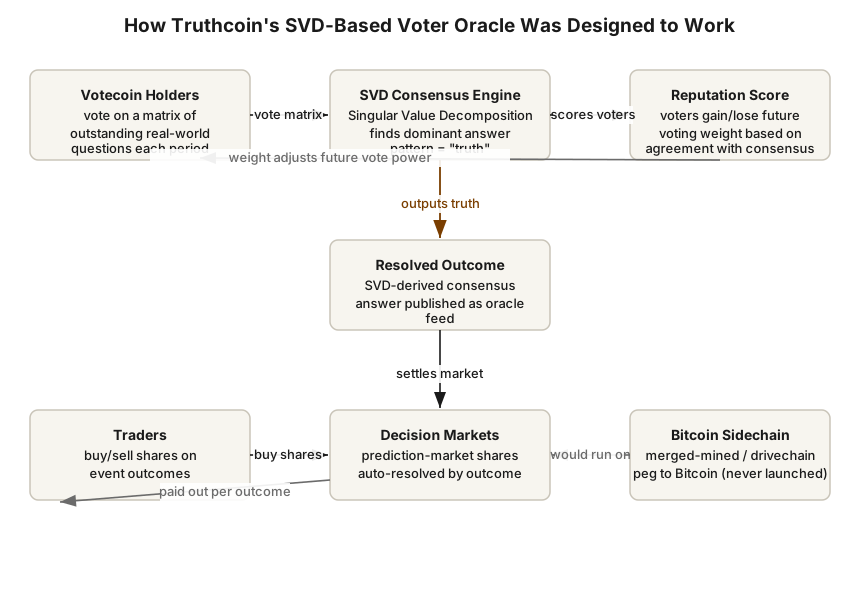
Truthcoin's core innovation was to make the oracle itself into a market-driven, self-policing crowd rather than a single trusted reporter. The system had two token types: Votecoin, held by "voters" whose job was to report on the true outcome of events, and Truthcoin/Reputation, used to price and trade the actual prediction-market shares (decision markets) referencing those outcomes.
Periodically, all Votecoin holders were required to vote on a standardized matrix of outstanding questions (a "voting period"). Because many questions were being answered simultaneously across many voters, Sztorc proposed using Singular Value Decomposition (SVD) — a linear-algebra technique — to analyze the resulting matrix of votes. SVD could identify the dominant, most common pattern of answers (interpreted as "the truth") and simultaneously score each voter by how closely they tracked that pattern. Voters who habitually voted with the emergent consensus gained reputation and future voting weight (and rewards); voters who deviated lost weight and could be effectively "fired" from the voter pool over time. This turned oracle-honesty into a repeated coordination game: since voters didn't know in advance who else would lie, the safest strategy for any self-interested, anonymous voter was to report honestly and vote with what they expected everyone else to report — "truth" became a Schelling point enforced by financial self-interest rather than trust in an institution.
On top of this oracle layer sat decision markets: ordinary prediction-market contracts (e.g., binary or scalar outcome shares) that traders could buy and sell, with markets automatically resolved by whatever the Votecoin oracle layer reported. The whole system was designed to run as a Bitcoin sidechain using merged mining / a drivechain-style two-way peg, so it could inherit Bitcoin's security and liquidity without requiring a new base-layer blockchain or altcoin bootstrap from scratch.
Outcome
Truthcoin/Hivemind was never launched as a production mainnet system. The whitepaper and subsequent research (published mostly across 2014-2015, with the Hivemind rename in September 2015) generated significant attention and endorsement within the Bitcoin community — Roger Ver called it "the most important invention since Bitcoin itself" (June 2015), and Bitcoin Core developer Peter Todd gave it a "low chance of success, but at least it's clever crazy rather than stupid crazy" (October 2015). Reference client software ("Hivemind Core") and testnet builds were released by the small development team over subsequent years and are still linked from bitcoinhivemind.com and the project's GitHub (github.com/bitcoin-hivemind, later github.com/LayerTwo-Labs/truthcoin-dc), but no live economic market or token ever launched at scale. Sztorc's energy shifted toward the more general-purpose "Drivechain" (BIP 300/301) sidechain proposal, which he has continued to promote as infrastructure that a future Truthcoin/Hivemind sidechain could eventually run on, through his company Layer Two Labs. As of the last verification date, Bitcoin has not activated drivechains via a soft fork, so Truthcoin/Hivemind remains dormant, unlaunched infrastructure rather than a running product.
Why it worked
- The theoretical design was influential and durable: the SVD-based "wisdom of the crowd" oracle mechanism is widely cited in later academic and industry work on decentralized oracles (e.g., Augur borrowed heavily from Truthcoin's reputation-voting oracle design for its own REP token).
- It correctly identified a real, unsolved problem (censorship-resistant, trustless resolution of real-world facts) years before "oracle" became a mainstream blockchain infrastructure category.
- It earned credibility and endorsement from serious Bitcoin-community technologists, which kept the idea alive in developer discourse for over a decade.
Where the design broke
- Truthcoin required a Bitcoin sidechain / drivechain mechanism that Bitcoin itself never adopted; without a soft fork enabling two-way pegged sidechains, there was no secure, decentralized way to actually deploy it against Bitcoin's base layer.
- The design was, and remains, extremely complex to implement correctly (SVD computation, incentive-compatibility proofs, sidechain federation/peg security), and was built by a very small, largely unfunded team rather than a well-resourced protocol company.
- Competing designs (Augur on Ethereum, later Polymarket, UMA's optimistic-oracle model) launched with working smart-contract platforms and captured the "decentralized prediction market" and "decentralized oracle" narratives that Truthcoin had pioneered conceptually.
Lessons
- A whitepaper's ideas can outlive the project that produced them: SVD-based crowd-consensus oracles and reputation-weighted voting became a design pattern reused (and shipped) by later projects like Augur, even though Truthcoin itself never launched.
- Depending on an unshipped piece of base-layer infrastructure (here, Bitcoin sidechains/drivechains) as a prerequisite is a major execution risk — a design can be theoretically sound yet permanently blocked by an external dependency outside the founder's control.
- Being early to identify a category (decentralized oracles, prediction-market resolution) is valuable for influence but not sufficient for adoption; execution speed and platform choice (e.g., launching on an already-programmable chain like Ethereum) mattered more for projects that actually shipped.
Redesign (EDITORIAL)
EDITORIAL — hypothesis, not fact. Had Sztorc targeted an already-live smart-contract platform (Ethereum, or even a simpler Bitcoin-adjacent chain with working smart contracts) instead of waiting on unshipped Bitcoin sidechain infrastructure, an early implementation of the SVD/Votecoin oracle mechanism might have captured the "decentralized oracle for prediction markets" niche before Augur formalized and shipped a similar design in 2018. A leaner MVP — perhaps limited to a small, curated set of high-value questions (e.g., major elections, sports outcomes) rather than an open general-purpose oracle from day one — could have built a track record of resolved markets and voter reputation, then expanded scope once the mechanism was battle-tested.
Sources
- Truthcoin: Peer-to-Peer Oracle System and Prediction Marketplace (whitepaper) — primary (primary)
- The Bitcoin Hivemind (official project site, archive of Truthcoin rename and history) — primary (primary)
- Truthcoin Renamed as Hivemind — primary (primary)
- The Truth Behind Truthcoin (news)
- Truthcoin's Paul Sztorc: 'Buying Predictions is Just like Buying Orange Juice' (news)
- From Reality Keys to Oraclize: A Deep Dive into the History of Bitcoin Oracles (academic)
Related experiments
Last verified: 2026-07-27 · Spot an error? Suggest a correction