Wombat Exchange
A BNB Chain-native 'stableswap 2.0' AMM that replaced Curve-style paired pools with single-sided deposits priced by an asset-liability coverage ratio, hit ~$215M TVL within months, spawned its own veToken 'WOM Wars' — then bled to near-irrelevance as stableswap volume consolidated elsewhere.
▶ Run interactive simulation animated mechanism with editable parameters
How it works onchain
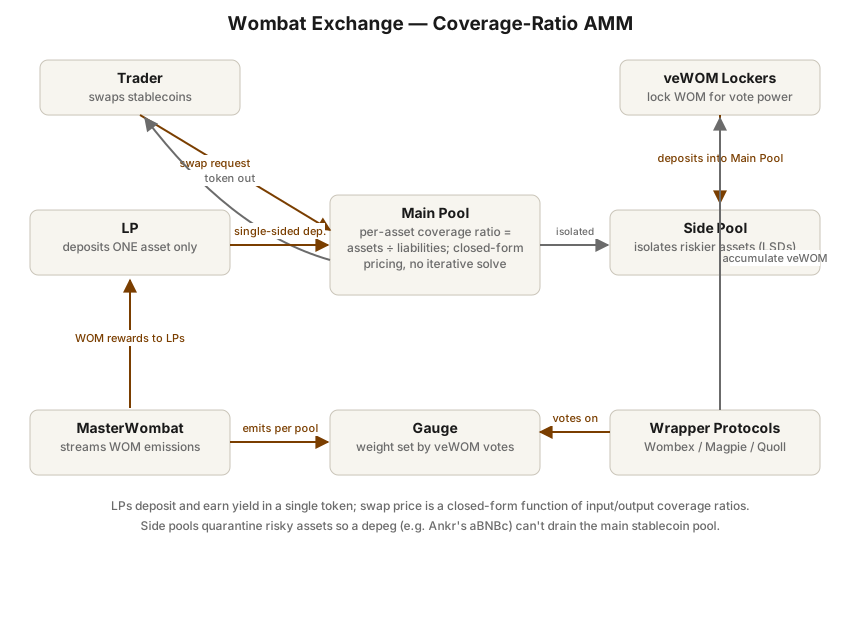 Open full-size diagram
Summary
Wombat Exchange is a stableswap AMM conceived in autumn 2021 by quant trader and blockchain engineer Alex Lee, incubated in Binance's MVB IV program (January 2022), and launched on BNB Chain mainnet on May 6, 2022 after a ~$5M raise from investors including Binance Labs, Animoca Brands, Jump Crypto, and Shima Capital. Its pitch was "stableswap 2.0": instead of Curve-style multi-asset pools where LPs hold a basket, Wombat let LPs deposit a single asset and priced swaps off each asset's coverage ratio (assets ÷ liabilities), a concept imported from bank asset-liability management (and pioneered onchain by Avalanche's Platypus Finance, of which Wombat is the best-known descendant). Launch demand was explosive — roughly $217M of deposits in the first 24 hours — and its WOM/veWOM gauge system spawned a miniature Curve-Wars ecosystem of wrapper protocols (Wombex, Magpie, Quoll). The mechanism worked as designed and the protocol still runs across ten chains, but TVL collapsed from a ~$215M peak (September 2022) to roughly $1.4M by mid-2026 as emissions dried up and stableswap flow consolidated into Curve, Uniswap V3-style concentrated liquidity, and intent-based fillers.
Design (Mechanism)
- Single-sided pools, shared invariant. Each token in a pool has its own asset and liability accounts. LPs deposit one token (e.g., only USDC) and accrue yield in that token, removing the basket exposure of Curve LP positions and the need to bootstrap both sides of a pair.
- Coverage-ratio pricing. Swap prices are a closed-form function of the coverage ratios of the input and output tokens rather than of pool balances. When a token's coverage ratio falls (more of it borrowed out of the pool than backed by deposits), swaps pushing it further get progressively worse pricing, and arbitrageurs are paid to restore equilibrium. Wombat's whitepaper claims a closed-form solution (no iterative solving) and lower slippage than Curve's invariant at comparable liquidity.
- Equilibrium coverage ratio / withdrawal design. The protocol tracks a global "equilibrium coverage ratio" as a system-health measure; deposits and withdrawals apply fees or gains depending on whether they move a token's coverage toward or away from equilibrium, discouraging bank-run dynamics.
- WOM / veWOM tokenomics. WOM emissions flow to LPs via MasterWombat; locking WOM mints veWOM (longer locks, more veWOM), which boosts LP rewards and, from January 2023, directed emissions through a voting gauge with an explicit bribe market — a deliberate replication of the Curve/Convex flywheel. Three Convex-style wrappers (Wombex, Magpie, Quoll) raced to accumulate veWOM ("WOM Wars"); by late 2022 Wombex held ~37% of locked veWOM, Magpie ~27%, Quoll ~17%.
- Side pools as risk isolation. Riskier assets (liquid-staked BNB variants, newer stables) were segregated into side pools so a depeg could not contaminate the main stablecoin pool.
Outcome
Commercially, Wombat had one of 2022's strongest launches ($217M TVL in a day; peak ~$215M in September 2022) and successfully exported its model to ten chains, starting with Arbitrum in March 2023. The core AMM was never exploited through its own code. Its worst incident was exogenous: the December 2022 Ankr aBNBc infinite-mint hack, in which the attacker dumped worthless aBNBc into Wombat's liquid-staking side pool, draining roughly $15M from Wombat LPs; Ankr (whose ex-employee caused the exploit) pledged compensation, and the side-pool design kept the main stablecoin pool unharmed. But the veWOM flywheel proved emissions-dependent: as WOM's price fell and emissions were deliberately cut in February 2024 (pivoting to "efficiency over TVL" for a planned Wombat 2.0), TVL slid continuously. By July 2026 DefiLlama shows ~$1.4M TVL across all chains — a >99% drawdown — with the wrapper protocols (Wombex ~$0.4M) similarly hollowed out. The protocol remains live and maintained (ongoing operationally), but as a mechanism-design business it is best classified as technically successful, commercially unsuccessful.
Why it worked
- Real UX and capital-efficiency innovation. Single-sided deposits with no impermanent-loss basket exposure genuinely lowered the cognitive and capital cost of LPing stables, and the closed-form coverage-ratio math delivered competitive slippage.
- Risk compartmentalization proved itself. The side-pool architecture contained the aBNBc collapse to one pool — a rare example of a depeg firewall working exactly as designed.
- Ecosystem timing and backing. Binance MVB incubation, Binance Labs investment, and a BNB Chain starved for a native Curve equivalent gave Wombat instant distribution; the deliberately seeded veWOM wrapper war concentrated attention and lockup demand in its first year.
Where the design broke
- The flywheel was rented, not owned. TVL was overwhelmingly emissions-mercenary; when WOM emissions were cut, liquidity left rather than staying for organic fees, revealing that swap-fee revenue never covered the yield LPs were being paid.
- Platypus-lineage designs lost the meta. Coverage-ratio AMMs (Platypus itself was exploited and faded) competed against concentrated liquidity, solver/intent routing, and Curve's entrenched network effects; Wombat's slippage edge mattered less once aggregators routed most stable flow.
- veToken wars at small scale fragment rather than compound. Three wrappers splitting a mid-cap protocol's governance diluted each other, and bribe yields collapsed with token prices — the Curve playbook did not survive miniaturization through a bear market.
Lessons
- Single-sided liquidity and asset-liability accounting are a real design contribution — the coverage ratio is a cleaner solvency signal than pool imbalance, and it has been absorbed into later AMM and bridge-liquidity designs.
- Risk isolation (side pools) should be treated as first-class mechanism design: Wombat's $15M loss was painful but bounded because contagion paths were pre-cut.
- A veToken/bribe flywheel replicated at sub-Curve scale mostly imports Curve's fragility (emissions dependence) without its moat (deep integrations and organic fee volume).
- Day-one TVL is a marketing metric, not a viability metric: $217M in 24 hours and >99% drawdown within two years can describe the same protocol.
- Exogenous asset risk (a partner token's mint bug) can be the largest loss vector for an AMM whose own code is sound — asset onboarding is security-critical.
Redesign (EDITORIAL — hypothesis, not fact)
This section is editorial hypothesis, not fact. A redesigned Wombat would keep the coverage-ratio core but abandon the emissions flywheel: cap WOM emissions to a fixed fraction of trailing realized swap fees per pool, so LP yield can never structurally exceed organic revenue and TVL right-sizes automatically. Side pools would gain per-asset circuit breakers — an oracle-checked mint-rate/velocity limit that pauses a single asset's swaps when inflows deviate wildly from historical norms — which would likely have throttled the aBNBc dump. Rather than courting three competing wrappers, the protocol could ship a native, non-transferable boost (Curve's mistake pre-Convex was making boost delegable) to prevent meta-governance fragmentation. Finally, the coverage-ratio engine is arguably more valuable as an embedded liquidity layer (bridge pools, LST/stable routing for intent solvers, B2B integrations) than as a destination DEX; licensing the invariant to fillers and chains-native routers would monetize the math where the flow actually lives.
Sources
- Wombat Exchange documentation (mechanism, tokenomics, team, contracts) — primary (docs)
- BNB Chain contract addresses — Wombat docs — primary (contract)
- Official links — Wombat docs — primary (docs)
- My Journey From Web2 to Web3: Alex Lee, Founder of Wombat Exchange — primary (retrospective)
- Wombat: What is Stableswap 2.0? — BNB Chain Blog (analysis)
- Wombat Exchange Dominates Stableswap Market With $217M TVL in 24 Hours (news)
- The Rise of WOM Wars (Wombat guest post) — primary (analysis)
- Ankr Pledges $3M More to Wombat Exchange Victims of $15M Attack (news)
- DefiLlama — Wombat Exchange TVL (API: peak ~$215M Sep 2022; ~$1.4M Jul 2026) (analysis)
Related experiments
Last verified: 2026-07-26 · Spot an error? Suggest a correction