The LAO
A Delaware LLC wrapped around Moloch v2 smart contracts that rebooted The DAO's venture-fund idea in a US-securities-law-compliant form, becoming the template for legally wrapped investment DAOs.
▶ Run interactive simulation animated mechanism with editable parameters
How it works onchain
 Open full-size diagram
Summary
The LAO ("Limited Liability Autonomous Organization") was the first serious attempt to resurrect The DAO of 2016 — a member-directed, on-chain venture fund — in a form that complied with US law. Announced by smart-contract company OpenLaw in September 2019 and launched on April 28, 2020, it paired a Delaware limited liability company (whose operating agreement delegated core decision-making to smart contracts and waived certain fiduciary duties) with the battle-tested Moloch v2 contract framework on Ethereum. Membership was restricted to accredited investors and capped at roughly 100 members, who bought voting units in ETH and collectively approved seed investments in Ethereum-based startups via on-chain proposals. Any dissenting member could "ragequit" and withdraw their pro-rata share of undeployed capital at any time. The LAO went on to deploy well over 18,000 ETH into dozens of crypto startups, incubated an ecosystem of sibling DAOs (most famously Flamingo DAO for NFTs and Neptune DAO for liquidity provisioning), and its LLC-wrapper design became the de facto legal template for investment DAOs. OpenLaw itself rebranded as Tribute Labs in September 2021 to focus entirely on building and supporting such DAOs.
Design (Mechanism)
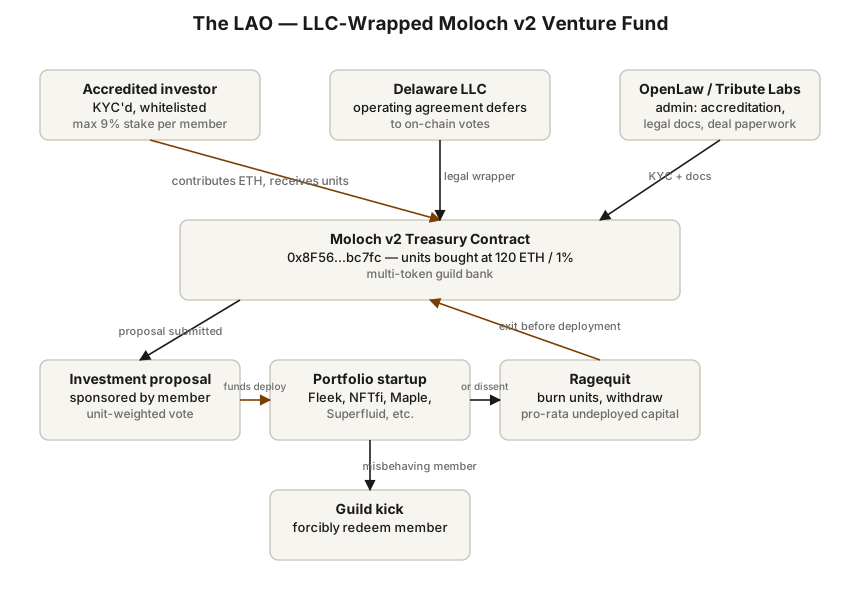
Legal wrapper. The LAO is a Delaware LLC. Its operating agreement (generated and managed via OpenLaw's legal-agreement tooling) states that governance is executed by the smart contracts: on-chain votes are the legally binding decisions of the company. Members receive limited liability and pass-through tax treatment; the fund relied on securities-law exemptions by admitting only accredited investors, keeping membership capped (reported around 99–100 slots, with roughly 75 active members in early accounts), and running KYC/accreditation checks off-chain before whitelisting addresses.
Capital formation. Membership interests were sold first-come-first-served in 1% blocks priced at 120 ETH each, with a 9% maximum stake per member — a deliberate anti-plutocracy cap so no single member could dominate voting.
On-chain mechanics (Moloch v2). The treasury contract (0x8F56682a…bc7fc, deployed April 27, 2020) is a customized Moloch v2 instance:
- Proposals & sponsorship: members sponsor funding proposals (typically seed investments via token purchase agreements or convertible instruments negotiated off-chain, executed on-chain).
- Voting: unit-weighted majority voting during a fixed voting period, followed by a grace period.
- Ragequit: during the grace period, members who voted against (or abstained from) a passing proposal may burn their units and withdraw their proportional share of the guild bank before funds are deployed — a continuous minority-protection/exit right that substitutes for fiduciary litigation.
- Guild kick: members can vote to forcibly redeem a misbehaving member.
- Moloch v2 additions over v1 included multi-token guild-bank support and "loot" (non-voting) shares; ConsenSys Diligence audited the code for The LAO (published January–March 2020), leading to a pull-payment withdrawal pattern, hard caps on whitelisted tokens (400) and guild-bank tokens (200) to prevent gas-griefing lockouts, and overflow handling for hyperinflationary tokens.
Service provider. OpenLaw (later Tribute Labs) acted as administrator — handling accreditation, legal docs, and deal paperwork — rather than as a discretionary fund manager; investment discretion stayed with members.
Outcome
The LAO filled quickly at launch in April 2020 and became the flagship venture DAO of the 2020–2021 cycle. Aggregator and press accounts credit it with contributing more than 18,000 ETH across investments in projects such as Fleek, NFTfi, EPNS/Push, Maple, Boardroom, Superfluid, and many others; PitchBook lists over 150 investments, and it was still writing checks in 2023–2024 (e.g., Superfluid's $5.1M round in December 2023, NFTfi's $6M round in March 2024). Just as importantly, it became an incubator: Flamingo DAO (NFT collecting, ~6,000 ETH raised in 2020), Neptune DAO (DeFi liquidity), and a family of other Tribute-Labs-supported DAOs reused the same LLC + Moloch pattern, with Tribute Labs reporting over $200M coordinated across its DAO network. The "LAO model" — a capped-membership LLC with on-chain voting and ragequit — heavily influenced subsequent industry practice and legal thinking around DAO entity wrappers (including the Wyoming DAO LLC debate) and remains the standard template for member-directed investment DAOs. Exact fund-level returns are not public (Unknown / not found).
Why it worked
- Legal realism instead of legal denial. The DAO (2016) failed partly because it ignored securities law; The LAO's founders (a law professor and an engineer) inverted that, using exemptions that already existed (accredited-investor private funds, sub-100-member caps) so regulators had nothing novel to attack.
- Minimal, audited, battle-tested contracts. Choosing Moloch v2 — small enough to audit thoroughly — rather than a bespoke framework avoided The DAO's fatal-bug failure mode.
- Ragequit as fiduciary substitute. Continuous pro-rata exit made majority tyranny and misappropriation structurally difficult, letting the LLC waive traditional fiduciary duties without leaving members unprotected.
- Anti-whale caps + curated membership produced a genuinely deliberative investor community whose deal flow and diligence became its moat, and which was cohesive enough to spawn spin-off DAOs.
- Timing: launching months before DeFi summer gave members cheap entry into a historic vintage of Ethereum startups.
Limitations and criticisms
The LAO's design carries real limits alongside its success. Accreditation gating and the ~100-member cap meant it was "permissionless Silicon Valley" in branding only — legally it was a private club of wealthy investors, a departure from The DAO's retail-inclusive ambition. Unit-weighted voting over every deal does not scale cleanly; in practice deal work concentrated in a small active subset, and the model caps fund size well below traditional VC. Off-chain paperwork (subscription docs, SAFTs, KYC) remained heavy, with OpenLaw/Tribute Labs as a central administrative dependency — a soft single point of failure for an otherwise decentralized structure. Fund-level performance was never published, so its track record is measured in deal volume and influence rather than audited returns.
Lessons
- Wrap the DAO in an entity that already fits existing law. The LAO showed that most of "DAO legality" is solved by mapping on-chain governance onto a familiar vehicle (Delaware LLC + private-fund exemptions) rather than waiting for new legislation.
- Exit rights can replace trust. Ragequit — guaranteed pro-rata withdrawal before capital deploys — is one of the most powerful minority protections in mechanism design, and it made duty-waiving governance palatable to sophisticated investors.
- Small, audited codebases beat feature-rich ones for treasuries. The Moloch lineage's minimalism, plus a pre-launch ConsenSys Diligence audit, is a direct anti-pattern response to The DAO hack.
- Caps that satisfy regulators also shape culture. The 100-member ceiling and 9% ownership cap simultaneously preserved a securities exemption and prevented plutocratic capture — legal constraints can double as governance design.
- A successful DAO is a factory. The LAO's most durable output was not any single investment but the replicable template (Flamingo, Neptune, the Tribute ecosystem) it spawned.
Redesign (EDITORIAL — hypothesis, not fact)
This section is editorial speculation, not a description of actual plans. A modern LAO could keep the LLC + ragequit core but reduce its two main frictions. First, replace all-member per-deal voting with elected, term-limited investment committees whose deals are subject to an objection window plus ragequit — preserving exit-based accountability while cutting voter fatigue and allowing more members. Second, modularize the legal wrapper: series-LLC or Wyoming DAO LLC cells per investment sleeve would let sub-groups (NFTs, DeFi, infra) form without full spin-offs. Third, publish standardized, privacy-preserving performance reporting (e.g., attested NAV oracles) so the ecosystem can compare venture DAOs on returns rather than vibes. Finally, a parallel non-security sleeve (grants or retro-funding of public goods, open to non-accredited participants) could recover some of The DAO's original inclusive spirit without contaminating the regulated fund.
Sources
- The LAO official site — primary (docs)
- Building a Permissionless Silicon Valley: The LAO Launches on April 28 (official Medium) — primary (docs)
- Moloch v2 Smart Contract Audit Report for The LAO (official Medium / ConsenSys Diligence) — primary (audit)
- The LAO: Treasury contract (Moloch v2) on Etherscan — primary (contract)
- openlawteam/TheLAO GitHub repository — primary (contract)
- OpenLaw Launches First 'Legal DAO' for Distributed VC Investments (CoinDesk) (news)
- Ethereum Startup OpenLaw Rebrands, Aims to Be a DAO Incubator (Decrypt) (news)
- The LAO, demystified (Preston Byrne legal analysis) (analysis)
- Flamingo DAO: An NFT Collective (official Medium) — primary (docs)
- Neptune DAO: A DAO for Liquidity (official Medium) — primary (docs)
Related experiments
Last verified: 2026-07-27 · Spot an error? Suggest a correction