MetaCartel Ventures
The first for-profit investment DAO on Ethereum — a Moloch v2 smart contract wrapped in a Delaware LLC ('Grimoire') that let ~80 members run a community venture fund with ragequit-protected exits.
▶ Run interactive simulation animated mechanism with editable parameters
How it works onchain
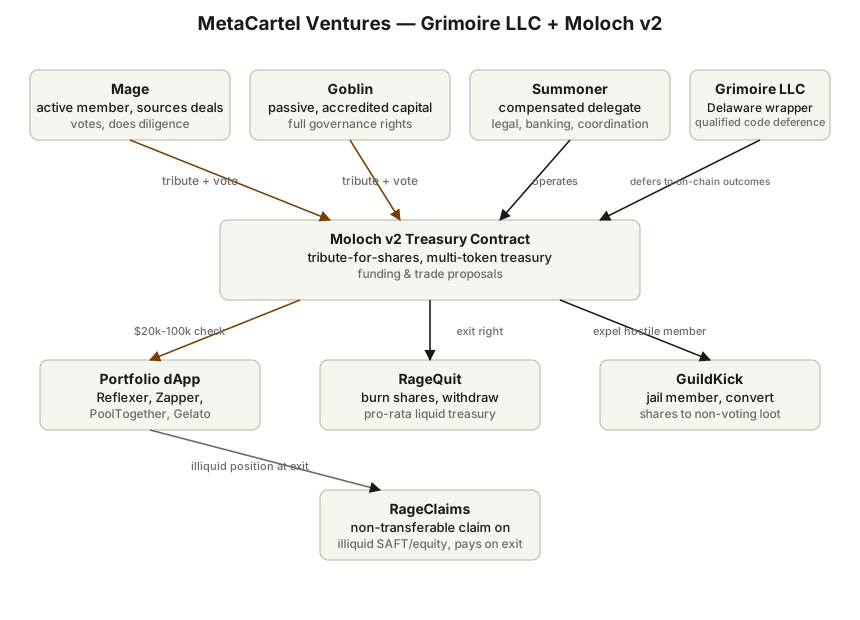 Open full-size diagram
Summary
MetaCartel Ventures (MCV, "Venture DAO") was the first for-profit investment DAO launched on Ethereum and the first production deployment of the Moloch v2 smart contract standard. It grew out of MetaCartel, a grants DAO community formed in 2018–2019 around Ethereum application-layer experiments. The whitepaper — authored by Peter "pet3rpan" Pan, attorney Gabriel Shapiro, and Ameen Soleimani — was published in December 2019, and the DAO went live at ETHDenver in February 2020. MCV's core innovation was not a new financial product but a new legal-technical composite: a member-managed Delaware LLC whose operating agreement (playfully named the "Grimoire") was drafted to defer to the outcomes of an on-chain Moloch v2 contract. It raised $5M+ and grew to roughly $10.5M AUM with 80+ members by the end of 2020, writing $20k–$100k first checks into early-stage dApps.
Design (Mechanism)
Moloch v2 core. MCV runs on Moloch v2, which extended the original grants-only Moloch design with multi-token treasuries, tribute-for-shares membership, and funding/trade proposals (eight proposal types total). The two signature mechanisms are:
- RageQuit — any member can permissionlessly burn shares at any time and withdraw a pro-rata slice of the treasury. This converts governance from "protect the minority with vetoes" into "let the minority exit instantly," collapsing most minority-oppression risk.
- GuildKick — members can propose to expel another member, who is "jailed" (converted to non-voting loot) and forced to ragequit, providing a remedy against inactive or hostile members.
- Jailing / SafeRageQuit refinements — members who voted "yes" on a pending proposal cannot exit until it processes (prevents vote-then-flee), and exits can skip broken/blacklisting tokens.
Membership classes. The Grimoire defines three roles: Mages (active members expected to source deals, do diligence, and vote; the class open to non-accredited but genuinely active participants), Goblins (passive capital, restricted to accredited investors, full governance rights but no participation duty), and Summoners (compensated operational delegates handling legal, banking, and coordination).
Code-law pairing ("qualified code deference"). Rather than claiming "code is law," Shapiro's legal architecture makes the Delaware LLC's operating agreement contractually bind members to treat smart-contract outcomes as authoritative in defined circumstances, while preserving off-chain legal recourse for fraud or bugs. Fiduciary duties among members are largely waived on the theory that free instant exit (ragequit) is a stronger minority protection than lawsuits. The fund is taxed as a partnership (K-1s), and membership interests are handled under Rule 506(c) accredited-investor exemptions until AUM thresholds are met.
Illiquid assets. Because venture positions (SAFTs, equity) cannot be ragequit like ETH or DAI, the design distinguishes RageTokens (liquid treasury assets withdrawable on exit) from RageClaims (non-transferable pro-rata claims on illiquid positions that pay out when those positions liquidate).
Outcome
MCV launched at ETHDenver in February 2020 and, per pet3rpan's 2020 recap, raised $5M+, reached $10.5M+ AUM, and grew past 80 members within its first year, completing 20+ investments — including Reflexer, Zapper, Pocket Network, PoolTogether, DAOhaus, Gelato, NIFTEX, EPNS, and several former MetaCartel grantees. Third-party fund trackers record continued activity years later (an investment in Streamflow in October 2024 and a portfolio exit, 3Box Labs, in February 2025), indicating the DAO remained a live, if quieter, vehicle rather than winding down. No exploit or governance failure has been reported. Comprehensive audited return figures were never published, so fund-level performance is Unknown / not found. Its clearest measurable impact is as a template: The LAO, Flamingo DAO, MetaCartel Ventures China, and the broader "venture DAO" category all trace directly to the MCV code-law blueprint, and Moloch v2 became DAOhaus's standard.
Why it worked
- Ragequit changed the trust math. Members could commit capital to a pseudonymous-friendly collective knowing they could exit to pro-rata treasury value in minutes, which made a member-managed fund of ~80 strangers viable without a GP's fiduciary lock-up.
- The legal wrapper was real, not decorative. A Delaware LLC with a carefully drafted operating agreement gave members limited liability, partnership tax treatment, and enforceable rights — solving the "unincorporated general partnership" nightmare that haunted earlier DAOs like The DAO.
- It launched into a community, not a market. MCV recruited from MetaCartel's existing grants network, so deal flow, diligence capacity, and social trust pre-existed the fund; five early investments were former grantees.
- Timing: deploying in February 2020 positioned the fund directly in front of DeFi summer and the 2020–2021 bull market.
Why it failed or underperformed
- Active-membership economics don't scale. The Mage model assumes sustained volunteer diligence from dozens of members; as the novelty faded, activity concentrated in a small core — the classic DAO participation decay — and the accredited-investor requirement for passive Goblins capped the fundraising pool.
- Illiquid-asset handling stayed clunky. RageClaims were a patch, not a solution: ragequitting members still bore trust and timing risk on SAFT/equity positions, weakening the design's central exit guarantee exactly where most of the fund's value sat.
- Transparency asymmetry. For a project premised on on-chain accountability, no public fund-level performance reporting exists, making it impossible for outsiders (or the ecosystem copying it) to evaluate whether member-managed venture actually beats a traditional GP/LP fund.
- The model was outcompeted by its own children. Syndicate-style tooling, The LAO/Flamingo, and eventually conventional crypto VC (including 1kx, where pet3rpan went) absorbed the deal flow; MCV proved the category then receded within it.
Lessons
- Exit rights are a governance primitive. RageQuit substitutes cheap, instant exit for expensive voice-based minority protections, and this single mechanism is what made a fiduciary-duty-waived, member-managed fund legally and socially plausible.
- Wrap the DAO before it holds money. MCV's "qualified code deference" — an LLC agreement that defers to chain state without pretending code is law — became the reference pattern precisely because it accepted that courts exist.
- Distinguish liquid from illiquid claims at the mechanism level. Any tokenized fund must design exit paths for assets that cannot be split on-chain; bolting this on (RageClaims) is the weakest part of an otherwise clean design.
- Community-first fundraising beats capital-first. Sourcing members from an existing grants DAO produced diligence labor and deal flow that pure capital pools lack — but expect active participation to decay and design compensation (Summoner fees, carry) accordingly.
Redesign (EDITORIAL — hypothesis, not fact)
This section is editorial speculation. A modern MCV would keep the LLC + qualified-code-deference wrapper but replace uniform Mage obligations with staked, compensated roles: deal scouts and diligence leads earn carry-weighted shares per accepted contribution, tracked on-chain, so participation decay is priced rather than assumed away. Illiquid positions would sit in a tokenized SPV per deal, letting ragequitting members receive transferable (restricted) SPV interests instead of trust-based RageClaims. Quarterly on-chain NAV attestations by a third party would fix the transparency gap. Finally, a sunset clause — automatic wind-down vote every four years — would force the "are we still a fund?" question that long-lived DAOs otherwise never ask.
Sources
- MCV Whitepaper (v1.0, December 2019) — primary (docs)
- MetaCartel Ventures — About (official site) — primary (docs)
- metacartel/MCV GitHub repo (whitepaper + Grimoire legal docs) — primary (docs)
- pet3rpan whitepaper announcement tweet (Dec 2019) — primary (archive)
- MetaCartel 2020 Recap — Peter 'pet3rpan' (Medium) — primary (retrospective)
- Investment Sorcery: MetaCartel Launches DAO Venture Fund — Crypto Briefing (news)
- MetaCartel Ventures: Double Helix of Code and Law or Faustian Bargain? — Otonomos (analysis)
- MetaCartel (Ventures) — Peer Production on the Crypto Commons (analysis)
- MetaCartel Ventures — CryptoRank fund profile (activity through 2024) (analysis)
Related experiments
Last verified: 2026-07-27 · Spot an error? Suggest a correction