Molecule
DeSci protocol that wraps biopharma intellectual-property rights in NFTs (IP-NFTs) so DAOs and communities can collectively fund, own, and govern early-stage research.
▶ Run interactive simulation animated mechanism with editable parameters
How it works onchain
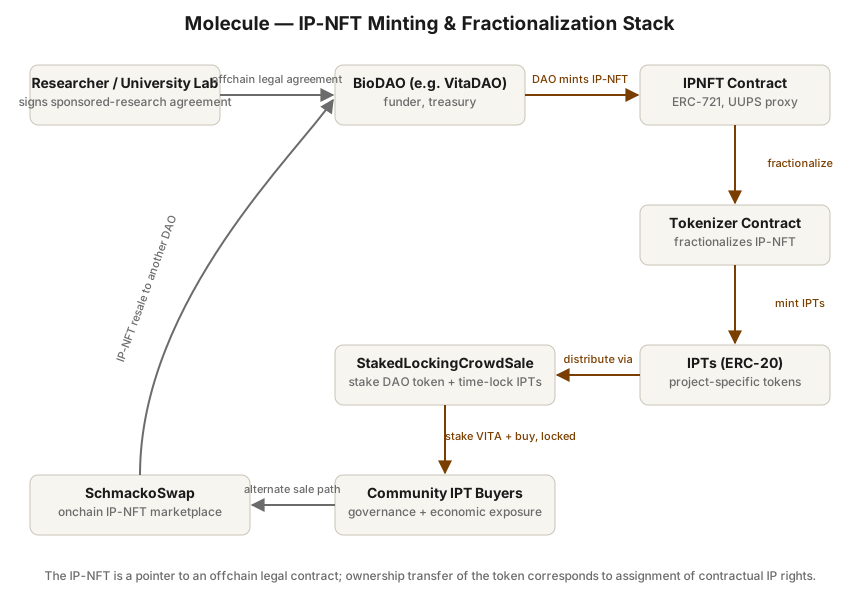 Open full-size diagram
Summary
Molecule (Molecule AG / "Molecule Labs") is the canonical decentralized-science (DeSci) infrastructure project, founded by Paul Kohlhaas and Tyler Golato (company origins circa 2018–2020; sources differ on the exact founding year). Its core invention is the IP-NFT: a legal framework plus ERC-721 token that wraps intellectual-property rights and licensing agreements for early-stage biopharma research, making research IP an ownable, transferable, fundable onchain asset. On August 18, 2021, Molecule executed the first-ever biopharma IP-to-NFT transfer, with longevity DAO VitaDAO acquiring rights to research from the Scheibye-Knudsen Lab at the University of Copenhagen. Molecule helped bootstrap VitaDAO (the first "BioDAO") and subsequently a family of BioDAOs (AthenaDAO, HairDAO, PsyDAO, ValleyDAO, Cerebrum DAO, and others), raised a ~$13M seed in June 2022 led by Northpond Ventures, and later spawned pump.science (Solana, crowd-funded organism experiments) and BIO Protocol (a financial layer for BioDAOs, which received Binance Labs' first DeSci investment in November 2024). The experiment is still live and evolving.
Design (Mechanism)
- IP-NFT (legal + technical stack). A research agreement (sponsored-research or licensing contract between a researcher/institution and a funder) is signed offchain; the ERC-721 token then represents controlling rights to that agreement, with document access gated to the tokenholder. Ownership transfers of the NFT correspond to assignment of contractual rights. V1 (2021) used ad-hoc legal wrappers (with Nevermined for the first transfer); IP-NFT V2 consolidated the legal-wrapper design and minting flow into Molecule's own contracts. Mainnet contracts (UUPS proxies, per the official repo): IPNFT
0xcaD88677CA87a7815728C72D74B4ff4982d54Fc1, Tokenizer0x58EB89C69CB389DBef0c130C6296ee271b82f436. - IPTs (IP Tokens). The Tokenizer contract fractionalizes an IP-NFT into fungible ERC-20 "IPTs," which grant governance/economic exposure to a specific research project. Distribution occurs through crowdsale contracts, including a StakedLockingCrowdSale that requires staking DAO tokens (e.g., VITA) and time-locks purchased IPTs — a mechanism designed to align buyers with the DAO community rather than pure speculation. A minimal onchain marketplace (SchmackoSwap) supports IP-NFT sales.
- BioDAO model. Molecule incubates disease- or field-specific DAOs that raise a treasury (VitaDAO's June 2021 Gnosis batch auction raised ~$5M), source proposals from academic labs, vote to fund them, and take IP rights via IP-NFTs — effectively a decentralized, community-governed translational-research fund in which researchers keep their university posts while the DAO holds and commercializes the IP (versus traditional biotech VC, which Kohlhaas notes often takes 60–70% of equity).
- Ecosystem layer. pump.science (with BIO Protocol, on Solana) extends the model to memecoin-style crowdfunding of live model-organism experiments; BIO Protocol acts as a launch/liquidity layer for BioDAO tokens.
Outcome
Ongoing. Verified milestones: first biopharma IP-NFT transfer (VitaDAO/University of Copenhagen, August 2021); $13M seed round (June 2022, Northpond Ventures, with Backed VC, Speedinvest, Shine Capital and others); dozens of research projects funded across the BioDAO network (Gate Learn cites 35+ projects; treat as secondary-source figure); notable funded work includes longevity research at the University of Rochester (VitaDAO) and Alzheimer's antibody research at Tel Aviv University. VitaDAO itself later attracted Pfizer Ventures participation in its ecosystem. By 2024–2025 the center of gravity shifted toward the spin-out layer: BIO Protocol facilitated 8 BioDAOs raising ~$30.3M collectively ($7.2M deployed into science as of early 2025), and pump.science popularized retail-scale experiment funding. No protocol exploit or collapse is on record ("Unknown / not found" for any security incident). The honest caveat: no IP-NFT-funded therapy has yet reached late-stage clinical validation, and secondary-market liquidity for IP-NFTs/IPTs remains thin.
Why it worked
- Legal-first engineering. Molecule solved the actual bottleneck — enforceable assignment of IP/licensing rights — and only then tokenized it. The NFT is a pointer to a real contract, not a vibes-based claim, which made universities and labs willing to transact.
- A real, underserved market. Early-stage "valley of death" translational research is systematically underfunded by both grants and VC; mission-driven crypto communities (longevity especially) had capital and motivation.
- Community-alignment mechanisms. Staked/locked crowdsales for IPTs tied speculation to DAO membership and time commitment rather than instant flipping.
- Ecosystem flywheel. Incubating VitaDAO first gave Molecule a flagship user and proof-of-concept before generalizing the stack to many BioDAOs.
Limitations and criticisms
- Liquidity and price discovery have not materialized at scale. Research IP is illiquid, hard to value, and slow; IP-NFTs mostly trade never or once, so the "marketplace for biopharma IP" vision remains largely aspirational rather than a functioning secondary market.
- Time-constant mismatch. Drug development runs on 10–15-year horizons; crypto communities' attention and treasuries (often denominated in volatile tokens) run on 1–2-year cycles. Bear markets shrank BioDAO treasuries raised in 2021, straining the funding pipeline.
- Regulatory and enforceability overhang. Fractionalized IPTs sit close to securities territory, and enforcement of tokenholder rights still ultimately routes through traditional courts and legal wrappers — the chain adds transferability, not enforcement.
- Outcome lag. Without a headline therapeutic success or exit distributing returns to tokenholders, the economic loop (fund → develop → license/exit → recycle) remains unproven end-to-end, even as the infrastructure itself continues to operate.
Lessons
- Tokenizing a real-world asset means tokenizing a contract. The IP-NFT's durability comes from the offchain legal agreement it wraps; any RWA design that skips the legal layer is decorative.
- Incubate your first power user. Building VitaDAO before generalizing the protocol gave Molecule a live demonstration that recruited every subsequent BioDAO.
- Match funding instruments to asset time horizons. Long-duration science funded by short-attention capital creates a structural mismatch; lockups and staking help but don't fully solve it.
- Fractionalization needs alignment filters. Staked, time-locked crowdsales are a reusable pattern for keeping fractional owners of long-duration assets aligned with governance rather than speculation.
- When the core asset is illiquid, monetize the funnel. Molecule's drift toward launch/liquidity layers (BIO Protocol, pump.science) shows the sustainable business may be the capital-formation rails, not the IP marketplace itself.
Redesign (EDITORIAL — hypothesis, not fact)
This section is editorial hypothesis, not a factual account. A redesigned Molecule might: (1) build a standing milestone-tranched escrow into the IP-NFT itself, releasing crowdsale proceeds against attested lab milestones (via designated verifier oracles) to reduce the trust gap between funders and labs; (2) create a portfolio token across many IP-NFTs (an index of BioDAO IP) rather than pushing per-project IPTs, since diversification is the only honest answer to single-asset drug-development risk and would concentrate liquidity in one instrument; (3) formalize a royalty-routing standard so that any future licensing revenue flows onchain automatically to IPT holders, making the economic loop legible before the first big exit; and (4) pre-negotiate template agreements with a consortium of university tech-transfer offices, turning each IP-NFT mint from a bespoke legal negotiation into a standardized instrument — the biggest cost in the current design. The main risk of this redesign is that index tokens and royalty routing sharpen the securities-law profile, so it likely requires an explicit regulated wrapper in at least one jurisdiction.
Sources
- moleculeprotocol/IPNFT (official contracts repo with mainnet addresses) — primary (contract)
- Molecule official site — primary (docs)
- Molecule documentation — primary (docs)
- IP-NFTs for Researchers: A New Biomedical Funding Paradigm (Tyler Golato) — primary (docs)
- Molecule Partners With VitaDAO and Nevermined Creating First Ever Biopharma IP-to-NFT Transfer (PR, Aug 2021) — primary (news)
- Introducing the IP-NFT V2 (Molecule blog) — primary (docs)
- IP-NFTs: Everything you need to know as a developer (Stefan Adolf, Molecule) — primary (docs)
- Decentralized science platform Molecule raises $13 million in seed funding (The Block) (news)
- How Molecule is accelerating medical research through tokenised IP (Tech.eu, Jan 2025) (news)
- Accelerating DeSci on Solana: Molecule, pump.science & BIO Protocol Team Up — primary (docs)
- A Comprehensive Overview of Molecule (Gate Learn) (analysis)
Related experiments
Last verified: 2026-07-26 · Spot an error? Suggest a correction