WeTrust Lending Circles
An Ethereum smart-contract platform that digitized ROSCAs (rotating savings and credit associations), letting trusted groups pool and rotate funds without a central administrator.
▶ Run interactive simulation animated mechanism with editable parameters
How it works onchain
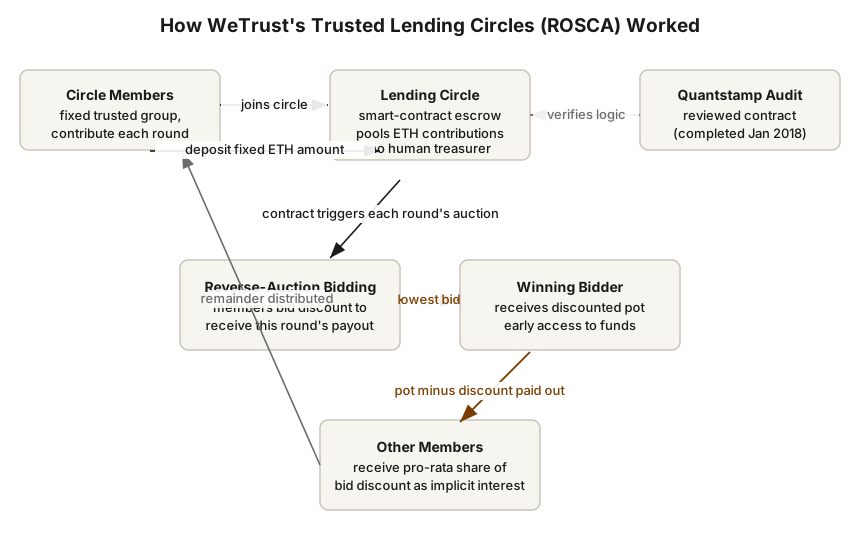 Open full-size diagram
Summary
WeTrust was a San Francisco-founded startup that set out to put ROSCAs — the informal rotating savings clubs used by hundreds of millions of people worldwide (susu, tandas, chit funds, hui) — onto the Ethereum blockchain. Its flagship product, Trusted Lending Circles, let a group of people who already knew and trusted each other commit to contributing a fixed amount at regular intervals into a shared pool, with the pooled funds rotating to a different member each round via smart contract instead of a human treasurer. The team, reportedly George Li and Patrick Long, shipped a working MVP in February 2017 and funded ongoing development with a TRST token crowdsale in March–April 2017 that raised over $4.6 million.
Design (Mechanism)
Trusted Lending Circles replicated the classic ROSCA structure on-chain: a fixed group of participants agrees to contribute a set amount of ETH (or another supported asset) at regular intervals. Each round, the pooled contribution is disbursed to one member, determined through a reverse-auction bidding process — members who are willing to accept a discounted payout (effectively paying implicit interest to the rest of the group for early access to the pot) bid the lowest amount, and the difference between the full pot and the winning bid is distributed pro-rata back to the other members as a return. This turns the circle into both a savings vehicle and a short-term credit market simultaneously, with the "interest rate" set by group demand each round rather than a lender. All contribution, bidding, and payout logic ran through Ethereum smart contracts, which WeTrust argued removed the need for a trusted administrator (historically the weak point of informal ROSCAs, which are vulnerable to absconding organizers) while preserving the social-trust selection of the group itself. Quantstamp audited the Trusted Lending Circles contracts, completing its review on January 31, 2018, and WeTrust's CEO stated at the time that the product met the security bar needed to build further decentralized financial services (savings, lending, insurance) on top of it.
Outcome
WeTrust delivered a real, audited, deployed product on Ethereum mainnet — an unusually complete outcome for a 2017-era ICO project. However, the platform never achieved meaningful adoption beyond an early enthusiast community. Development activity slowed markedly after 2018, and the company's broader roadmap (decentralized insurance, expanded lending products) was not built out. The TRST token was progressively delisted from major centralized exchanges (Binance, Coinbase Pro, Kraken among them) and now trades, where it trades at all, at a small fraction of a cent with negligible liquidity. Secondary sources describe the project as "effectively dormant" by the mid-2020s, with occasional code activity but no active user base or business operations. No formal shutdown announcement, hack, or regulatory action was found in this research pass — the project appears to have quietly wound down rather than failed catastrophically.
Why it worked
- The underlying real-world mechanism (ROSCAs) is genuinely popular and has proven demand across many cultures, so the product concept was not speculative — it digitized something that already worked socially.
- The team shipped and audited a live, functioning smart-contract product rather than staying at the whitepaper stage, which was relatively rare among 2017 ICOs.
- Automating payout and bidding logic in a smart contract directly targeted the real failure mode of informal ROSCAs (an organizer running off with the pot), which is a credible value proposition.
Where the design broke
- Ethereum gas costs and UX friction in 2017–2018 made small, frequent-interval contributions (the essence of a ROSCA, often small weekly/monthly sums) impractical for the low-income, unbanked populations WeTrust said it wanted to serve.
- ROSCA trust circles are inherently local and social; there was no clear mechanism for WeTrust to actually recruit or onboard the offline communities that use these instruments, so usage stayed within the existing crypto-native audience rather than expanding to underbanked users.
- The TRST token's main utility was loosely tied to platform fees/governance rather than being essential to using Lending Circles, weakening the economic case for the token and for continued ecosystem investment once crypto markets turned down in 2018.
- Continued development depended on proceeds from a speculative token sale rather than product revenue; once crypto markets turned down post-2018 and TRST's dollar value collapsed, the funding available for growth and business-development work (partnerships, community organizing, compliance) that a real-world financial-inclusion product requires shrank correspondingly.
Lessons
- A technically sound smart-contract replica of a proven offline financial mechanism does not guarantee adoption if the onboarding/UX/cost barriers of the underlying chain exceed what the target users can bear.
- Financial-inclusion crypto products need a go-to-market strategy for reaching genuinely underbanked communities, not just crypto-native early adopters; without on-the-ground distribution, "for the unbanked" framing often does not translate into actual unbanked usage.
- Shipping and auditing a real product is necessary but not sufficient — token economics that are only loosely coupled to the core product's actual usage undermine long-term sustainability once speculative capital dries up.
Redesign (EDITORIAL)
EDITORIAL — hypothesis, not fact. A modern version of Trusted Lending Circles built on a low-fee L2 (or an app-chain) with stablecoin-denominated contributions would remove the two biggest practical barriers of the 2017 version: gas costs incompatible with small recurring deposits, and ETH price volatility undermining the "savings" purpose of a ROSCA. Pairing the smart-contract circle with a fiat/stablecoin on-ramp integrated into a messaging app (e.g., WhatsApp-based bots, common in the regions where ROSCAs are culturally dominant) could address the distribution problem directly, rather than assuming crypto-native users would want ROSCAs. Finally, replacing the speculative platform token with pure protocol fees paid in the stablecoin being saved would align incentives more directly with actual usage rather than requiring a separate token market to sustain the project.
Sources
- WeTrust Launches Trusted Lending Circles (ROSCA) Platform, Attracts Participants with Trustcoin Crowdsale (news)
- Quantstamp Completes Audit of WeTrust's Trusted Lending Circles — primary (audit report / blog)
- What is WeTrust (TRST)? A Guide to the Token, Its History, and Current Status (explainer / secondary)
- WeTrust: Lending Circles Going Blockchain (blog)
- WeTrust official site — primary (official site)
Related experiments
Last verified: 2026-07-27 · Spot an error? Suggest a correction