Pickle
DeFi Summer fair-launch experiment that used dynamic PICKLE farming weights to push stablecoins toward peg, evolved into a multi-chain yield aggregator, survived a $19.7M 'evil jar' exploit, merged talent into Yearn, and wound down in 2025.
▶ Run interactive simulation animated mechanism with editable parameters
How it works onchain
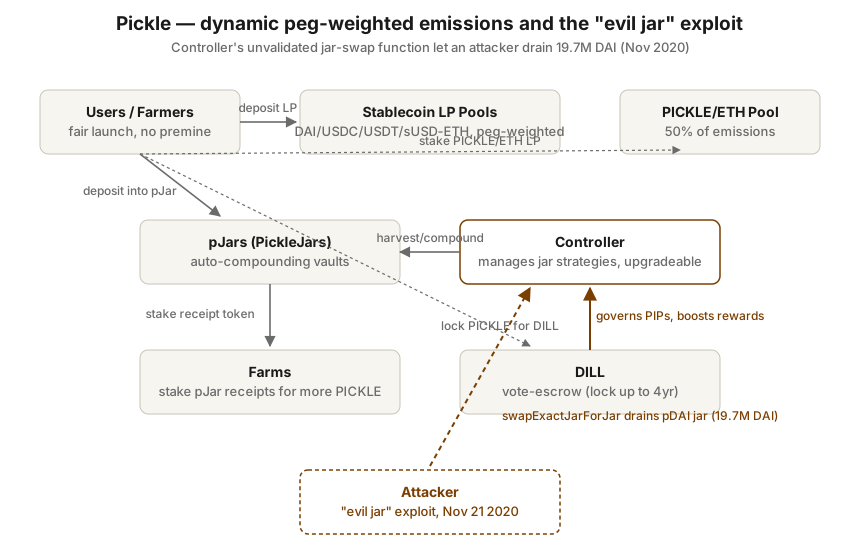 Open full-size diagram
Summary
Pickle Finance launched on September 11, 2020 (rewards from Ethereum block 10838600) at the height of DeFi Summer as "an experimental protocol to bring stablecoins closer to their pegs using farming incentives, vaults, and governance." It was a textbook fair launch: no VC allocation, no premine, no ICO — PICKLE tokens were emitted entirely through liquidity mining. Its founding hook was novel: instead of paying identical rewards to all pools, Pickle dynamically re-weighted PICKLE emissions across four stablecoin pools (DAI-ETH, USDC-ETH, USDT-ETH, sUSD-ETH) to create sell pressure on above-peg stablecoins and buy pressure on below-peg ones. The project quickly pivoted toward auto-compounding "PickleJars" (pJars), a Yearn-vault-style yield aggregator, reaching roughly $140M TVL and briefly ranking among the top-6 Uniswap pools. In November 2020 it lost 19.7M DAI to the "evil jar" controller exploit, then announced a landmark integration with Yearn — often called DeFi's first "merger" — and issued CORNICHON tokens tracking victims' losses. Pickle continued as an independent multi-chain aggregator (13 chains at peak) with a veToken-style DILL lock introduced in April 2021, before formally sunsetting in June 2025 and distributing its remaining ~$170K treasury to token holders via a Merkle claim.
Design (Mechanism)
- Dynamic emission weighting for peg stabilization. PICKLE rewards per pool were adjusted relative to each stablecoin's deviation from $1: pools for above-peg stablecoins received fewer PICKLEs, below-peg pools more. The theory: farmers chasing yield would buy discounted stablecoins (to LP into the higher-reward pool) and sell rich ones, arbitraging pegs back into line. The PICKLE/ETH pool received 50% of emissions; the four stablecoin pools split the rest.
- Fair-launch emissions. 10 PICKLE per block for the first two weeks (early-adopter bonus), then 1 per block — no premine, no investor tranche.
- pJars (PickleJars). Auto-compounding vaults (originally announced as pVaults) modeled on Yearn's yVaults: users deposit LP tokens, strategies harvest and compound rewards, and performance fees flow to the protocol; a portion (initially 1.5%) was earmarked to buy back and burn PICKLE. Planned flash-loan arbitrage strategies against off-peg stablecoins were part of the original vision.
- Farms + Jars stacking. Depositors could stake pJar receipt tokens in Farms to earn PICKLE on top of compounded yield.
- DILL (from April 2021). A Curve-style vote-escrow: locking PICKLE for up to 4 years yielded DILL, which governed Pickle Improvement Proposals, boosted farm rewards, and shared protocol fees.
- Governance and controller architecture. Jars were managed by an upgradeable Controller contract under a governance multisig — the component that ultimately proved fatal in the exploit.
Outcome
Explosive early growth (~$140M TVL within weeks) was followed by the November 21, 2020 "evil jar" exploit: an attacker exploited the Controller's swapExactJarForJar function, which failed to validate that jar arguments were legitimate, passing two attacker-crafted fake jars to drain 19.7M DAI from the pDAI jar. PICKLE fell ~50% immediately. Days later (November 24, 2020), Andre Cronje announced "Pickle and Yearn ferment co-operation dill": Pickle's developers joined Yearn's ecosystem, Jars were to merge with Yearn v2 vaults, and CORNICHON tokens were minted to track hack losses. Pickle nonetheless continued operating independently for years, expanding to 13 chains and adopting DILL tokenomics. The 2022 bear market, contributor burnout, and a saturated yield-aggregator market eroded its position; on June 11, 2025 the team announced "Closing the Jar," snapshotting balances (June 10, 2025), distributing 170,280 USDC pro-rata to PICKLE/DILL holders via indefinitely-claimable Merkle proofs, and disabling the UI on October 1, 2025. Overall: a genuine mechanism-design pioneer and 5-year survivor, but its founding peg-stabilization thesis was abandoned early and it never sustained a durable moat — hence partial_success.
Why it worked
- Perfect timing and memetic fair launch. Launching mid-DeFi-Summer with no premine attracted mercenary liquidity and genuine community goodwill; the pickle/Veggie Tales branding made it memorable.
- A real idea beneath the meme. Emission-weighting as a peg-stabilization tool was an original contribution — an early articulation of "directed liquidity incentives" later industrialized by Curve gauge wars and protocol-owned-liquidity designs.
- Fast-follower execution. pJars shipped quickly on the proven Yearn vault model, capturing aggregator demand while Yearn v2 was still in development.
- Crisis response built trust. The rapid
setMin(0)mitigation via the governance multisig, a transparent post-mortem culture (including banteg's reverse-engineering), CORNICHON loss-tracking, and the Yearn tie-up salvaged credibility most exploited 2020 protocols never regained.
Where the design broke
- Unvalidated inputs in privileged contracts. The Controller's jar-swap function trusted caller-supplied jar addresses; combined with other design flaws, arbitrary "evil jars" could be swapped against real ones. Rapid, unaudited iteration on upgradeable architecture created the attack surface.
- The founding mechanism was vestigial. Peg-weighting was quietly deprioritized within weeks in favor of generic yield aggregation, leaving Pickle differentiated mainly by brand in a commodity market against Yearn, Beefy, Convex and dozens of forks.
- Fair launch = thin treasury. With no investor or premine reserve, Pickle had little capital to fund development, security, or hack restitution; the final treasury of ~$170K illustrates the structural underfunding.
- No contributor-retention mechanism. The fair-launch design allocated no ongoing compensation, vesting, or equity to core builders; by December 2020 several founding pseudonymous contributors had exited, and the official sunset post cites post-2022 contributor burnout as a factor in the wind-down.
- Emission-dependent TVL. Liquidity was mercenary; when PICKLE emissions' value fell, deposits left — the classic DeFi Summer death spiral.
Lessons
- Incentive re-weighting can steer liquidity, but it is a subsidy, not a peg mechanism: farmers arbitrage the reward schedule itself; without a redemption or arbitrage primitive tied to the peg, the effect is weak and evaporates with emissions.
- Privileged "swap/migrate" functions must validate all address arguments against an allowlist — the evil-jar exploit is the canonical example of trusting caller-supplied contract addresses inside a controller.
- Fair launches trade credibility for fragility: zero premine wins community trust but leaves no war chest for audits, incident response, or bear-market payroll; some protocol-owned revenue buffer is essential.
- Speed of fork-and-ship is not a moat: a fast follower of Yearn was itself instantly forkable; durable aggregators needed either lockup flywheels (Convex) or relentless multi-chain ops (Beefy).
- An orderly, pro-rata sunset with indefinitely-claimable funds is a reputational asset — Pickle's 2025 wind-down is a model exit compared to silent abandonment.
Redesign (EDITORIAL — hypothesis, not fact)
This section is editorial hypothesis, not historical fact. A modern Pickle would keep the founding insight — emissions as a peg-steering instrument — and make it the whole product rather than a launch gimmick: a "peg gauge" protocol where emissions to stablecoin LP gauges are set algorithmically by a controller reading TWAP deviation from $1, with vote-escrowed lockers able to amplify but not override the peg signal. Security-wise, the controller should be minimal and non-upgradeable, with jar/vault registries enforced by allowlist and any swap/migration path timelocked behind governance. Funding-wise, retain the fair launch optics but route a fixed protocol-fee share (e.g., 20%) into a mandate-restricted security-and-runway treasury from day one, plus an onchain insurance backstop (self-staked PICKLE slashed on exploits) so restitution does not depend on a rescuer like Yearn. Finally, sunset criteria should be encoded upfront: if fee revenue falls below operating cost for N consecutive quarters, an automatic Merkle distribution of the treasury triggers — institutionalizing the graceful exit Pickle eventually improvised.
Sources
- Pickle Finance Launch (official Medium announcement) — primary (docs)
- Introducing PickleJars (official Medium) — primary (docs)
- Pickle Finance Docs — primary (docs)
- Pickle Finance: Closing the Jar (official sunset retrospective, June 11, 2025) — primary (retrospective)
- banteg/evil-jar — technical post-mortem of the Nov 21, 2020 exploit — primary (audit)
- PICKLE token on Etherscan — primary (contract)
- Yearn Finance absorbs Pickle to boost DeFi rewards (Cointelegraph) (news)
- DeFi Protocol Pickle Finance Hacked For $20 Million (Decrypt) (news)
- What is Pickle Finance? (Cryptotesters review — team background) (analysis)
- Pickle Finance: The Tastiest New Yield Farming Protocol (Glassnode) (analysis)
Related experiments
Last verified: 2026-07-26 · Spot an error? Suggest a correction