Gods Unchained
A Hearthstone-style trading card game whose cards are player-owned Ethereum NFTs, which pioneered the 'true digital ownership' gaming thesis, spawned Immutable X, and survived the play-to-earn boom-bust as a still-running but diminished flagship.
▶ Run interactive simulation animated mechanism with editable parameters
How it works onchain
 Open full-size diagram
Summary
Gods Unchained is a free-to-play, Hearthstone-style digital trading card game in which competitively usable cards are ERC-721 NFTs that players genuinely own, trade, and sell. It was built by Sydney-based Fuel Games (founded by brothers James and Robbie Ferguson with Alex Connolly), which rebranded to Immutable. The project ran a card presale beginning in 2018 backed by Coinbase Ventures and others, sold out a 33,333 ETH ($6.2M) "Genesis" pack sale by October 2019, and raised a $15M Series A led by Naspers Ventures and Galaxy Digital in 2019. Gods Unchained became the canonical test of the "true digital ownership" gaming thesis — and its scaling pain (minting millions of cards on Ethereum L1) directly motivated Immutable to build Immutable X, the StarkEx-based NFT L2 the game migrated to in 2021. A GODS ERC-20 token launched via CoinList in October 2021 (~$10.3M raised) added play-to-earn rewards, staking, crafting, and nominal governance. The game still ships expansions and a 2026 roadmap, but its token is down severely from peak and its player base is far below bull-market highs: a real, playable product that outlived its economic hype cycle without achieving mainstream breakout.
Design (Mechanism)
- NFT card ownership. Core cards are ERC-721 tokens (originally on Ethereum L1, contract
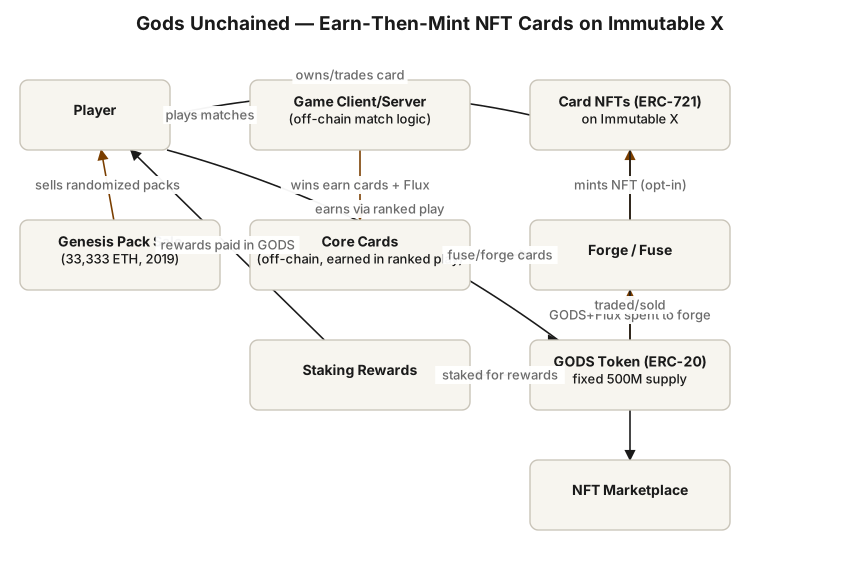
0x6EbeAf8e...f60e8Ab), freely tradable on open marketplaces. The game itself remains a conventional off-chain client/server game; the chain is used as a property registry, not a game engine. - Genesis pack sale as funding. Rather than a token ICO, the initial monetization was selling randomized card packs (loot-box economics with on-chain provable ownership), capped at 33,333 ETH. Scarcity tiers (Plain through Mythic, e.g., one-of-a-kind Mythic titans auctioned for large sums) created a collector market layered on the gameplay market.
- Earn-then-mint ("fusing"/Forge). Players earn off-chain "core" cards and Flux/Fragments through ranked play; only when fused/forged do cards become on-chain NFTs. This throttled mint volume, kept free-to-play onboarding gasless, and made on-chain status an opt-in upgrade.
- L2 migration. In 2021 the card economy moved to Immutable X (StarkEx validium) for gas-free minting and trading — the game effectively bootstrapped its own scaling infrastructure company, which became Immutable's main business.
- Dual-token economy (2021). GODS (ERC-20, fixed 500M supply,
0xccc8cb52...2afd97) was added as reward currency, crafting input for forging NFTs, staking asset (rewards for holding on Immutable X plus playing), pack-purchase currency, and governance token. Weekend-ranked performance paid out packs and tokens — classic play-to-earn emissions layered on a skill game.
Outcome
Partial success, still ongoing. Gods Unchained shipped a genuinely playable, well-reviewed TCG — rare among 2018-era crypto games — sold out its Genesis sale, drove hundreds of thousands of signups (including a spike during the October 2019 Hearthstone/Blitzchung controversy, when it positioned itself as the censorship-resistant alternative), and seeded Immutable X, now a major web3 gaming platform. GODS reached a multi-billion-dollar fully diluted valuation in the 2021 mania, then fell more than 95% from highs; it declined roughly 74% during 2024 alone. Immutable cut staff touching the Gods Unchained team in 2022 reorganizations, and reporting described the dev team as "gutted" at points, with concurrent players falling to the low tens of thousands and below. Yet the game kept shipping: Epic Games Store listing (2023), global mobile release (2024), and a 2026 roadmap with new expansions (Roots of Ruin, Guardians of Elderym), Sealed mode, and a "Forge 2.0" requiring GODS plus Flux. It is the longest-lived major NFT game — technically vindicated, commercially far short of its Hearthstone-killer ambitions.
Why it worked
- Game-first sequencing. A competent core game existed before token incentives; players who don't care about crypto could play free, so the product wasn't purely a yield vehicle.
- Earn-then-mint throttling. Making NFT status opt-in (forge/fuse) kept gas costs and mint spam out of the onboarding funnel — a mechanism many later games copied.
- Selling assets, not tokens, first. The Genesis pack sale funded development with a product-shaped instrument (cards) years before any fungible token, avoiding early ponzi dynamics and 2018 ICO regulatory heat.
- Turning a constraint into a company. L1 minting pain produced Immutable X; the game's biggest legacy is the infrastructure built to serve it.
Where the design broke
- Play-to-earn emissions vs. skill game. Paying tokens for ranked wins attracted botting and reward farmers rather than durable card gamers; when GODS price fell, the "earn" pitch inverted into sell pressure and player churn.
- Card-as-asset undermines game balance. Buffing/nerfing cards that people paid real money for creates constant community conflict; the collectible market and the competitive metagame pull in opposite directions.
- Resourcing tied to the parent's platform cycle. The game's funding and staffing scaled with a parent company that also had a separate infrastructure business (Immutable X); when platform priorities took precedence, the game's roadmap and headcount fluctuated accordingly, leaving it periodically under-resourced relative to AAA competitors on stand-alone budgets.
- Ownership was not a sufficient draw. The core thesis — players will switch games for asset ownership — proved weaker than gameplay quality, polish, and network effects of incumbent TCGs.
Lessons
- "True ownership" is a feature, not a product: it did not overcome the gameplay/polish gap against Hearthstone or Magic Arena, and most players never exercised it.
- Opt-in minting (earn off-chain, forge on-chain) is the right pattern for chain-backed games: it separates the free-to-play funnel from gas and speculation.
- Adding a fungible reward token to a skill game converts players into extractors; token emissions tied to ranked wins invite bots and collapse when price does.
- Selling in-game assets (packs) is a more regulation-resilient and product-aligned funding mechanism than a token sale — but layering a token on later reintroduces every avoided problem.
- A game can be the loss-leading R&D lab for infrastructure: Gods Unchained's most durable output is Immutable X, not its own economy.
Redesign (EDITORIAL — hypothesis, not fact)
This section is editorial hypothesis, not fact. A redesign would keep the earn-then-forge NFT pattern but delete the fungible reward token entirely: rewards paid only in cards and cosmetics, with scarcity enforced per-season, so the speculative surface is the collectible market players already understand. Competitive balance could be protected by an explicit "reprint policy" smart-contract commitment — caps on future supply per card enforced on-chain — replacing vague scarcity promises with verifiable ones, while balance changes apply to a separate "tournament-legal" ruleset rather than mutating owned assets. Bot pressure could be reduced by gating tangible rewards behind entry-fee'd, prize-pooled events (poker-room economics) instead of open ranked emissions. Finally, governance should be scoped to what token/card holders can credibly control (set rotation schedules, prize splits, reprint caps) rather than nominal control of a game that necessarily remains an off-chain editorial product.
Sources
- Gods Unchained cards ERC-721 contract (Etherscan) — primary (contract)
- GODS token ERC-20 contract (Etherscan) — primary (contract)
- Gods Unchained Whitepaper (Sep 2021 edition) — primary (docs)
- $GODS: official token of Gods Unchained (official blog) — primary (docs)
- Immutable Sells out US$6.2 Million Genesis Sale (news)
- Crypto gaming company behind Gods Unchained raises $15 million in Series A (Decrypt) (news)
- Immutable (company) — Wikipedia (archive)
- Gods Unchained developer Immutable lays off around 8% of staff (The Block) (news)
- Gods Unchained global mobile release (PR Newswire, 2024) (news)
- Gods Unchained Newsletter, February 2026 (official portal) — primary (docs)
- A Deep Dive Into Gods Unchained (CoinList) (analysis)
Related experiments
Last verified: 2026-07-27 · Spot an error? Suggest a correction