Fractional.art
NFT fractionalization protocol that locked an NFT in a vault, minted ERC-20 ownership fractions, and used holder-voted reserve prices plus buyout auctions to reconstitute the whole asset.
▶ Run interactive simulation animated mechanism with editable parameters
How it works onchain
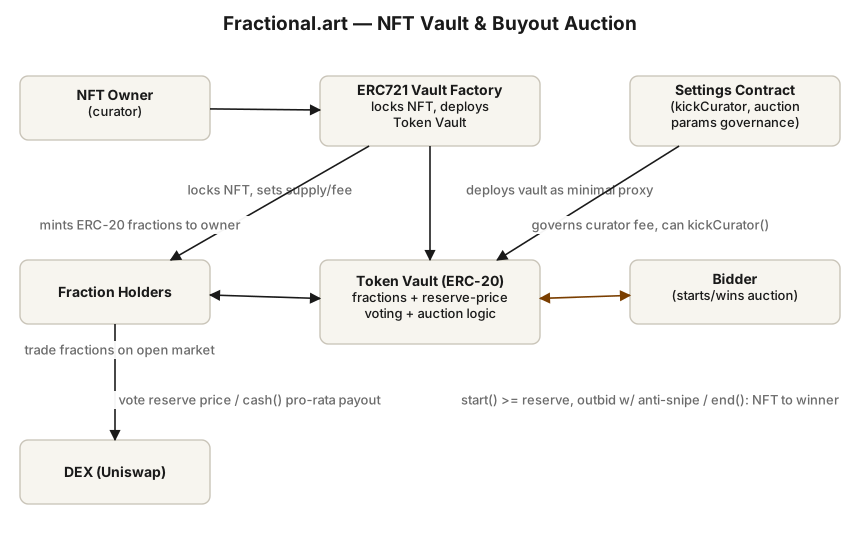 Open full-size diagram
Summary
Fractional.art was the canonical NFT fractionalization protocol of the 2021 cycle. Founded by Andy Chorlian (ex-MakerDAO) and launched on Ethereum mainnet in mid-2021, it let an NFT owner deposit a token (or a basket of tokens) into a vault and mint a fixed supply of ERC-20 "fractions" representing collective ownership. Fraction holders could trade on any DEX, vote continuously on a reserve price, and be bought out via an on-chain auction that reconstituted the whole NFT for a single winner while paying holders pro-rata in ETH. Fractional powered some of the era's most famous experiments — above all PleasrDAO's Doge meme NFT ($DOG), fractionalized into ~16.97 billion tokens whose implied valuation briefly reached the $300–500M range. In August 2022 the company rebranded to Tessera alongside a $20M round led by Paradigm; in May 2023 Tessera (and sister project Escher) announced a full shutdown for business-model reasons. The immutable vaults themselves remain on-chain and usable.
Design (Mechanism)
- Vault creation. A user calls the ERC721 Vault Factory (mainnet:
0x85aa7f78…fc63) to lock an NFT into a new Token Vault, deployed as a minimal proxy over shared vault logic. The vault itself is an ERC-20 contract: the depositor chooses total fraction supply, ticker, initial reserve valuation, and a curator fee. - Curator role. The vault creator ("curator") earns an annualized AUM-style fee (minted as new fractions) and can adjust auction length and fee within governance-set bounds; protocol governance (the Settings contract,
0xE0FC…ddCa) can remove abusive curators viakickCurator(). - Reserve price by continuous token-weighted vote. Each holder can set a personal reserve price (
updateUserPrice); the effective reserve is the supply-weighted average of votes. Two guardrails: (1) a quorum — if holders of less than 50% of supply have voted, no valid reserve exists and no buyout can start; (2) votes may not deviate more than ~5x from the current weighted average, preventing a single holder from yanking the price to absurd levels. - Buyout auction. Anyone can call
start()with ETH ≥ the reserve price, opening a live auction. Subsequent bids must exceed the prior bid by a governance-set minimum increment, and bids near the deadline trigger 15-minute anti-snipe extensions. Onend(), the NFT transfers to the winner and the vault closes. - Exit paths. After a successful auction, fraction holders call
cash()to burn fractions for their pro-rata ETH share. Alternatively, anyone who accumulates 100% of supply canredeem()to withdraw the NFT directly without an auction. - Basket vaults. An Index ERC721 contract let multiple NFTs be held and fractionalized as one collection vault.
Outcome
Technically the protocol worked as designed for its full life: no major exploit of the core vaults is on record, and buyouts, reserve votes, and cash-outs executed as specified. Commercially and culturally it peaked fast: the Doge NFT fractionalization (June–Sept 2021) raised $45.5M for 20% of $DOG supply via a MISO auction and hit a ~$500M implied valuation; CryptoPunks, Meebits, EtherRocks, and Feisty Doge followed. Activity collapsed with the 2022 NFT bear market. The company rebranded to Tessera (Aug 2022, $20M led by Paradigm) to pursue broader "collective ownership" infrastructure, then announced on May 12, 2023 that Tessera and Escher would cease operations, with Chorlian citing an economic model whose path to profitability "didn't add up." Contracts remain live and permissionless; the product and company are gone.
Why it worked
- It solved a real liquidity problem of the moment: blue-chip NFTs had six-to-eight-figure price tags and zero partial exposure; fractions made "owning a piece of a Punk/Doge" tradable on Uniswap in one transaction.
- The weighted-average reserve vote with quorum was an elegant, fully on-chain price-discovery mechanism — no oracle, no order book — and the buyout auction gave the fraction token a hard redemption floor rather than being a pure meme claim.
- Composability: fractions were plain ERC-20s, so DEX pools, DAO treasuries (PleasrDAO), and PartyBid flowed through it naturally, making Fractional the default settlement layer for collective NFT ownership.
Why it failed or underperformed
- Demand was almost entirely beta on the NFT bull market; when floor prices fell, fraction tokens became illiquid claims on illiquid assets, and volume (the fee base) evaporated.
- The business sat on top of an immutable, fee-light protocol: value accrued to token holders and curators, not the company, and pivots (Tessera's rendered "tessellated" ownership UX, Escher's art platform) could not find a profitable model — the stated reason for the 2023 shutdown.
- Structural mechanism frictions: the 50% vote quorum left many vaults with no valid reserve (no exit path); passive holders anchored stale reserve prices; and buyouts of large vaults required a single bidder to front the entire valuation in ETH.
Lessons
- A redemption mechanism is what separates fractional ownership from a memecoin. Fractional's buyout auction gave fractions a floor value tied to the underlying NFT; designs without a credible reconstitution path are just branded tokens.
- Holder-voted reserve prices need participation engineering. Continuous token-weighted voting with a 50% quorum is clean on paper but fails with passive holders; defaults, delegation, or decay of stale votes are needed for the exit valve to stay functional.
- Protocol success ≠ company survival. An immutable, low-fee protocol can execute flawlessly while the company atop it starves; teams must design value capture (or a sustainability plan) before the cycle turns.
- Fractionalizing a volatile, illiquid asset compounds illiquidity in a downturn — fractions add liquidity in bull markets and merely distribute the bag in bear markets.
Redesign (EDITORIAL — hypothesis, not fact)
This section is editorial hypothesis, not historical record. A modern redesign would attack the two weakest joints: reserve-price governance and buyout financing. Replace the 50%-quorum weighted vote with a default reserve that decays toward a Dutch-auction floor unless holders actively re-ratify it — turning passivity into an eventual exit rather than a deadlock — and let holders delegate reserve voting to curators or specialist appraisal delegates. For buyouts, allow syndicated bids (PartyBid-style pooled bidding as a first-class protocol primitive) and installment or debt-financed buyouts collateralized by the NFT itself, so reconstituting a $50M vault does not require one whale with $50M of idle ETH. On sustainability, route a small protocol fee on buyout settlement (the one moment of real value crystallization) to the operating entity or a maintenance DAO, rather than relying on curator AUM fees that dilute holders.
Sources
- fractional-company/contracts (GitHub, mainnet deployment addresses) — primary (contract)
- Fractional docs — Token Vault (smart contract breakdown) — primary (docs)
- Reserve Price — A Key Fractional Vault Property to Understand (official Medium) — primary (docs)
- The Future of Fractional.art (Andy8052, Tessera Medium — rebrand announcement) — primary (retrospective)
- Record Doge NFT Sale Highlights Growing Demand for Fractionalization (CoinDesk) (news)
- Paradigm-Backed NFT Ownership Platform Tessera is Shutting Down (CoinDesk, May 2023) (news)
- Tessera and Escher Will Cease All Operations (nft now) (news)
- Fractional NFT project Tessera to shut down amid tough crypto market (The Block) (news)
Related experiments
Last verified: 2026-07-26 · Spot an error? Suggest a correction