Acala aUSD Depeg
A misconfigured liquidity-mining reward function let attackers mint ~3 billion aUSD out of thin air, crashing Acala's stablecoin 99% in hours.
▶ Run interactive simulation animated mechanism with editable parameters
How it works onchain
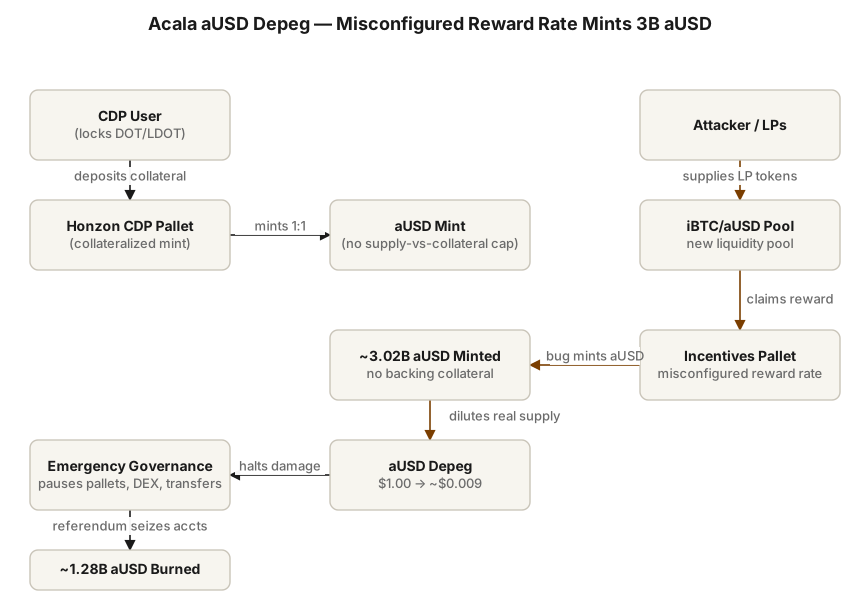 Open full-size diagram
Summary
Acala is a DeFi hub built as a parachain on Polkadot, centered on aUSD, a multi-collateral stablecoin issued through its "Honzon" collateralized-debt-position (CDP) protocol (analogous to MakerDAO's DAI system, but native to the Polkadot ecosystem). On August 14, 2022, hours after Acala launched a new iBTC/aUSD liquidity pool, an attacker exploited a misconfigured reward-rate parameter in the protocol's incentives pallet to mint roughly 3.02 billion aUSD with no backing collateral. The flood of newly minted, uncollateralized supply crashed aUSD's price from roughly $1.00 to about $0.009 — a ~99% depeg — within hours, making it one of the largest stablecoin-mechanism failures in the Polkadot ecosystem.
Design (Mechanism)
Honzon let users lock approved collateral assets (DOT, LDOT, and other cross-chain assets bridged into Acala) into CDPs to mint aUSD against them, with liquidation and stability-fee mechanisms modeled on Maker's approach. Separately, Acala ran a DEX liquidity-mining program that paid LP providers rewards in ACA and other incentive tokens via a function in the incentives pallet (reported as accumulate_dex_saving / reward-claim logic). When the iBTC/aUSD pool went live, a configuration parameter governing the DEX-saving reward rate for that pool was set incorrectly. Instead of crediting liquidity providers with modest reward tokens, the flawed logic allowed claim calls to mint aUSD directly and essentially without limit. An attacker (and, once the exploit became visible, opportunistic followers) repeatedly triggered the flawed reward-claim path, minting billions of aUSD units that had no collateral backing whatsoever, and swapping/spreading a portion of it before the network could react.
Outcome
Acala's core team and validators detected the anomaly quickly and pushed emergency on-chain governance motions to pause the incentives pallet, the DEX, and token transfers to stop further damage and prevent minted tokens from being cashed out. A published incident report traced roughly 3.022 billion erroneously minted aUSD: about 2.96 billion held by 16 identified liquidity-pool contributor accounts, ~12.4 million spread across roughly 35 other accounts, and ~52 million across remaining addresses. The team and community pursued a bounty/return program and put a governance referendum to the ACA token holders to seize/burn the erroneously minted aUSD held in the 16 largest flagged accounts to restore the 1:1 backing ratio. The referendum passed, and over 1.28 billion of the minted aUSD across those accounts was returned to the Honzon protocol and burned. aUSD's peg was not immediately restored to a healthy market price and the incident significantly damaged confidence in the token; Acala later pursued further remediation and, eventually, a broader wind-down/restructuring of the aUSD stablecoin business.
Why it worked
- N/A in the conventional sense — as an economic mechanism, Honzon/aUSD's core CDP design was not what failed; the exploit worked against the protocol, not for it. The attacker succeeded because the incentives module trusted a manually configured reward-rate parameter without adequate bounds checking, and that misconfiguration bypassed collateralization entirely.
Where the design broke
- No bounds-checking on the reward-rate parameter: the iBTC/aUSD pool's reward configuration carried no hard cap or sanity check tying claim payouts to the incentive token, so a single misconfigured value let claim calls mint the stablecoin itself rather than the intended incentive token.
- Insufficient invariant checks: the protocol lacked a hard, code-level cap tying total aUSD supply to actual locked collateral value, so a bug in an adjacent module (rewards) could silently violate the core solvency invariant.
- Centralized emergency response required: stopping the bleeding depended on validators/governance rapidly voting to freeze transfers and pause pallets — an action that worked, but only underscored how much the "decentralized" system relied on a small set of empowered actors to intervene in a crisis.
- Slow full peg recovery: even after burning back over a billion aUSD, restoring market confidence and a clean $1 peg took much longer than the technical fix, since trust and liquidity had already fled.
Lessons
- Reward/incentive-distribution modules that can mint the protocol's core asset are just as security-critical as the minting logic itself and need the same audit rigor and rate-limiting/circuit breakers.
- Protocols should enforce collateralization as a hard on-chain invariant checked at the point of every mint, not just within the primary CDP/vault code path — any code path capable of increasing supply must respect it.
- Rapid, pre-authorized emergency-pause mechanisms (as Acala had) can be the difference between a $3B mint being contained versus fully cashed out, but they also reveal a centralization trade-off worth being transparent about with users.
- Post-incident social-recovery via governance vote to claw back and burn erroneously minted tokens can work when holders are identifiable on-chain and cooperative, but it is not guaranteed and sets a precedent that supply is mutable under duress.
Redesign (EDITORIAL)
EDITORIAL / hypothesis, not fact: A more resilient design would separate "mint aUSD" permissions into a strictly firewalled module that only the Honzon CDP contract can call, with every other pallet (DEX, incentives, rewards) restricted to pre-minted, capped token pools rather than being able to invoke stablecoin minting logic at all. Reward-rate parameters for new pools could be required to pass through a time-locked, simulation-tested governance process (e.g., a mandatory testnet dry run plus a multi-day timelock before going live on a fresh pool), reducing the chance that a rushed launch introduces an unbounded mint path. Additionally, an automated on-chain circuit breaker comparing total aUSD supply against aggregate collateral value in real time — halting all minting the instant the ratio breaks a sane bound (e.g., supply exceeding 105% of collateral) — could have stopped the exploit within a single block rather than requiring humans to notice, propose, and vote on emergency pallet pauses.
Sources
- Acala Incident Report — 14/08/2022 — primary (official postmortem)
- DeFi Platform Acala's Stablecoin Falls 99% After Hackers Issue 1.3B Tokens (CoinDesk) (news)
- Another depeg: Acala trace report reveals 3B aUSD erroneously minted (Cointelegraph) (news)
- Acala's Unlimited $aUSD Minting Exploit Analysis (QuillAudits) (security analysis)
- Inside the $3B DeFi Exploit of Acala's Crypto Platform (CoinDesk) (news)
Related experiments
Last verified: 2026-07-27 · Spot an error? Suggest a correction