Frax Finance
The first fractional-algorithmic stablecoin, which dynamically adjusted its collateral ratio to market confidence, survived the 2022 algorithmic-stablecoin extinction event, then voluntarily retired its algorithmic component to become a fully collateralized 'stablecoin operating system.'
▶ Run interactive simulation animated mechanism with editable parameters
How it works onchain
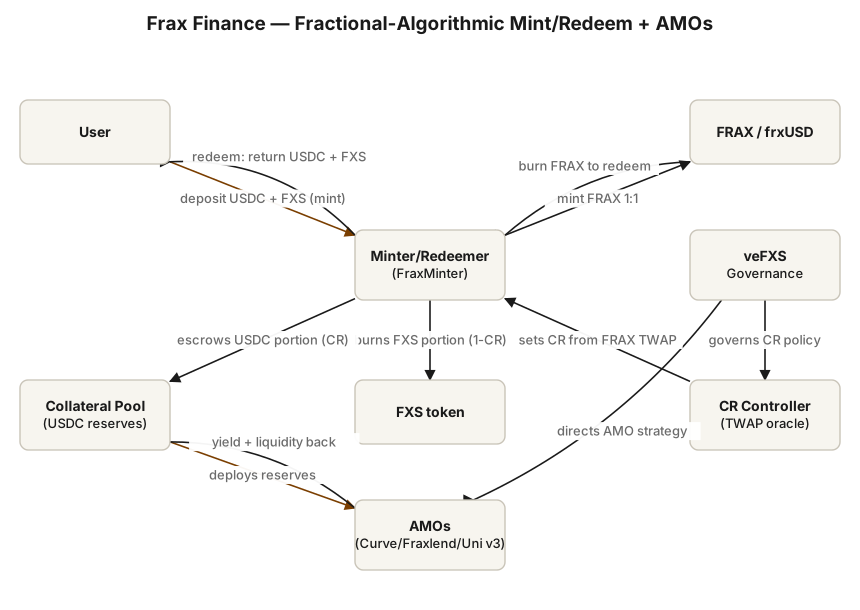 Open full-size diagram
Summary
Frax Finance launched FRAX on Ethereum on December 20, 2020 as the world's first "fractional-algorithmic" stablecoin: each FRAX was backed partly by hard collateral (USDC) and partly by the protocol's own seigniorage token, FXS, with the split — the collateral ratio (CR) — adjusted algorithmically based on market demand. Founded by Sam Kazemian (previously co-founder of Everipedia), Travis Moore, and Jason Huan, the project attracted over $300M TVL within days of launch. Frax's central bet was that the market itself could reveal the minimum collateral a stablecoin needs. The CR fell to roughly 82% at its low, and — unlike Terra's UST, Iron Finance, and nearly every other partially-backed design — FRAX held its peg through the May 2022 Terra collapse, the November 2022 FTX bankruptcy, and the March 2023 USDC depeg. In February 2023 the community passed FIP-188, raising the target CR to 100% and retiring the algorithmic component; the protocol then evolved into a multi-product "Stablecoin OS": frxUSD (the renamed, fully-backed stablecoin), sFRAX/staking vaults, the frxETH liquid-staking system, Fraxlend, and the Fraxtal L1/L2 chain, with the FXS governance token renamed FRAX in the April 2025 "North Star" upgrade and positioned around U.S. GENIUS Act stablecoin regulation.
Design (Mechanism)
- Fractional-algorithmic minting/redemption (v1). Minting 1 FRAX required $1 of value split by the current CR: e.g., at CR 85%, $0.85 USDC plus $0.15 of FXS (burned). Redemption returned the same mix. Arbitrageurs kept FRAX at $1 because mint/redeem was always at par against the basket.
- Market-driven collateral ratio. The CR ticked down when FRAX traded above $1 (demand signals confidence, so less collateral needed) and up when below $1. This "PID-like" feedback loop was the core experiment: discover the minimum viable backing empirically rather than assume 0% (UST) or 100% (DAI-style).
- FXS as seigniorage absorber. FXS captured seigniorage and fees, and acted as the recapitalization buffer — mintable and sellable to defend the peg, with veFXS vote-escrow (Curve-style) for governance and fee capture.
- AMOs (Algorithmic Market Operations, v2). Instead of idle collateral, autonomous smart-contract "central bank operations" deployed reserves into Curve pools, Fraxlend lending markets, and Uniswap v3 positions — generating yield and giving the protocol direct control over its own on-chain liquidity, provided operations never pushed FRAX below the target CR.
- v3 / frxUSD (post-FIP-188). Target CR fixed at 100%, backed by AMO positions plus tokenized real-world assets (e.g., treasury exposure via approved partner entities); sFRAX, an ERC-4626 vault, passes protocol yield (benchmarked to the Fed's IORB rate) to stakers. The North Star upgrade (April 2025) renamed FXS→FRAX as the ecosystem's sole commodity/gas token on Fraxtal, and legacy FRAX→frxUSD.
Outcome
Ongoing and substantial. FRAX became a top-five stablecoin with a market cap above $1B at its 2022 peak and never lost its peg through three systemic crises that destroyed or crippled its peers. The fractional-algorithmic mechanism itself, however, was voluntarily sunset: FIP-188 (February 2023) acknowledged that post-Terra, a sub-100% CR was a reputational and regulatory liability, and directed protocol earnings toward full collateralization rather than minting FXS. The experiment's honest verdict is therefore split — the protocol is a durable success; the original algorithmic mechanism was a partial success that was retired undefeated but also unwanted. Frax subsequently shipped frxETH (a top liquid-staking derivative), Fraxlend, the Fraxtal chain, and repositioned frxUSD as a GENIUS Act-compliant payment stablecoin, with Kazemian publicly involved in U.S. stablecoin policy discussions.
Why it worked
- Redeemability at par, always. Unlike UST, FRAX redemption returned mostly hard collateral at every CR level, so the reflexive "death spiral" had a hard floor: at CR 82%, a redeemer got $0.82 of USDC plus FXS, not 100% protocol-token exposure.
- Conservative, incremental de-collateralization. The CR moved in small steps driven by observed peg behavior, and never got remotely close to Terra's 0% — the system was ~4/5 a collateralized stablecoin at its most aggressive.
- AMOs made reserves productive and defensive. Protocol-controlled Curve liquidity meant Frax could manage its own exit liquidity during panics instead of depending on mercenary LPs.
- Willingness to kill its own thesis. Governance updated the design when evidence (Terra, regulatory climate) changed, converting mechanism credibility into brand credibility.
Limitations and criticisms
- The algorithmic fraction never proved necessary or clearly valuable. The capital-efficiency gain (~18% at the CR low) was modest, while the perceived tail risk after UST was enormous; the market repriced all partial backing as suspect, pushing the protocol to retreat to 100% CR of its own accord.
- Dependence on USDC. Using a centralized stablecoin as primary collateral meant FRAX inherited USDC's risks — visible during the March 2023 SVB/USDC depeg, when FRAX wobbled alongside its collateral.
- FXS holders bore the cost. Seigniorage upside largely evaporated once the algorithmic model was retired; FXS fell an estimated 80%+ from its highs in 2022, and value accrual had to be re-architected repeatedly (veFXS, sFRAX, North Star).
- Complexity as a moat and a burden. The sprawling product suite (stablecoin, LSD, lending, DEX positions, own chain) makes the system hard to analyze and governance-heavy relative to single-product rivals.
Lessons
- Partial redeemability in hard assets is the difference between a drawdown and a death spiral. Frax survived 2022 because every FRAX always had a mostly-collateral redemption path; UST did not.
- Let the market set risk parameters, but bound the experiment. The dynamic CR was a genuinely novel discovery mechanism — and its survival owes much to the fact that it only explored the 80-100% range, not the 0-100% range.
- Mechanism success and mechanism adoption are different outcomes. A design can pass every stress test and still be abandoned because narrative and regulation, not solvency math, determine stablecoin demand.
- Protocol-owned liquidity is a peg-defense weapon. AMOs turned reserves from dead weight into both yield and crisis-time market-making capacity — an idea widely copied across DeFi.
- Optionality to re-architect is itself a mechanism. Frax's governance retained the authority (and legitimacy) to raise the CR to 100%, rename tokens, and pivot to compliance — flexibility that pure-immutability designs lack.
Redesign (EDITORIAL — hypothesis, not fact)
This section is editorial hypothesis, not fact. A modern re-run of the fractional-algorithmic experiment might keep the market-driven CR but replace the FXS-mint recapitalization with a pre-funded, segregated junior tranche: third-party capital that explicitly sells peg insurance for yield, so the "algorithmic" fraction is backed by committed risk capital rather than reflexive token issuance. Collateral should be diversified away from any single centralized stablecoin (a basket of T-bill tokens, staked ETH with haircuts, and USDC) with on-chain proof-of-reserves. The CR controller could be hardened into a slow, bounded PID with a governance-immutable floor (e.g., 90%) so the market can never vote the system into fragility during euphoria. Finally, rather than one token absorbing seigniorage, governance, and gas roles (which forced Frax's repeated token re-architectures), separate the insurance tranche, the fee-claim token, and governance — accepting lower token-narrative power in exchange for legible risk.
Sources
- Frax Finance Documentation (Ecosystem Overview) — primary (docs)
- FRAX ABI & Token Addresses (official docs) — primary (docs)
- [FIP - 188] Increase CR to 100% (Frax governance forum) — primary (governance)
- Frax North Star Proposal V1.0 (Frax governance forum) — primary (governance)
- Frax Finance X announcement: FXS becomes FRAX (contract addresses) — primary (governance)
- Frax Finance Votes to Fully Collateralize Its $1B Stablecoin (CoinDesk) (news)
- Interview with Sam Kazemian, founder of Frax Finance (DeFi Prime) (retrospective)
- FRAX: A Fractional-Algorithmic Stablecoin (Messari) (analysis)
- Frax Finance will undergo North Star upgrade (PANews) (news)
Related experiments
Last verified: 2026-07-26 · Spot an error? Suggest a correction