Angle Protocol
Decentralized euro (agEUR/EURA) and dollar (USDA) stablecoin protocol that pioneered hedging-agent and Transmuter price-stability designs, survived collateral loss in the Euler exploit, but voted to wind down in 2026 as the team pivoted to Merkl.
▶ Run interactive simulation animated mechanism with editable parameters
How it works onchain
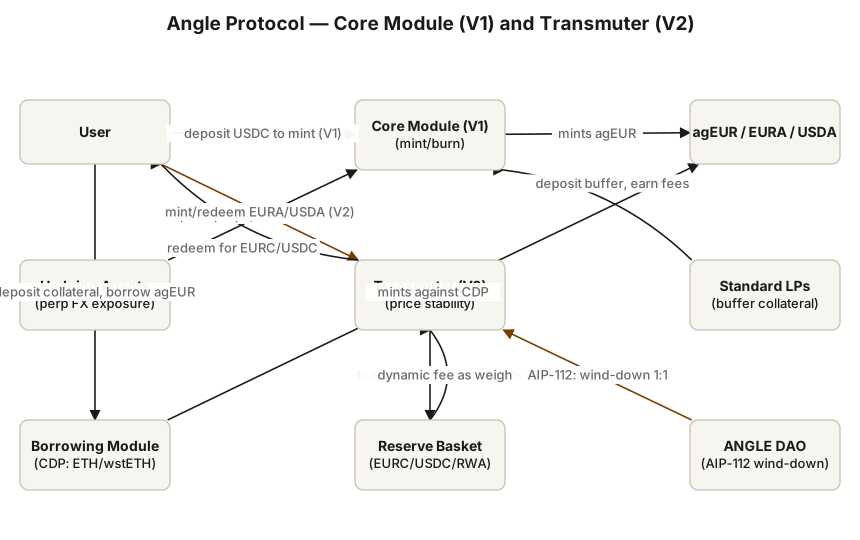 Open full-size diagram
Summary
Angle Protocol was a decentralized stablecoin protocol built by Angle Labs, a French team of École Polytechnique classmates — Pablo Veyrat, Guillaume Nervo, and the pseudonymous Picodes — founded in early 2021. After a $5M seed round led by Andreessen Horowitz (September 2021), Angle launched on Ethereum mainnet in November 2021 with agEUR, which became the largest decentralized euro stablecoin for a period. The protocol went through two distinct architectural eras: the original Core Module (mint/burn against stablecoin collateral, with perpetual-futures "Hedging Agents" absorbing volatility) and, after losing 17.6M USDC of reserves in the March 2023 Euler Finance exploit, a rebuilt V2 centered on the Transmuter, an autonomous price-stability module backed by a diversified basket. In 2024 agEUR was rebranded EURA and a dollar twin, USDA, was launched alongside yield-bearing savings tokens (stEUR/stUSD). Despite technical resilience, euro-stablecoin demand never scaled: in early 2026, governance vote AIP-112 approved an orderly wind-down, with EURA and USDA redeemable 1:1 for EURC and USDC until March 1, 2027, after which the protocol ceases operations. The team's focus shifted fully to Merkl, its DeFi incentives platform.
Design (Mechanism)
Core Module (V1, 2021–2023). Users minted agEUR by depositing accepted collateral (primarily USDC and other stablecoins) at oracle price. The novel piece was risk transfer: Hedging Agents opened leveraged perpetual-style positions on the collateral's EUR exchange rate, contractually absorbing the protocol's FX risk in exchange for leveraged upside; Standard Liquidity Providers deposited extra collateral as a buffer and earned protocol fees and yield. In principle, agEUR was fully hedged against the USD/EUR pair rather than simply over-collateralized. Idle reserves were deployed into yield strategies (which is how funds ended up lent on Euler).
Borrowing Module. A parallel CDP facility: deposit volatile collateral (e.g., ETH, wstETH), borrow agEUR against it with liquidation thresholds — closer to a euro-denominated Maker/Liquity design.
Transmuter (V2, 2023 onward). After the Euler incident, Angle rebuilt around the Transmuter: a basket-based price stability module holding diversified, liquid euro (later dollar) assets, including tokenized yield-bearing instruments. Minting and redeeming applied dynamic fees that steepen as the basket's composition drifts from target weights, plus circuit breakers under adverse conditions; redemptions remained possible even under stress at a pro-rata basket value. Protocol revenue funded native savings rates on stEUR and stUSD. Governance ran through the ANGLE token and a DAO (AIP proposals, guardian/governor multisigs for emergency pauses).
Wind-down mechanism (2026–2027). AIP-112 converted reserves so that EURA redeems 1:1 for EURC and USDA 1:1 for USDC via the Transmuter on Ethereum until March 1, 2027; remaining reserves are then airdropped pro-rata to Ethereum holders, with a further one-year claim window on Merkl.
Outcome
- Launched November 2021; agEUR became the leading decentralized euro stablecoin (DL News describes a "5-year slide from top spot" ending in shutdown).
- March 13, 2023: the Euler Finance exploit hit Angle hard — roughly 74% of its USDC reserves (~17.6M USDC) were deposited in Euler, leaving agEUR temporarily undercollateralized; guardians paused the protocol within hours. Euler's negotiated fund recovery later made affected protocols and users substantially whole, and Angle relaunched on the Transmuter architecture.
- 2024: rebrand to EURA, launch of USDA and stEUR/stUSD savings; positioned as on-chain forex infrastructure.
- 2026: AIP-112 wind-down vote passed. The protocol remained fully collateralized, every EURA and USDA redeemable 1:1 (EURA supply on Ethereum was down to roughly 17M by this point). Operations cease after March 1, 2027. The team continues as Merkl.
- Net: no user haircut, no death-spiral, an unusually orderly exit — but the stablecoins themselves did not achieve durable product-market fit.
Why it worked
- Genuine mechanism innovation. The Hedging Agent design and later the Transmuter (dynamic fees + pro-rata redemption on a diversified basket) were serious contributions to stablecoin design; the Transmuter contracts were built as a reusable module for other protocols.
- Crisis competence. Fast guardian pause during the Euler exploit, transparent accounting, and a full architectural rebuild preserved trust and the peg's redeemability.
- Responsible endgame. Winding down via governance with a 1:1 redemption path into EURC/USDC, plus a pro-rata airdrop of residual reserves, is close to best-practice for retiring a stablecoin.
- Team quality compounding elsewhere. Merkl, incubated inside Angle, found stronger product-market fit than the stablecoins and gave the team a landing.
Where the design broke
- Euro stablecoin demand never materialized at scale. DeFi is dollar-denominated; euro pairs had thin liquidity, few integrations, and negative-to-low EUR rates for much of the protocol's life removed the carry argument. Centralized, regulated competitors (Circle's EURC, MiCA-compliant issuers) captured what institutional euro demand existed.
- Reserve concentration risk. The yield strategy for idle reserves had no concentration cap: roughly 74% of USDC reserves sat in a single lending venue (Euler), so that venue's third-party exploit converted directly into an existential solvency event for Angle rather than a bounded drawdown.
- Complexity vs. adoption. The Hedging Agent model required a persistent population of sophisticated counterparties to price and absorb FX risk; that counterparty layer never reliably materialized, and the later architecture (the Transmuter) replaced it with a simpler basket-and-fee mechanism that needed no standing hedging counterparties.
- Regulatory headwinds. MiCA raised the compliance bar for euro-pegged tokens in the protocol's natural home market, favoring licensed issuers over decentralized ones.
Lessons
- Mechanism design cannot conjure demand: a technically excellent stablecoin in a currency DeFi doesn't want remains small. Distribution and denomination beat elegance.
- Reserve management is part of the stablecoin mechanism, not an afterthought — concentration limits on where backing assets are deployed matter as much as the peg mechanism itself.
- Designs that depend on a standing class of sophisticated risk-takers (Hedging Agents) are fragile; basket-plus-dynamic-fee designs degrade more gracefully.
- A governed, fully-collateralized wind-down with 1:1 redemption is achievable and should be the template: dying well preserves ecosystem trust and the team's future options.
- Side products (Merkl) discovered during protocol operation can be worth more than the protocol; teams should notice and act on that signal early.
Redesign (EDITORIAL — hypothesis, not fact)
This section is editorial hypothesis, not established fact. A rebooted Angle might invert the strategy: treat the euro stablecoin as a thin, MiCA-cognizant wrapper over tokenized euro money-market assets (T-bill-like instruments) rather than a DeFi-native hedged construction, and make the Transmuter the product — licensing it as a neutral price-stability module to other issuers, which is where Angle's real IP lay. Hard-code reserve deployment limits (e.g., no more than 15–20% of backing in any single external venue, enforced on-chain) so an Euler-class failure is a drawdown, not a solvency crisis. Bootstrap euro demand where it actually exists — European payroll, remittances, and on-chain FX pairs against USDA — via Merkl-style incentives targeted at EUR/USD liquidity rather than generic emissions. Finally, pre-commit the wind-down mechanism at launch (a standing 1:1 redemption facility into a regulated euro token), turning Angle's ad-hoc graceful exit into a credible, always-on guarantee that itself becomes a selling point.
Sources
- Angle Protocol official site (wind-down notice, EURA/USDA redemption) — primary (docs)
- EURA (previously agEUR) token contract — Etherscan — primary (contract)
- AngleProtocol/angle-docs — protocol documentation (Transmuter, Borrowing, Savings) — primary (docs)
- angle-transmuter — smart contracts for the Transmuter price stability module — primary (contract)
- Angle on X: 'Angle Protocol is winding down: here's what you need to know' — primary (governance)
- LlamaRisk: The Euler Exploit Effect on Angle agEUR and Curve Pools (analysis)
- Fabric Ventures: Angle Labs $5m Seed Round for Capital Efficient Stability (news)
- Blockonomi: Angle Protocol Winds Down EURA and USDA Stablecoins After Community Governance Vote (AIP-112) (news)
- DL News: Angle to shutter euro stablecoin EURA after 5-year slide from top spot (news)
- IQ.wiki: Angle Protocol (analysis)
Related experiments
Last verified: 2026-07-26 · Spot an error? Suggest a correction