Civil
A ConsenSys-backed attempt to save journalism with a token-curated registry of ethically-bound newsrooms, whose CVL token sale famously failed and whose registry shut down in 2020.
▶ Run interactive simulation animated mechanism with editable parameters
How it works onchain
 Open full-size diagram
Summary
Civil (The Civil Media Company) was one of the most prominent "canonical" applications of the token-curated registry (TCR) idea: a decentralized marketplace of self-governing newsrooms on Ethereum, policed by CVL token holders against a shared ethics charter (the "Civil Constitution"). Conceived by CEO Matthew Iles (first written up in late 2016) and funded with $5M from ConsenSys in October 2017, Civil onboarded a "First Fleet" of real newsrooms and signed partnerships with the Associated Press (August 2018) and Forbes (October 2018). Its public CVL token sale (September 18 – October 15, 2018; $8M soft cap, $24M hard cap) raised only about $1.4M — roughly three-quarters of it from ConsenSys itself — and was cancelled with full refunds. Civil relaunched the token and the on-chain Civil Registry in early 2019, but usage of the token mechanics never materialized. The company shut down on June 2, 2020, with the team absorbed into ConsenSys's decentralized identity efforts.
Design (Mechanism)
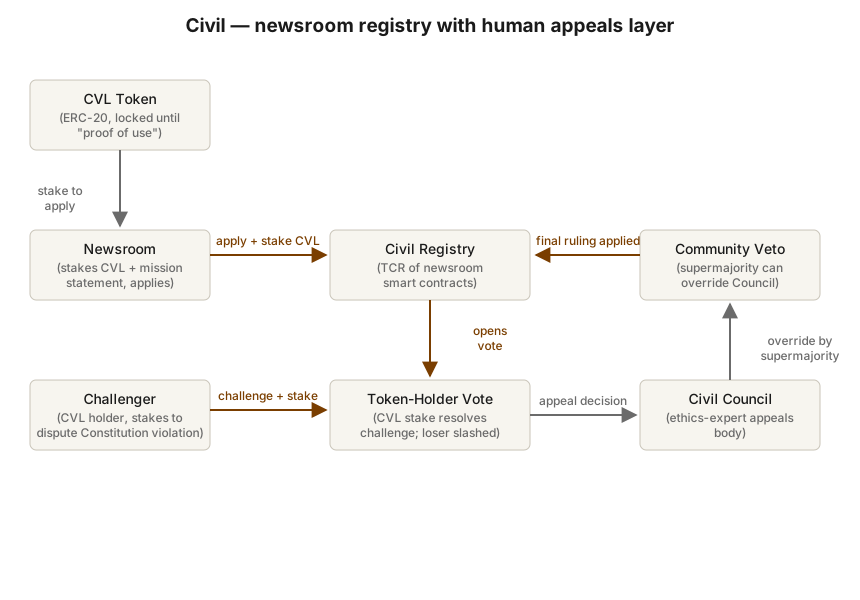
- Token-curated registry of newsrooms. The Civil Registry was a TCR (in the lineage of the generic Goldin-style TCR contracts; Civil's implementation is open source at github.com/joincivil/Civil) whose listees were Newsroom smart contracts. A newsroom applied by staking CVL alongside a public mission statement/charter.
- Challenge-and-vote enforcement. Any CVL holder could challenge a newsroom they believed violated the Civil Constitution (an ethics charter covering accuracy, transparency, no hate speech, etc.) by staking tokens. Challenges were resolved by a token-holder vote; winners earned a share of the loser's stake — the classic TCR incentive for honest curation.
- Appeals layer. Uncommonly for TCRs, Civil added a human backstop: decisions could be appealed to the Civil Council (an independent body of journalism-ethics experts, per the whitepaper's "Journalism Advisory Board" concept), and Council decisions could in turn be overridden by a supermajority community veto vote.
- Token distribution and "proof of use." 100M CVL total: 34% public sale, 33% to the Civil Media Company, 33% to partners/newsrooms. To deter pure speculation (and bolster a consumer-utility argument against securities classification), purchasers could not transfer CVL until they had "proved use" of a portion of their tokens in platform actions — enforced via a token-controller pattern on the ERC-20 (CVL: 0x01fa555c97d7958fa6f771f3bbd5ccd508f81e22).
- Newsroom economics. The whitepaper also sketched reader pledges/tips, recurring sponsorships, and CVL-bonded fact-checking, with on-chain compensation tables — most of which never reached meaningful production use.
Outcome
The 2018 token sale was a highly public failure: ~$1.4M raised against an $8M minimum, with a purchase flow contemporaneously derided as requiring dozens of steps, and automatic refunds issued from October 29, 2018. ConsenSys committed a further $3.5M via token purchase, and Civil relaunched in early 2019 with a simpler ongoing sale, the live Civil Registry, WordPress publishing plugins, and token grants to newsroom partners. But CVL saw almost no organic use for its intended curation purpose; the token's value sank, plans to pay journalists in CVL were dropped, and Civil pivoted toward memberships and identity tooling ("Civil ID Hubs"). When ConsenSys funding ran out and could not be replaced, Civil shut down on June 2, 2020. Some incubated newsrooms (e.g., Block Club Chicago) survived independently — arguably Civil's most durable legacy. Outcome status: failed (the registry technically functioned, but the core mechanism went essentially unused and the venture did not survive).
Why it worked
- The TCR + human-appeals design was a genuinely thoughtful hybrid: pure token voting was tempered by an expert Council and a community veto, anticipating later "optimistic governance with escalation" patterns.
- Civil attracted real, credentialed newsrooms and blue-chip partnerships (AP, Forbes), proving mainstream media curiosity about on-chain provenance and archiving.
- The refund-everyone response to the failed sale, and the proof-of-use transfer restriction, were unusually good-faith moves in the 2018 ICO era.
Where the design broke
- The token was a solution looking for users. Readers wanted journalism, not curation work; journalists wanted salaries, not volatile CVL. Almost nobody needed to hold CVL to get value from Civil's newsrooms.
- Fatal UX. Buying CVL involved KYC, quizzes, and a multi-dozen-step crypto onboarding flow in 2018 — a filter that excluded exactly the news-loving general public Civil courted.
- Circular demand. ~75% of the failed sale was bought by its own lead investor; there was no independent market signal, and the second sale did not change that.
- Mechanism–problem mismatch. Journalism's crisis is a revenue crisis; a registry that slashes bad actors' stakes does nothing to fund good actors. The TCR guarded gates nobody was storming.
- Single-benefactor fragility. Civil was operationally a ConsenSys subsidiary; when ConsenSys retrenched (2019–2020), Civil had no independent runway.
Lessons
- A token-curated registry only creates value when listing is scarce and contested; if there is no adversarial pressure on the list, staking and challenges are dead weight.
- Do not make a token the mandatory interface for mainstream consumers; every extra onboarding step in 2018-era crypto UX cost an order of magnitude of participants.
- A token sale in which the lead investor buys most of the supply is a subsidy, not a market test — and it masks the absence of product-market fit until the subsidy ends.
- Governance design (Constitution + Council + veto) can be excellent and still irrelevant if the underlying economic loop (who pays journalists, and why) is unsolved.
- Mission-driven projects should separate the durable asset (the newsrooms, the ethics charter, the publishing tools) from the speculative asset (the token) so the former can outlive the latter — as Block Club Chicago did.
Redesign (EDITORIAL — hypothesis, not fact)
This section is editorial analysis — a hypothesis, not established fact. A modern Civil would invert the stack: start from revenue, not curation. Newsrooms would onboard with fiat-abstracted subscriptions and crowdfunds (onchain only under the hood), with each article hashed/attested on a low-fee L2 for provenance — the part of Civil's vision (content authenticity, archival permanence) that aged best in the deepfake era. The ethics registry would be reframed as an optimistic allowlist: newsrooms post a small stake and are listed by default, with Kleros-style or Council-arbitrated challenges only on alleged Constitution violations — no general token vote, no requirement that readers ever touch a token. Curation rewards would come from a protocol fee on subscriptions (real cash flow) rather than token inflation, and the Council would be funded as a public good via an endowment (retroactive-funding rounds) instead of a single corporate benefactor. Finally, "proof of use" would be replaced by simply not selling a token to consumers at all: governance rights could accrue non-transferably to paying subscribers and working journalists, making capture-by-purchase impossible and eliminating the securities-law contortions that shaped so much of Civil's worst UX.
Sources
- The Civil White Paper (Matthew Iles) — primary (docs)
- Civil whitepaper repository — primary (docs)
- Announcing the CVL Token Launch — primary (docs)
- CVL Token contract on Etherscan — primary (contract)
- Civil open-source monorepo (joincivil/Civil) — primary (contract)
- Media Startup Civil to Issue Refunds as $8 Million Token Sale Fails (CoinDesk) (news)
- Civil's token sale has failed. Now what? (Nieman Lab) (analysis)
- Media Startup Civil Shuts Down, Team Absorbed Into Decentralized ID Efforts at ConsenSys (CoinDesk) (news)
- R.I.P. Civil — Lessons from a failed startup (Poynter) (retrospective)
- ConsenSys bought most of the CVL tokens in Civil Media's disappointing ICO (Quartz) (news)
- Civil Announces $5 Million In Funding From ConsenSys (news)
Related experiments
Last verified: 2026-07-26 · Spot an error? Suggest a correction