ai16z (ElizaOS)
A Solana memecoin-DAO that fundraised 420.69 SOL for an 'AI VC fund' fronted by a parody Marc Andreessen agent, spawned the most-adopted open-source AI-agent framework (Eliza/ElizaOS), peaked above $2B, then fell ~99.9% amid a rebrand and a 1:6 token migration.
▶ Run interactive simulation animated mechanism with editable parameters
How it works onchain
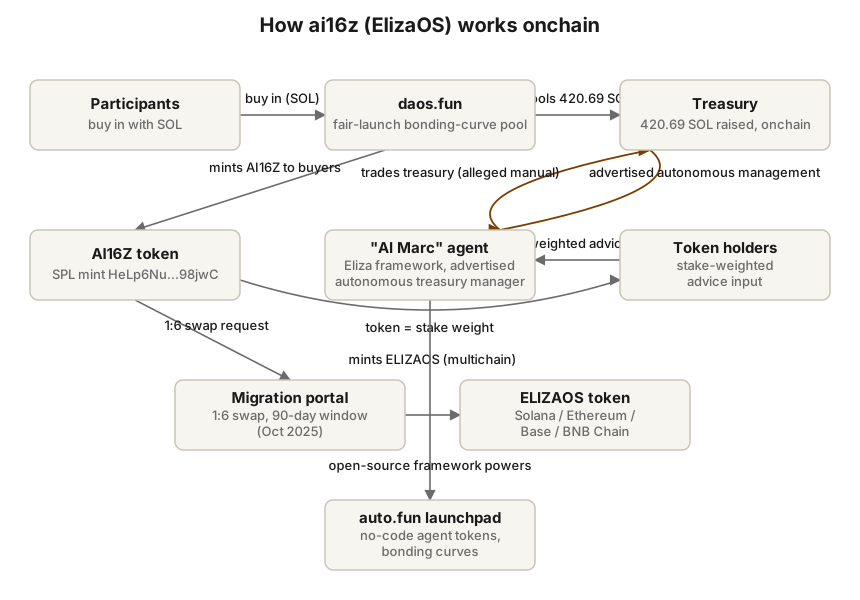 Open full-size diagram
Summary
ai16z launched in late October 2024 on Solana's daos.fun as a satirical "AI venture fund": a fair-launch DAO that raised 420.69 SOL to seed a treasury advertised as being managed by "Marc AIndreessen" (handle @pmairca), an AI agent parodying Marc Andreessen. Founded by AI/game developer Shaw Walters (Eliza Labs), the project's real engine was Eliza, an open-source TypeScript framework for building autonomous AI agents that could post on X/Discord/Telegram and hold wallets. Eliza became the #1 trending GitHub repository during the December 2024 AI-agent mania, and the AI16Z token rode that narrative from roughly $0.02–0.06 at launch to an all-time high of ~$2.47 on January 2, 2025 (market cap above $2B). After a naming complaint from the real a16z, the project rebranded to elizaOS (announced January 28, 2025), later executed a 1:6 token migration to a new ELIZAOS token (October–November 2025) with multichain deployment, and shipped the auto.fun no-code agent launchpad. By mid-2026 the token had lost ~99.9% from its high. The framework remains widely used; the token experiment did not hold value.
Design (Mechanism)
- Fair-launch DAO fundraise (daos.fun): Participants bought into a pooled treasury (420.69 SOL initial raise) receiving AI16Z tokens (SPL mint
HeLp6NuQ...98jwC). daos.fun's model wrapped a fund-like treasury inside a tradable memecoin with bonding-curve entry. - AI-agent fund manager (advertised): The treasury was to be managed autonomously by the "AI Marc" agent built on Eliza, making trades and taking token-holder input weighted by stake — a "delegate governance to an AI" pitch layered on a "marketplace of trust" concept where humans earn reputation by giving the agent good advice.
- Open-source flywheel as token narrative: The Eliza framework (MIT-licensed, modular plugin architecture, unified message bus across Discord/Telegram/X/onchain) was free; the token was positioned as the index on the ecosystem's growth, without hard-coded value accrual.
- Rebrand + migration mechanics: After the a16z naming dispute, the ticker migrated AI16Z → ELIZAOS at 1:6 via a 90-day portal beginning October 21, 2025, expanding supply (~7.5B circulating) and deploying across Solana, Ethereum, Base, and BNB Chain.
- auto.fun (April 2025): a pump.fun-style, open-source Solana launchpad for no-code AI agent tokens with bonding curves and Raydium liquidity, marketed with "fairer than fair" tokenomics.
Outcome
Explosive rise, severe collapse, durable software. AI16Z hit ~$100M market cap in November 2024 after Marc Andreessen amicably acknowledged the project on X, then surpassed $2B by early January 2025 — the largest Solana AI-agent token of the cycle. Eliza topped GitHub trending charts (thousands of forks, 1,000+ teams reportedly building on it; the site now claims 200+ plugins and ~1,350 contributors). The token then bled with the broader AI-agent sector through 2025. The migration to ELIZAOS did not restore value: by mid-2026 market cap sat in the single-digit millions, down ~99.9% from peak. The framework and Eliza Labs continue shipping (ElizaOS v2, auto.fun, enterprise partnerships).
Why it worked
- Perfect narrative timing: It fused the two hottest 2024 primitives — memecoins and AI agents — with a legible joke (an AI version of a16z) at the exact moment agent frameworks became investable narratives.
- Real, open technology underneath: Unlike most memecoins, there was substantive engineering; Eliza's plugin architecture made it the default way to ship a crypto-native AI agent, and every fork advertised the token.
- Celebrity validation loop: Andreessen's good-humored engagement acted as unpaid, high-credibility marketing that no ad budget could buy.
- Low-friction collective entry: daos.fun made "buying into an AI hedge fund" a one-click memecoin purchase, with the treasury visible onchain.
Where the design broke
- No enforced link between token and framework value: MIT-licensed software adoption did not require holding AI16Z; the token priced pure narrative, and when agent-sector attention rotated away, nothing caught the knife.
- Advertised autonomy was never demonstrated: The core mechanism — an AI autonomously managing the treasury, with the promised "AI Marc trades with holder input" loop — never became a demonstrated, audited, onchain process.
- Borrowed-brand fragility: The a16z parody that fueled the rise forced a rebrand, and the subsequent ticker change plus 1:6 supply-expanding migration confused holders and reset exchange liquidity at the worst point of the cycle.
- Governance vagueness: "DAO" branding without crisp treasury-control, reporting, or revenue mechanisms left holders with no claim on Eliza Labs' actual commercial progress.
Lessons
- Open-source adoption is not token value accrual; if the software is free and forkable, the token needs an explicit, enforced role (fees, staking, access) or it trades purely on attention.
- Advertising "autonomous AI management" without proof invites distrust once scrutinized — mechanisms should be verifiable onchain (signed agent actions, auditable policies) rather than asserted in marketing.
- Parody branding is a loan, not an asset: the borrowed name accelerates discovery but the forced rebrand/migration later destroys ticker equity precisely when the project is weakest.
- Token migrations with ratio changes (1:6) during drawdowns compound holder confusion and rarely reprice a project whose underlying demand problem is unsolved.
- A celebrity's playful engagement can move nine figures of market cap; systems that let this set the price of a "fund" are pricing pure attention, not fundamentals.
Redesign (EDITORIAL — hypothesis, not fact)
This is editorial speculation. A sturdier design would have separated the three products it accidentally bundled. (1) The framework: fund it via a protocol fee at the point of enforced scarcity — e.g., agent registration/identity and plugin marketplace fees payable in the token, so every Eliza deployment touches the asset. (2) The fund: if the pitch is an AI-managed treasury, make autonomy verifiable — the agent's keys in a smart-contract wallet whose transactions can only be initiated by attested agent inference (TEE or zkML attestations), with holder "advice" recorded onchain and scored, turning the "marketplace of trust" into a measurable reputation system instead of a slogan. (3) The brand: launch under an original name; parody as a costume for one agent character, not the ticker. Finally, pre-commit migration policy in the token contract (ratio, window, burn of unmigrated supply) so any future rebrand is a mechanical event rather than a discretionary shock.
Sources
- elizaOS official site — primary (docs)
- elizaOS/eliza GitHub repository — primary (contract)
- AI16Z token on Solana Explorer — primary (contract)
- Meet AI16z DAO: An AI-Based Investment Project That Aims to Upend Silicon Valley (Decrypt) (news)
- Marc Andreessen shoutouts help AI-powered VC fund ai16z to nearly $100 million market cap (The Block) (news)
- Ai16z Is Rebranding as ElizaOS After Request From Venture Firm a16z (Unchained) (news)
- Eliza Labs migrating from 'experimental' ai16z token to elizaOS (The Block) (news)
- Eliza Labs unveils auto.fun, a no-code AI agent launchpad (The Block) (news)
- Crypto.com support notice: AI16Z token swap and rebrand to ElizaOS (news)
- elizaOS (ELIZAOS) on CoinMarketCap (analysis)
Related experiments
Last verified: 2026-07-26 · Spot an error? Suggest a correction