PVP
TokenWorks' second experiment: an ERC-20 whose holders could be 'raided' via 24-hour all-pay ETH auctions, an on-chain dramatization of memecoin trading as a zero-sum player-versus-player game.
▶ Run interactive simulation animated mechanism with editable parameters
How it works onchain
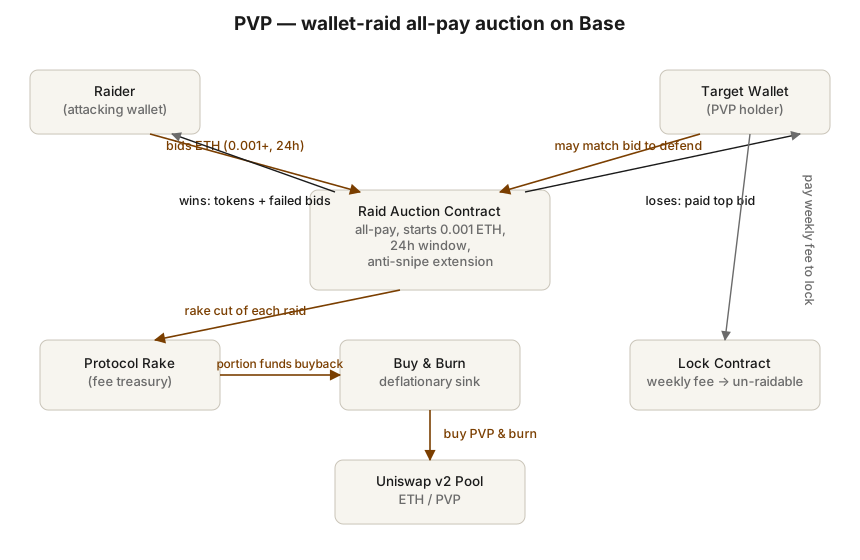 Open full-size diagram
Summary
PVP was the second experiment (#002 in their archive, dated 27 October 2024) from TokenWorks — an anonymous "playground for onchain financialized ideas" that would later become known for PunkStrategy ($PNKSTR). It followed their debut token, Circle (#001, 9 October 2024). PVP is a custom ERC-20 on Base (contract 0x63e14921ba4546cb15087d574346574eee055812) that turned the memecoin holder base itself into the game board: every wallet holding PVP was a raidable target, and anyone could attempt to seize another holder's tokens by winning a timed on-chain auction.
The project's stated intent was didactic. TokenWorks wanted to make the zero-sum nature of memecoin trading literal and visible on-chain — in their words, "to illustrate that, for every person making 1e on a coin, someone is losing 1e." Rather than the usual implicit player-versus-player dynamic of a bonding curve, PVP encoded PvP directly into token transfers. It was a fair launch (full supply paired with 1 ETH in a Uniswap V2 pool at roughly a $5,000 market cap) and never achieved meaningful traction, which TokenWorks documents candidly in a public post-mortem. It is best understood as an art / game-theory experiment rather than a commercial token.
Design (Mechanism)
The core primitive was the raid, structured as an all-pay auction against a chosen wallet:
- Targeting: "Every wallet holding PVP was a potential raid." Anyone could open a raid on any holder's address.
- Auction: A raid started at 0.001 ETH and ran for 24 hours, with the timer extended when new bids arrived (an anti-snipe extension mechanic).
- All-pay dynamics: Losing bids were not refunded; they accumulated in the raid pot. This made bidding costly and was intended to create escalating "bidding wars."
- Settlement: The winning raider received the target wallet's PVP tokens plus the accumulated failed bids. The raided (losing) wallet received the amount of the top/highest bid as compensation for its seized tokens.
- Defense: A targeted holder could match the current bid to defend and keep their tokens. TokenWorks also later added the option to pay a weekly fee to lock tokens in a separate contract, making them un-raidable while locked.
- Protocol economics: A portion of each raid was retained by the protocol as a rake, and some proceeds were used to buy PVP from the market and burn it, a deflationary sink meant to accrue value to remaining holders.
Value flow (actors): Raider (attacker) posts ETH → protocol escrows bids and takes rake → target either matches (defends, keeps tokens) or loses tokens and receives the top bid → winner takes tokens + failed bids → protocol buys and burns PVP with part of the rake. The design blends an all-pay auction, a PvP raid game, and a buy-and-burn tokenomic loop into a single ERC-20.
Outcome
outcome_status: failed. By TokenWorks' own accounting, the project lost roughly $10,000 and several weeks of development time and "generated minimal market traction." The verified BaseScan contract shows a total supply of ~821.2M PVP across ~671 holders — a small, short-lived holder base consistent with a micro-cap experiment that did not find product-market fit.
The intended engagement loop — competitive, escalating bidding wars over other people's tokens — largely failed to materialize. Instead, activity collapsed into ordinary price arbitrage around the raid mechanics rather than the dramatic PvP raids the team envisioned. Participants who engaged reportedly found the concept "exciting and cool," but not enough of them bid, and the token had no reason to be held beyond price speculation. TokenWorks archived it and moved on to their next experiment, Golden Handcuffs (#003, December 2024), continuing a rapid cadence of ~monthly launches that eventually produced their breakout hit, PunkStrategy, in September 2025.
Why it worked
Judged as a commercial token it did not work, but as an experiment several things went right:
- Conceptual clarity: The mechanism successfully made the zero-sum "someone loses 1e for every 1e won" thesis of memecoin PvP explicit and on-chain — a legible, teachable artifact.
- Novel primitive: Combining an all-pay auction with wallet-level raiding was genuinely original and technically shipped (a verified Solidity 0.8.20 contract on Base) rather than staying a thought experiment.
- Community seeding: Even as an individual failure, PVP contributed to TokenWorks' iterative playbook — accumulating a "cold-start seed user group" and reputation that later powered their successful strategy-token meta.
- Honest documentation: The public post-mortem turned a loss into reusable knowledge, which is itself a form of success for a research studio.
Where the design broke
- No reason to hold: TokenWorks concluded "it's hard to see a reason why you'd hold PVP, other than hoping the price will go up." The token had no yield, utility, or defensive necessity that made holding attractive.
- Perverse defensive incentive: They found "people would rather have their tokens inflated and become worthless, rather than actually removing the tokens from their wallet" — i.e., holders preferred passive dilution to actively engaging the raid/defense loop.
- Too many moving parts: Raids, all-pay bidding, matching-to-defend, weekly lock fees, rake, and buy-and-burn were a lot of surface area for a micro-cap memecoin; the complexity outran the user base's willingness to learn it.
- Insufficient liquidity/attention: A ~$5k fair-launch cap and a small holder set never generated enough simultaneous participants to sustain bidding wars, so the game degenerated into arbitrage.
- Misaligned incentives: The mechanics rewarded passivity and arbitrage over the intended competitive raiding, so the emergent behavior diverged from the design intent.
Lessons
- A mechanism is only as strong as the reason to hold the asset it governs. PvP raids give attackers something to do, but without a holding incentive (yield, utility, or unavoidable stakes), a token collapses into pure speculation and the clever mechanic goes unused.
- All-pay auctions need dense, simultaneous participation to produce "wars." In a thin market, the same mechanic that should create escalating competition instead produces one-sided arbitrage; auction designs must account for the liquidity/attention density they actually receive, not the density they assume.
- Opt-in adversarial mechanics fight loss aversion. Asking users to defend against having tokens seized triggers strong loss-aversion and disengagement; players chose passive dilution over active defense. Adversarial "steal your tokens" games must make participation the default or make defense trivially cheap.
- Ship-measure-archive iteration compounds. Even outright failures build audience, reputation, and design intuition; TokenWorks' willingness to launch ~monthly and publish honest post-mortems is arguably why a later experiment (PunkStrategy) succeeded.
Redesign (EDITORIAL — hypothesis, not fact)
The following is the researcher's editorial analysis, not a claim by TokenWorks or a statement of fact.
PVP's fatal flaw was that holding the token was optional and unrewarded, so the raid game had no captive stakes. A redesign should make being raidable the point of holding, not a risk to be passively endured:
- Yield-bearing raid targets. Route the protocol rake and a share of trading fees into a reward pool paid only to actively-held, un-locked (raidable) wallets. This inverts the perverse incentive: holding un-defended tokens earns yield but exposes you to raids, creating a genuine risk/reward tension instead of "hold and hope."
- Seasons and matchmaking to concentrate attention. Replace always-on, any-wallet raids with scheduled raid "seasons" or tiered brackets (e.g., only top-N wallets are targetable during a window). Concentrating raids in time and cohort would manufacture the simultaneous participation an all-pay auction needs to produce real bidding wars.
- Bounded, transparent all-pay auctions. Cap failed-bid exposure (e.g., partial refunds below a threshold) to lower the psychological cost of bidding, and surface a live leaderboard of raids so the PvP drama is a spectacle that attracts more bidders — turning the mechanism into content, which is how later memecoin metas actually spread.
- Simplify the surface. Cut either the weekly-lock defense or the match-to-defend option; two overlapping defense systems plus rake plus buy-and-burn was too much. A tighter loop (earn yield by being raidable, defend by matching, protocol burns the rake) would be more legible.
Whether any of this would have found product-market fit is unknowable — PVP's real legacy is the lesson, not the token.
Same-name caution: the crypto TokenWorks (token.works, @token_works) is unrelated to "TokenWorks, Inc." (tokenworks.com), a New York ID-scanner/hardware company founded in 1998. There are also multiple unrelated tokens named "PVP" on BSC, Ethereum, and Base; the only TokenWorks PVP is the Base contract 0x63e14921ba4546cb15087d574346574eee055812.
Sources
- TokenWorks Archive — PVP (#002) — primary (retrospective)
- TokenWorks Archive (project index, PVP dated 10-27-24) — primary (docs)
- PVP (PVP) Token Tracker — BaseScan (verified contract) — primary (contract)
- TokenWorks™ (@token_works) on X — primary (docs)
- How I Achieved a 20x: NFTStrategy / TokenWorks history (context on Circle and PVP) (analysis)
- What TokenWorks Is Building Next — Bankless (news)
Related experiments
Last verified: 2026-07-26 · Spot an error? Suggest a correction