Seed Club
A DAO-structured accelerator for social tokens and tokenized communities that took ~3% token allocations from cohort projects, governed itself with the $CLUB token, and gradually morphed from 'Y Combinator of web3 communities' into a conventional venture arm.
▶ Run interactive simulation animated mechanism with editable parameters
How it works onchain
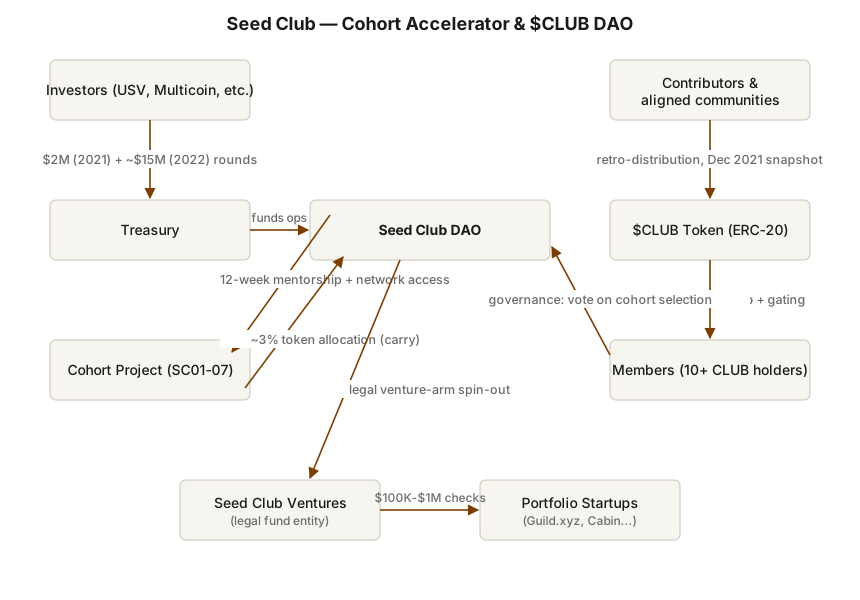 Open full-size diagram
Summary
Seed Club was the canonical accelerator of the 2020–2022 social-token and DAO wave: a tokenized community that helped creators and communities launch their own tokens, taking a small token allocation from each cohort project in exchange for a 12-week program of mentorship, product help, and access to a dense network of crypto founders and investors. It began in 2020 as a small Telegram group of early social-token issuers (members of the founding cohort included Alex Masmej of $ALEX, Brian Flynn of $JAMM, and Joon Ian Wong of $JOON) convened by Jess Sloss, who framed it as "a social token incubator." By 2022 CoinDesk was calling it "the Y Combinator of Web3." The DAO governed itself via the $CLUB ERC-20 token, launched in late December 2021 through a retroactive distribution to contributors and aligned communities. Seed Club ran seven publicly numbered cohorts (SC01 through SC07), progressively widening from personal creator tokens to community DAOs and finally to consumer crypto startups. Its legally structured investment arm, Seed Club Ventures, a venture DAO with a reported $25M fund and 60+ members, outlived the accelerator's public activity and was still making investments as of 2026, while the $CLUB token itself became illiquid and the original seedclub.io domain stopped resolving.
Design (Mechanism)
- Cohort accelerator with token-based carry. Projects joined ~12-week cohorts; per CoinDesk and Seed Club's own materials, accepted projects allocated roughly 3% of their token supply to Seed Club, aligning the DAO's treasury with the long-term success of incubated communities — YC's equity-for-help model translated into tokens. Select cohort projects also received $CLUB allocations, creating bidirectional alignment.
- $CLUB token and gated membership. $CLUB is an ERC-20 on Ethereum (0xf76d80200226ac250665139b9e435617e4ba55f9, 10M total supply). Holding 10 $CLUB granted DAO membership: gated Discord, private events, and governance rights over cohort selection and DAO-level decisions.
- Retroactive, contribution-weighted distribution. Rather than a public sale, $CLUB launched (December 2021) via retro-distribution against a snapshot at block 13430405 (October 16, 2021). Reported allocations: a community treasury holding the majority of supply (~67%), ~25% to early contributors under a 6-month cliff and 3-year vest (first unlock June 28, 2022), plus unvested airdrops — e.g., 185,000 $CLUB to wallets holding two or more of $FWB, $BANK, $FF, $WRITE; 185,000 to Seed Club NFT-sale contributors; fixed 2,500-$CLUB grants to 40 past cohort project leads.
- Treasury funding via investors, not token sales to retail. The DAO raised
$2M in a July 2021 treasury round from USV, Multicoin, Placeholder, Framework, IDEO CoLab, The LAO and others, with a further strategic round ($15M reported by Chain Broker) closing around May 2022. - Two-layer structure. The DAO layer (community, accelerator, governance) sat beside Seed Club Ventures, a legally wrapped venture DAO writing $100K–$1M checks into community-oriented web3 startups (portfolio/network includes Guild.xyz, Cabin, Coordinape, Metalabel).
Outcome
Seed Club scaled fast: by August 2022 it had run four cohorts covering ~55 projects in 16 months, having started as "11 people in a Telegram chat" that struggled to fill its first cohort of eight. It survived the 2022–2023 downturn better than most tokenized accelerators, continuing to run cohorts as peers went dormant. As the social-token narrative deflated, Seed Club repositioned twice — from social tokens to "DAO builders and operators," then to a Consumer Crypto Accelerator: SC07 selected 8 companies from ~300 applications and held its demo day on June 20, 2024 (Sidequest, Bracket.game, Xhibit, LISA, Chipped, Ponder, and two others). After SC07, no subsequent public cohort (SC08) was found. As of mid-2026 the $CLUB token is reported by Chain Broker as "not tradeable anywhere," seedclub.io no longer resolves, and the durable remnant is Seed Club Ventures, which continued investing into 2026. Verdict: the accelerator genuinely shaped the social-token/DAO era and its network compounded into a functioning venture operation, but the tokenized-DAO mechanism itself — $CLUB membership, token governance, token carry — did not sustain independent value.
Why it worked
- Curation and network density were the real product. Seed Club aggregated nearly every notable social-token founder of 2020–2021 into one room; the accelerator's value was warm access to that network, which token gating made legible and scarce.
- Retroactive, vesting-heavy distribution avoided the worst token-launch pathologies. No public sale, contributor cliffs/vesting, and airdrops targeted at aligned communities ($FWB, $BANK holders) meant $CLUB launched into hands with context rather than mercenary capital.
- Token carry aligned incentives cheaply. Taking ~3% of cohort tokens let a small DAO share upside across dozens of experiments without deploying much capital — a portfolio approach well matched to a high-variance, pre-product space.
- Willingness to re-narrate. Pivoting from "social tokens" to "DAOs" to "consumer crypto" kept the brand relevant across three market cycles, and the venture arm gave the network a legal, durable vehicle.
Where the design broke
- The asset class it accelerated largely evaporated. Most 2020–21 creator/social tokens lost their liquidity and communities; token carry in dead tokens is worthless carry, so the treasury's core alignment mechanism underperformed equity.
- $CLUB never developed durable independent utility. Membership gating and governance rights over an accelerator's cohort selection proved a thin value proposition; the token is now effectively untradeable.
- The DAO layer was gradually outcompeted by its own legal wrapper. Seed Club Ventures — a conventional LP-structured fund with a member network — captured the durable functions (capital, deal flow, support), leaving the token-governed DAO with a shrinking role, a common pattern among 2021 "venture DAOs."
- Accelerator cadence stopped. No public cohort after SC07's June 2024 demo day was found; the flagship program appears dormant (Unknown / not officially announced as ended).
Lessons
- Token-denominated carry inherits the survival rate of the tokens themselves. An accelerator paid in early-stage community tokens is levered long on a single narrative; equity or diversified terms hedge narrative collapse.
- Membership tokens need a job beyond access. When the gated thing (Discord, events, cohort votes) loses cultural heat, a pure-access token has no floor. Recurring, hard-to-replicate utility must be built before the hype cools.
- The legal wrapper tends to eat the DAO. If a tokenized org spins up a traditional legal/financial vehicle for its highest-value activity, expect gravity to pull talent, capital, and legitimacy into the wrapper; design explicit value flows back to token holders or accept the DAO's obsolescence.
- Retroactive distribution to proven contributors is a strong launch pattern. Seed Club's snapshot-based, vested, no-public-sale launch avoided regulatory and mercenary-capital problems that sank contemporaries — the mechanism is worth copying even where the token thesis is not.
Redesign (EDITORIAL — hypothesis, not fact)
This section is editorial hypothesis, not historical fact. A redesigned Seed Club would collapse the DAO/fund duality from day one: a single legally wrapped entity whose carry (in both tokens and equity, at the project's choice) flows into an onchain treasury in which $CLUB is a claim, not just a keycard — e.g., a non-transferable governance token paired with a transferable treasury unit, so membership reputation and economic exposure are separable. Cohort carry should be diversified by construction: convert a portion of each project-token allocation into ETH/stables on a programmatic schedule post-liquidity, so the treasury banks narrative peaks instead of round-tripping them. Governance should be scoped narrowly to what token holders are actually good at — cohort selection and network curation — with an elected, term-limited investment committee handling deployment. Finally, make the accelerator's alumni network itself the token sink: ongoing services (hiring, distribution partnerships, follow-on introductions) priced in $CLUB, giving the token recurring demand tied to the org's genuinely scarce asset, its network.
Sources
- Introducing Seed Club, a Social Token Incubator (Jess Sloss, Medium, 2020) — primary (docs)
- Welcome to Seed Club: $CLUB Guide (Mirror) — primary (docs)
- CLUB token contract (Etherscan) — primary (contract)
- How to Get Into Seed Club, the 'Y Combinator of Web3' (CoinDesk, Aug 2022) (news)
- Seed Club Ventures — Community Owned Networks — primary (docs)
- SC07: Consumer Crypto (Seed Club site) — primary (docs)
- Seed Club (CLUB) token sale information (ICO Drops) (analysis)
- Seed Club (CLUB) funding and market data (Chain Broker) (analysis)
- 11 New Projects join the Seed Club Social Token Incubator #SC02 (Jess Sloss, Medium) — primary (docs)
Related experiments
Last verified: 2026-07-26 · Spot an error? Suggest a correction