Golden Handcuffs
A TokenWorks ERC-20 art experiment in which a handful of large pre-seeded 'handcuffed' wallets each trigger, on their first outgoing transfer, the automatic deployment of a personalized child memecoin — turning the act of selling into an onchain spectacle that mirrors and satirizes influencer token launches.
▶ Run interactive simulation animated mechanism with editable parameters
How it works onchain
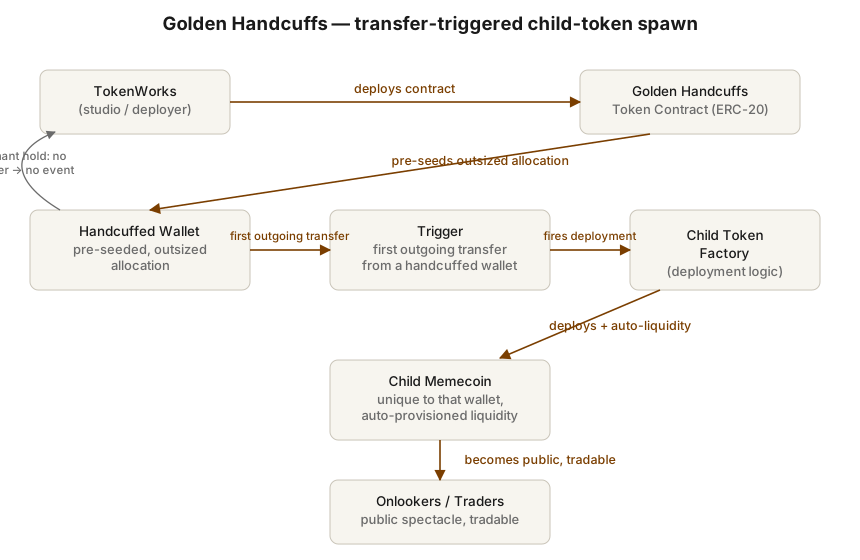 Open full-size diagram
Summary
Golden Handcuffs is the third experiment (project 003, dated 2024-12-01) from TokenWorks, a studio that describes itself as "a playground for onchain financialized ideas" and that has shipped roughly monthly token-art experiments since October 2024. Like most TokenWorks drops it is best understood as conceptual art rendered as a live token contract rather than as a product seeking product-market fit.
The premise, per the studio's own description, is an ERC-20 in which a set of preselected "handcuffed" wallets each hold large allocations. The moment such a wallet makes its first outgoing transfer, the contract deploys a personalized child memecoin for that wallet, complete with auto-provisioned liquidity. The effect is to convert the ordinarily private, mundramatic act of an insider "selling" into a public, irreversible onchain spectacle. The stated intent is to mirror and reframe influencer token launches — the recurring 2024 pattern in which a personality launches a coin, wallets seeded before public trading sell first, and price typically declines for buyers who enter afterward.
Naming is the whole thesis: real-world "golden handcuffs" are compensation structures (unvested equity, deferred bonuses) engineered to make leaving costly. Here the "handcuff" is inverted and made theatrical — you can leave at any time, but the act of leaving publicly mints a monument to your exit.
TokenWorks' founder is credibly Adam Lizek, who operates under the handle Rhynotic (@Rhynotic); the studio account @token_works is linked directly from token.works and is treated as the canonical channel. No dedicated Golden Handcuffs project site, contract address, or post-mortem could be located from primary sources, so several outcome facts below are explicitly marked as not found.
Design (Mechanism)
Reconstructed from the studio's own one-line description (a verified contract for this specific drop was not located, so the internals below are described at the level the studio published, not line-by-line from bytecode):
- Pre-seeding. At deployment, a curated set of wallets — the "handcuffed" addresses — are granted outsized token balances. The selection is editorial: these stand in for the "insiders/influencers" of a typical launch.
- Dormant hold. So long as a handcuffed wallet never sends tokens out, nothing happens. Holding is free and silent.
- Transfer-triggered deployment. A handcuffed wallet's first outgoing transfer is the trigger. The contract (or an associated factory) responds by deploying a new child memecoin uniquely tied to that wallet and seeding it with auto-liquidity.
- Spectacle. The child token becomes a permanent, public artifact of that wallet's decision to move/sell — legible to anyone watching the chain or a front-end. Selling is no longer a quiet exit; it is a broadcast that literally spawns a new object.
Actors / value flow: the studio (author + deployer) → handcuffed wallets (the "cast") → the moment of first transfer (the trigger) → a freshly deployed child token with liquidity (the output) → onlookers/traders who may interact with the child token. Value is not obviously extracted to the studio; the mechanism's payoff is expressive/reflexive rather than a fee capture (no fee/tax structure is documented for this drop, in contrast to later TokenWorks pieces like PunkStrategy).
Mechanism family. It combines a behavioral trip-wire (state change gated on a specific action) with on-demand token deployment (a factory pattern) and reflexivity (the design's meaning depends on participants reacting to being watched). It is a close cousin of TokenWorks' other early "game-theoretic performance" drops (e.g., PVP's wallet-raid auction).
Outcome
Status: too_early_to_judge / effectively an art edition. Concrete outcome metrics — participation, how many child tokens actually spawned, holder counts, secondary-market activity, or any dollar figures — could not be found in primary or secondary sources. No dedicated post-mortem, governance thread, audit, or contract explorer link for Golden Handcuffs surfaced. What is confirmed is only that the piece was published as project 003 on 2024-12-01 and remains listed in the TokenWorks archive.
This absence is itself informative: unlike TokenWorks' later, more commercially resonant works (PunkStrategy/$PNKSTR and TokenStrategy drew press coverage on Bankless and elsewhere), Golden Handcuffs generated little durable public documentation. That pattern is consistent with a small, early, conceptual drop that was appreciated within a niche and then archived — not a failure so much as a piece whose "success" was expressive rather than economic.
Why it worked
- Sharp, legible concept. The core idea — "make the act of selling deploy a monument to your selling" — is instantly graspable and rhymes with a well-known 2024 pattern (influencer-launched tokens followed by early insider sales). Good conceptual art tokens win on legibility, and this one is legible.
- Mechanism is the message. The satire isn't in a manifesto; it's enforced in code. The contract can't be argued with, which is exactly the rhetorical power TokenWorks trades on.
- Fits a coherent, credible studio practice. Coming from a studio with a monthly cadence and an identifiable author (Rhynotic/Adam Lizek), the piece benefits from context and continuity rather than standing alone as an anonymous coin.
Where the design broke
- No lasting economic or documentary footprint. With no findable contract, metrics, or retrospective, the piece left almost no verifiable trail — limiting both its cultural reach and any historian's ability to evaluate it.
- Reflexive mechanisms need an audience to fire. A "spectacle triggered by selling" only becomes spectacle if enough people are watching and enough handcuffed wallets actually transfer. An early, low-attention drop risks the trigger simply not being pulled at scale, leaving the concept theoretical.
- Satire adjacent to the thing it satirizes. "Handcuffed wallets that spawn child memecoins on sale" is uncomfortably close in shape to the insider-seeded launches it critiques; without strong framing, such pieces can be misread as the very behavior they mock.
Lessons
- Encode the thesis in the trigger, not the copy. Golden Handcuffs' most reusable idea is gating a dramatic, irreversible on-chain event on a specific human action (first outgoing transfer). Designers wanting behavior to feel consequential can make consequences literal and public rather than relying on messaging.
- Reflexive/spectacle mechanisms have an attention prerequisite. If your design's value depends on people watching participants act, you must budget for distribution and observability up front; the mechanism is inert without an audience. Pair novel triggers with a way to surface them.
- Document your own primary record, or the work vanishes. The single biggest gap here is evidentiary: no canonical contract link, no metrics, no retrospective. Even purely artistic drops should publish a durable, self-hosted record (address, notes, snapshot) — otherwise the piece becomes un-analyzable and effectively disappears from the historical ledger.
- Same-name accounts are a real hazard. A separate
@TokenWorksX account (distinct from the official@token_works) exists; conflating them would misattribute the work. Always resolve the handle the official domain actually links to.
Redesign (EDITORIAL — hypothesis, not fact)
The following is the researcher's editorial hypothesis, not established fact.
If the goal is to sharpen the satire and leave a durable, analyzable artifact, a v2 might:
Publish a canonical record at deploy time. Ship a minimal, self-hosted project page (like TokenWorks' later drops get) with the verified contract address, the list of handcuffed wallets, and a live counter of how many child tokens have spawned. This turns an ephemeral gesture into a legible historical object and lets the spectacle accumulate visibly.
Make the "handcuff" cost real and reflexive. Rather than a free hold, route a small, transparent share of each child token's launch liquidity back to the remaining handcuffed holders — so that each insider who "breaks handcuffs" measurably enriches those who don't. This makes the retention metaphor bite (leaving is now literally a gift to those who stay) and creates a genuine game among the cast, not just a one-shot event.
Force observability into the mechanism. Emit rich, indexed events and mint a companion soulbound "exit certificate" to any wallet that trips the trigger — a permanent, non-transferable badge of the sell. This guarantees the spectacle is discoverable on-chain even without a front-end and hardens the satire (the exit is branded, not just broadcast).
Pre-register the interpretation. Because the piece structurally resembles the launches it critiques, an explicit, contract-linked artist's statement (pinned by @token_works and mirrored on the project page) would reduce the risk of the work being mistaken for an actual insider token sale.
Net: keep the elegant core trigger; add durability, a real inter-participant game, and enough framing that the critique can't be mistaken for the crime.
Sources
- TokenWorks — official studio site (project listings) — primary (docs)
- TokenWorks — Archive (Golden Handcuffs listed as project 003, dated 12-01-24) — primary (docs)
- TokenWorks (@token_works) on X — official studio account linked from token.works — primary (docs)
- TokenWorks project profile (RootData) (analysis)
- What TokenWorks Is Building Next (Bankless, W. M. Peaster) (news)
- Rhynotic / Adam Lizek profile (The Monty Report) (analysis)
Related experiments
Last verified: 2026-07-26 · Spot an error? Suggest a correction