Circle
TokenWorks' first onchain experiment: a fair-launched ERC-20 memecoin on the Shape L2 whose onchain circle visually grows and shrinks with its market cap.
▶ Run interactive simulation animated mechanism with editable parameters
How it works onchain
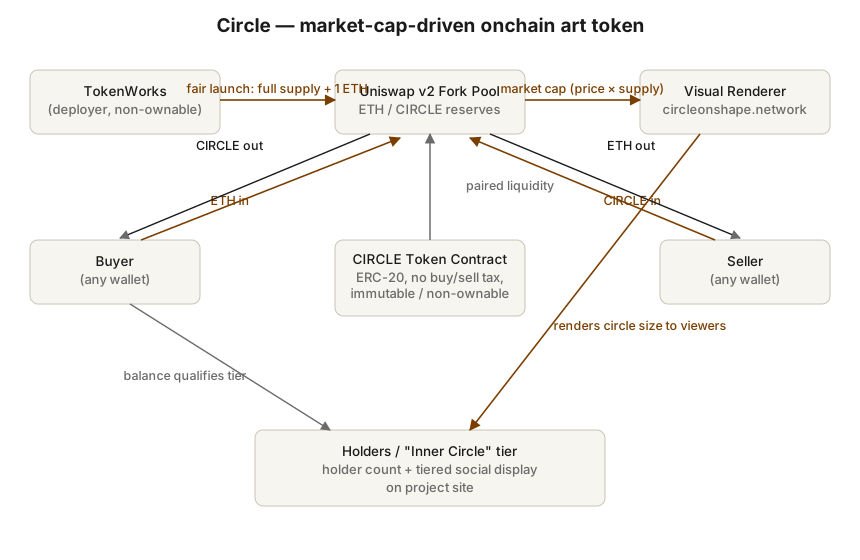 Open full-size diagram
Summary
Circle was the inaugural experiment from TokenWorks, the "part game studio, part research lab" run by developer Adam Lizek (known onchain as @Rhynotic). It launched in early October 2024 on Shape — an Ethereum L2 aimed at artists and creators that went live around September 30, 2024. Circle is best understood not as a serious financial instrument but as a piece of interactive onchain art wearing a memecoin as its medium: a single ERC-20 token whose entire pitch is a circle that visibly grows as the token's market cap rises and shrinks when it falls. The name deliberately plays off the host chain, "Shape." TokenWorks describes its ethos as an onchain analogue to MSCHF, and Circle set the template for the studio's later, more mechanically ambitious "strategy coin" products (NFTStrategy, PunkStrategy).
Design (Mechanism)
The core mechanism is intentionally minimal and legible. TokenWorks deployed a Uniswap v2 fork on Shape and fair-launched by pairing the full token supply against just 1 ETH in the pool, which set the opening market cap at roughly $5,000. There was no presale, no team allocation carve-out, and — by choice — no buy/sell tax, even though the team publicly acknowledged that a tax would have been an obvious revenue lever.
The distinctive feature is the market-cap-driven onchain visual: the size of the rendered circle is a direct function of the pool-derived market cap, so "every buy makes the circle bigger, and every sell makes it smaller." This turns the AMM price curve itself into a live generative-art object, making the speculative act (buying/selling) and the aesthetic payload (the growing/shrinking circle) one and the same. The project also layered in a social/tiered-holder element — a general "holders" count plus an "Inner Circle" category — surfaced through the project site. Because the contract was deployed in a non-ownable configuration, the mechanism was credibly immutable, which is thematically consistent with a fair-launch art piece but had a real cost (see below).
Outcome
Outcome status: partial_success. Circle succeeded strongly as a viral art-and-attention experiment and as a proof of concept for TokenWorks, while remaining a small, non-durable financial asset. Launching on a brand-new chain meant "there were no snipers" at genesis, so distribution happened organically through Shape community channels and Twitter, drawing thousands of participants who bridged in to take part. The visual gimmick was highly screenshot-able and generated meaningful social engagement; notably, the artist Beeple featured Circle in his daily-artwork series, a strong signal of reach within the digital-art community. TokenWorks later added cross-chain bridge functionality to lower friction and gave the token renewed momentum. Concrete peak-market-cap and long-term liquidity figures are Unknown / not found as of last verification; the token appears to persist onchain but is not a live commercial success. Most importantly, Circle validated the studio and its audience, directly seeding the later strategy-coin ecosystem (TokenWorks subsequently raised ~250 ETH via its FundingWorks model).
Why it worked
- Perfect chain/theme fit and timing. Launching a "shape"-themed art coin on the art-focused Shape L2 on roughly day one meant a captive, aligned audience and no adversarial snipers to spoil the fair launch.
- The mechanism is the marketing. Tying an onchain generative visual directly to market cap made the token inherently shareable — the chart and the artwork were the same object, which drove organic distribution.
- Credible neutrality. A fair launch (full supply vs. 1 ETH), no tax, and a non-ownable contract signaled that the team wasn't extracting value, which built trust in a trust-scarce memecoin environment.
- Founder credibility. Adam Lizek / @Rhynotic already had standing in the digital-art collector community, giving the experiment a warm audience and endorsements (e.g., Beeple).
Where the design broke
- No durable value accrual. By design there was no tax, no fee routing, and no sink — nothing that would let the token capture value or sustain a floor after the novelty faded. It was an art piece first, so it behaved like one.
- Non-ownability forfeited operational upside. Because the contract was non-ownable, ~3 ETH in Shape gas rewards reportedly went unclaimable by any address — a direct cost of the "immutable art" configuration.
- Single-chain, thin-liquidity origin. Bootstrapping against 1 ETH on a nascent L2 kept liquidity shallow; the later bridge additions were a patch, not a native cross-chain design.
- Ephemeral attention. Like most memecoins, its social momentum was a spike, not a compounding flywheel; the mechanism was a one-note (if elegant) idea.
Lessons
- A mechanism that is visually legible can be its own distribution channel. When the speculative action and the aesthetic output are unified onchain, the artifact markets itself far more efficiently than a whitepaper.
- Immutability has real, quantifiable costs. Non-ownable, tax-free deployments buy trust but forfeit revenue (here, unclaimed gas rewards and any protocol fee capture). Designers should decide consciously whether they are building art or a business — and price the trade-off.
- Fair launches benefit enormously from launching where snipers aren't. Timing a launch to a fresh ecosystem, rather than a mature MEV-saturated venue, materially improved distribution fairness.
- Small experiments can be strategically valuable even if financially minor. Circle's real payoff was validating TokenWorks' audience and thesis, which funded and shaped its later, more complex strategy-coin products.
Redesign (EDITORIAL — hypothesis, not fact)
The following is the researcher's opinion, not established fact. If I were redesigning Circle to keep its artistic soul while giving it durability, I would move the mechanism to a Uniswap v4 hook (the toolkit TokenWorks itself adopted for later projects) so the circle-rendering logic and a modest, transparent dynamic fee live in the same swap path. A small fee could route into a protocol-owned liquidity reserve and a buyback-and-deepen loop, so that speculation actively thickens the pool rather than just inflating a transient price — turning "the circle grows" into "the floor grows." I would make the visual multi-dimensional: encode not just market cap in radius but volatility, holder count, and time-held in color, stroke, or concentric rings, so the "Inner Circle" tier becomes a legible, evolving artwork rather than a flat counter. To fix the gas-reward forfeiture without sacrificing credible neutrality, I'd keep the core token immutable but route ancillary rights (gas rewards, fee switches) through a timelocked, publicly-owned module governed by holders, separating "art contract is immutable" from "operational upside is unclaimable." Finally, I'd design a deliberate, honest end state — e.g., a snapshot/mint that immortalizes the final circle as a 1/1 onchain artwork — so the experiment has a dignified conclusion instead of decaying into an abandoned memecoin. These changes are hypotheses about how to trade off Circle's purity for longevity; they would need onchain validation.
Sources
- Circle — TokenWorks archive page — primary (docs)
- Circle On Shape — project site — primary (docs)
- #384: The Strategy in TokenWorks' NFTStrategy (retrospective on TokenWorks experiments incl. Circle) (analysis)
- Collecting Art in the 21st Century: A Conversation with Adam Lizek, AKA Rhynotic (news)
- THE FUNDING WORKS — TokenWorks / Rhynotic funding model (Bored Ape Gazette) (news)
- Chainlink Callback Exploit Hits TokenWorks (later, unrelated TokenWorks product) (news)
Related experiments
Last verified: 2026-07-26 · Spot an error? Suggest a correction