Ajna Protocol
A fully immutable, oracle-free, governance-free peer-to-pool lending protocol that replaces price feeds with lender-chosen price buckets and replaces governance with market-derived interest rates and bond-backed liquidation auctions.
▶ Run interactive simulation animated mechanism with editable parameters
How it works onchain
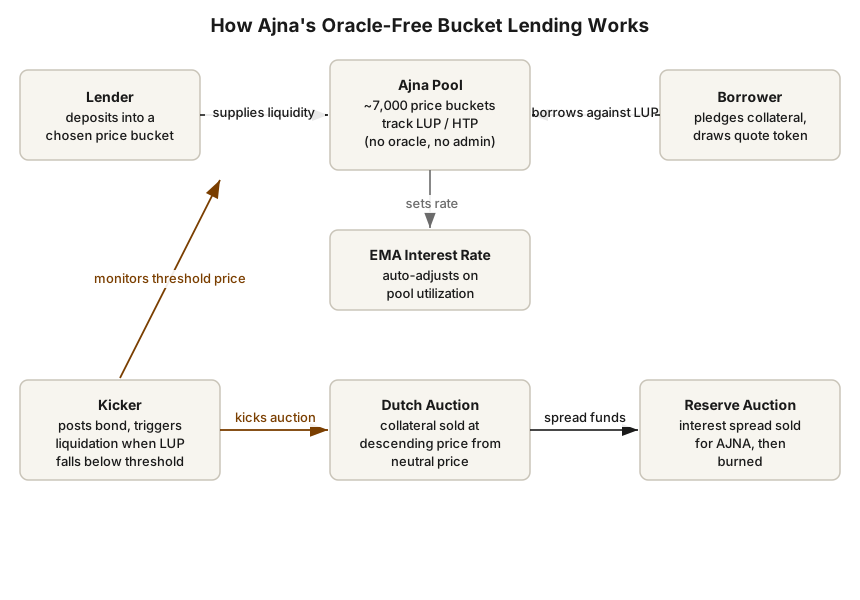 Open full-size diagram
Summary
Ajna is an attempt to build lending the way Uniswap built trading: a hyperstructure with no admin keys, no governance, no upgradability, and — most radically — no price oracles. Written by MakerDAO alumni Akash Patel (former Head of Trading at Maker) and Ed Noepel, the whitepaper's thesis is that oracles and governance are the two great centralization vectors and systemic-risk sources in DeFi lending. Ajna deletes both: anyone can permissionlessly create a pool for any ERC-20 or ERC-721 pair, lenders themselves express prices by choosing deposit buckets, interest rates float algorithmically with utilization, and liquidations are policed by bonded third-party "kickers" running Dutch auctions. First deployed to Ethereum mainnet on July 13, 2023 after roughly ten audits/contests (Sherlock, Trail of Bits, Quantstamp, Code4rena, Prototech), it was wound down after independent auditor Kirill Fedoseev found a griefing vector, then re-audited (Sherlock, Certora, Prototech, Fedoseev) and relaunched in January 2024 across mainnet and L2s. The design works as specified and has been bridged to a dozen-plus chains, but adoption never compounded: TVL briefly crossed ~$10M in early 2024 and by 2026 sat under ~$1M with negligible fee revenue.
Design (Mechanism)
Each Ajna pool pairs one quote token (lent) with one collateral token (pledged) and discretizes prices into ~7,000 fixed buckets, conceptually similar to Uniswap v3 ticks. A lender deposits quote tokens into the bucket whose price equals the maximum amount of quote token they are willing to lend per unit of collateral — the lender's bucket choice is the price feed. Key mechanisms:
- LUP/HTP solvency logic. The Lowest Utilized Price (LUP) is the lowest bucket price at which deposits are needed to cover all outstanding debt; the Highest Threshold Price (HTP) is the threshold price of the least-collateralized loan. A loan is liquidation-eligible when the LUP falls below its threshold price; lenders can only withdraw deposits that don't push the LUP below the HTP. The pool thus tracks the external market price through lenders' and borrowers' revealed preferences, not an oracle.
- Bonded liquidations via Dutch auction. Anyone may "kick" an undercollateralized loan by posting a liquidation bond. The collateral is sold in a descending-price auction anchored to a "neutral price"; kickers who trigger auctions that clear above the neutral price lose part of their bond, so false liquidations are penalized economically rather than prevented by an oracle check.
- Market-derived interest rates. Rates adjust algorithmically (no governance parameter-setting) based on EMA measures of pool utilization, nudging the rate up or down on a rate-limited schedule until lender supply and borrower demand balance.
- Reserve auctions and AJNA burn. A spread between borrower interest and lender yield accrues to pool reserves, which are periodically sold via Dutch auction for AJNA tokens that are burned — a buy-and-burn value accrual requiring no fee switch or treasury vote.
- Immutability as policy. Contracts have no upgrade path or admin functions; Ajna Labs cannot alter them post-deployment. The only collective mechanism is a Grant Fund that lets AJNA holders allocate a communal treasury quarterly to ecosystem builders. NFT pools reuse the same bucket machinery, treating pricing as the traders' problem rather than an oracle's.
- Implementation details: Fenwick trees track deposits across buckets in O(log n); a max-heap orders loans by threshold price.
Outcome
Technically, Ajna largely delivered: a genuinely oracle-free, governance-free, immutable lending system passed one of the heaviest audit gauntlets of its era (10+ engagements). The one blemish — the 2023 griefing vector — was caught before user losses, and because immutable contracts can't be patched, the team executed a full wind-down and redeploy, relaunching January 2024 on Ethereum, Arbitrum, Base, Optimism, and Polygon (later bridged to Avalanche, Blast, BNB, Gnosis, Linea, Mode, Filecoin, Rari, Hemi). Commercially it stalled. TVL crossed ~$10M in January 2024 amid relaunch enthusiasm and integrations (e.g., Summer.fi front-ends), but never approached Aave/Morpho scale; by 2026 DefiLlama-tracked TVL had decayed to under $1M with annual fee revenue in the hundreds of dollars, and AJNA's market price collapsed to fractions of a cent. The protocol still runs exactly as deployed — which is the point — but almost nobody uses it.
Why it worked
- The bucket mechanism proved that oracle-free, market-priced lending is implementable and safe: no oracle-manipulation surface, no governance-capture surface, no admin-key rug surface.
- Extreme audit discipline plus willingness to wind down and redeploy (rather than hot-patch) preserved a clean loss record.
- Long-tail permissionlessness worked as designed — any token pair, including NFTs, can get a market with no listing vote.
Where the design broke
- The UX cost of no oracle is high: lenders must actively manage bucket positions as prices move or lose money to rebalancing/liquidations — lending became market-making. Passive capital, which dominates DeFi lending, went to Aave/Morpho/Spark instead.
- No governance also meant no levers for growth: no incentive programs, fee tweaks, or partner listings could be voted in; the Grant Fund was too weak a flywheel.
- Immutability turned every bug into a full redeploy; the 2023 wind-down cost six months of momentum into a market where competitors (notably Morpho Blue, launched the same winter) offered similar permissionless-market pitches with familiar oracle-based UX.
- Liquidity fragmentation across ~7,000 buckets and many chains left thin books, high borrowing rate volatility, and poor headline rates.
Lessons
- Oracles and governance are not just risks; they are subsidies. Removing them transfers pricing work and parameter-tuning onto users, and most users will not pay that cost for marginal trust gains.
- Immutability converts security incidents from patches into relaunches; teams choosing it need a credible wind-down mechanism (Ajna's worked) and should budget for the momentum loss.
- "Truly decentralized" is not a distribution strategy. Ajna's ideological purity won respect (Bankless coverage, MixBytes teardowns) but competitors that compromised — permissionless markets with oracles (Morpho Blue) — captured the demand Ajna identified.
- Bonded, auction-based liquidation is a reusable primitive: penalizing false kicks economically is a viable substitute for oracle-verified liquidation triggers.
Redesign (EDITORIAL — hypothesis, not fact)
This section is editorial speculation, not fact. A plausible redesign keeps Ajna's bucket/LUP core but sells passivity back to lenders: ship first-party "managed range" vaults (analogous to Uniswap LP managers) that auto-migrate deposits across buckets tracking a manipulation-resistant internal TWAP of the pool's own LUP, so passive lenders get oracle-like UX with oracle-free settlement. Second, make immutability modular rather than monolithic — versioned pool factories with a standing, well-funded migration bounty so redeploys are routine rather than existential. Third, replace the quarterly Grant Fund with automatic AJNA emissions streamed to pools weighted by organic interest paid (not TVL), giving the ungoverned system a growth loop that cannot be captured because it is formulaic. Finally, concentrate: launch with 5–10 curated deep pools on one chain instead of bridging a ghost town to fourteen.
Sources
- Ajna Protocol Whitepaper (Akash Patel, Ed Noepel; Jan 11, 2024) — primary (docs)
- ajna-finance/contracts (GitHub, BUSL with OSI transition Apr 2026) — primary (contract)
- Ajna FAQ — Deployment Addresses & Bridges — primary (docs)
- Ajna FAQ — General (audit history) — primary (docs)
- Ajna launches oracle and governance-free lending protocol on Ethereum (The Block, Jul 13, 2023) (news)
- Ajna Protocol Completes Audits and Relaunches on Mainnet and L2s (press release, Jan 2024) (news)
- Modern DeFi Lending Protocols, how it's made: Ajna (MixBytes) (analysis)
- Ajna Protocol TVL, Fees & Revenue (DefiLlama) (analysis)
Related experiments
Last verified: 2026-07-27 · Spot an error? Suggest a correction