BendDAO
The first peer-to-pool NFT-collateralized lending protocol on Ethereum, canonical for its August 2022 bank run when illiquid NFT collateral met instantly-withdrawable ETH deposits.
▶ Run interactive simulation animated mechanism with editable parameters
How it works onchain
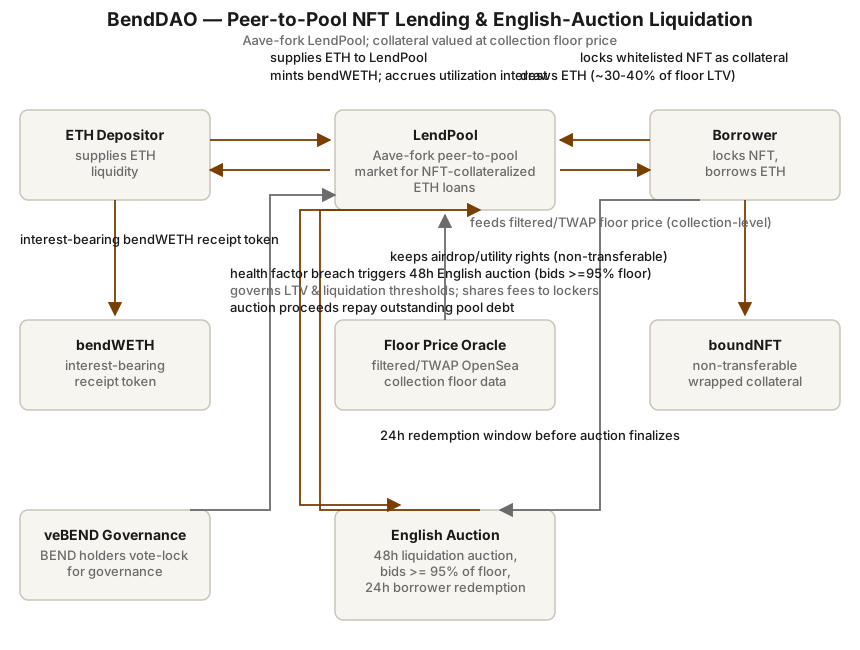 Open full-size diagram
Summary
BendDAO, launched on Ethereum in March 2022 by a pseudonymous team (co-founder "CodeInCoffee" is the most-cited name), was the first significant peer-to-pool NFT lending protocol. Instead of matching individual lenders with individual NFT borrowers (the earlier NFTfi model), BendDAO pooled ETH deposits Aave-style and let holders of "blue-chip" collections (BAYC, MAYC, CryptoPunks, Azuki, Doodles, CloneX) instantly borrow 30–40% of their collection's floor price. Within 44 days of launch it had absorbed hundreds of top NFTs and became the largest single holder of BAYC and MAYC. In August 2022, falling floor prices triggered a now-canonical liquidity crisis: liquidation auctions found no bidders, depositors ran for the exit, and the ETH reserve was almost completely drained before an emergency governance vote (BIP#9, ~97% in favor) re-parameterized the protocol. BendDAO survived, later shipping a V2 and ApeChain staking products, but never regained its 2022 scale.
Design (Mechanism)
- Peer-to-pool lending: Depositors supply ETH to a shared LendPool (architecture explicitly adapted from Aave, per the project's own repo) and earn utilization-based interest via an interest-bearing token (bendWETH). Borrowers lock a whitelisted NFT and instantly draw ETH up to a collection-level LTV (~30–40% of floor price).
- Floor-price oracle: Collateral is valued at the collection floor price fed by an oracle (filtered/time-averaged OpenSea data), not per-item traits — pricing every ape as the cheapest ape.
- boundNFT: Collateralized NFTs are wrapped into non-transferable boundNFTs, preserving airdrop/utility rights for the borrower while making the custody contract-native and theft-resistant.
- Health factor + English auction liquidation: When debt/collateral crossed the liquidation threshold (originally 85–95% region relative to floor), anyone could trigger a 48-hour auction; the original design also required bids ≥95% of floor price and gave borrowers a 24-hour redemption window. Auction proceeds repay the pool.
- Aux products: "Collateral Listing" (list an NFT for sale while borrowing up to 40% of floor immediately) and "NFT Down Payment" (buy blue-chips with ~60% down, remainder flash-loaned from Aave and converted into a Bend loan).
- Governance/token: BEND token with vote-escrow (veBEND) governance over parameters; fee sharing to lockers.
Outcome
For its first months BendDAO was a runaway product success: by early May 2022 it held 231 BAYC, 288 MAYC, 126 Azuki, 108 CloneX, 50 CryptoPunks and 21 Doodles. Then NFT floors fell ~50%+ through mid-2022. Loans went underwater, but auctions failed: the 95%-of-floor minimum bid plus a 48-hour capital lockup made bidding irrational in a falling, thin market, so bad debt sat unliquidated. Depositors, seeing floor-price risk with no liquidation clearing, withdrew ~15,000 ETH within about 48 hours in late August 2022; contemporaneous reports put the remaining reserve anywhere from a few hundred WETH down to under 20 WETH at the trough, with utilization pinned at 100% and lenders temporarily unable to exit. Emergency proposal BIP#9 passed with ~97% support: liquidation threshold stepped down from 95% toward a 70% baseline (5%/week to Sept 20), auction period cut from 48h to 4h, the 95%-of-floor first-bid rule removed, and base interest rates raised (rates briefly spiked toward ~100% APR at full utilization, pulling deposits back). The protocol avoided insolvency and never went down, but the episode permanently damaged confidence; alongside the broader NFT bear market, TVL collapsed from hundreds of millions at peak to under ~$1M on the core protocol by 2025–26 (DefiLlama), with the team pivoting toward V2 modular lending and ApeCoin/ApeChain staking. Verdict: partial_success — the mechanism survived its stress test only via emergency governance, and the business never recovered its peak; but it did not fail, was not exploited, and still operates.
Why it worked
- Instant liquidity against illiquid assets was a genuinely new primitive at scale; peer-to-pool removed the negotiation friction of P2P NFT lending, and adoption was explosive.
- boundNFT elegantly solved the "collateral loses its utility" problem (airdrops, claims) that plagued custodial NFT loans.
- Conservative LTVs (30–40%) meant the crisis was primarily a liquidity crisis, not a solvency one — a crucial distinction that made the governance rescue possible.
- Governance actually functioned under fire: BIP#9 was drafted, voted (97%), and executed within days, and the parameter changes worked as intended.
Where the design broke
- Duration/liquidity mismatch: instantly-withdrawable deposits funded loans against assets that can take weeks to sell — a textbook bank-run structure with no liquidity buffer or withdrawal gate.
- Liquidation design assumed continuous market depth: the 95%-of-floor minimum bid and 48h lockup meant liquidators were asked to buy falling NFTs at nearly spot price — so nobody did, and the backstop mechanism silently switched off exactly when needed.
- Floor-price oracle reflexivity: floor prices are thin and manipulable; mass liquidations of the largest BAYC holder would themselves crash the floor, threatening a cascade (partially avoided only because liquidations weren't clearing).
- Correlated, single-sector collateral: all collateral was blue-chip NFTs that crash together; no diversification dampened the shock.
Lessons
- Match redemption terms to collateral liquidity. Demand deposits against auction-cleared collateral recreate fractional-reserve bank fragility onchain; either term-match funding or hold explicit liquidity buffers.
- Stress-test the liquidation mechanism at the point of maximum pain. A liquidation system that is unprofitable for liquidators during a crash is functionally absent; minimum-bid floors and long capital lockups are hidden off-switches.
- Floor-price oracles import reflexivity. When the protocol itself is the largest holder of the collateral, its own liquidations move the oracle; concentration limits per collection are a risk parameter, not an afterthought.
- Parameter governance is a real, but last-resort, safety valve. BendDAO shows fast token-holder governance can avert insolvency — and also that needing it means the automated design already failed.
- Surviving is not recovering. Trust in a lending pool, once broken by a visible bank run, is far more expensive to rebuild than the bad debt itself.
Redesign (EDITORIAL — hypothesis, not fact)
This section is editorial hypothesis, not established fact. A redesigned BendDAO would attack the duration mismatch first: tranche the deposit side into instant-withdrawal (capped at, say, 20% of pool, earning less) and time-locked term deposits that fund the bulk of loans, with a utilization-triggered withdrawal queue instead of a first-come-first-served drain. Liquidations would be Dutch auctions starting above oracle floor and decaying continuously to a true clearing price — no minimum bid, no bidder lockup — plus a protocol-owned backstop fund (funded from interest spread) that buys collateral at a deep, pre-committed discount as bidder of last resort. Oracle risk would be reduced with per-collection concentration caps (e.g., the pool may hold no more than 5–10% of a collection's supply as collateral) and LTVs that scale down as the protocol's share of a collection rises. Finally, publish the reserve-coverage ratio as a first-class dashboard metric; the August 2022 run accelerated precisely because depositors could see utilization hitting 100% but had no credible signal about orderly-exit capacity.
Sources
- BendDAO Lending Protocol (verified source, audits listed) — primary (contract)
- BendDAO GitBook portal (mechanism docs: boundNFT, collateral listing, down payment) — primary (docs)
- BIP#9: Adjusting Liquidation Threshold, Auction Period, and Interest Base Rate — primary (governance)
- BendDAO LendPool on Etherscan — primary (contract)
- CoinDesk: Bank Run at NFT Lender BendDAO Prompts Attempt to Avert Another Liquidity Crisis (news)
- Decrypt: How Ethereum NFT Lending Service BendDAO Aims to Solve Its Liquidity Crisis (news)
- Fortune: How Bored Ape lender BendDAO nearly went bust (news)
- Fundamental Labs: BendDAO, the NFT liquidity crisis (analysis)
- MixBytes: BendDAO Protocol Overview (analysis)
- DefiLlama: BendDAO TVL (analysis)
Related experiments
Last verified: 2026-07-26 · Spot an error? Suggest a correction