American CryptoFed DAO
The first legally recognized DAO in the US, a Wyoming DAO LLC that designed a Hayekian two-token 'inflation-proof' monetary system (Ducat/Locke) but never launched it onchain, spending nearly five years pursuing a federal token-registration process that closed out unresolved in 2026.
▶ Run interactive simulation animated mechanism with editable parameters
How it works onchain
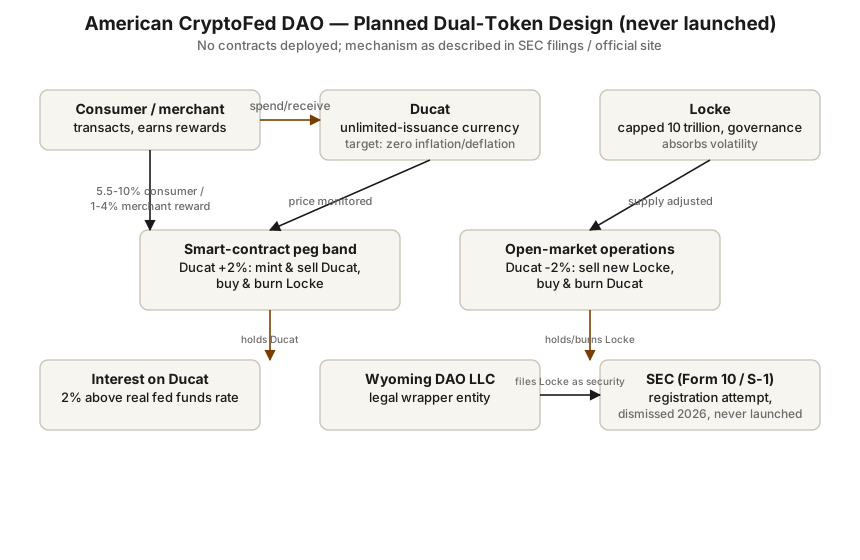 Open full-size diagram
Summary
American CryptoFed DAO is a Wyoming entity that became, on July 1, 2021, the first legally recognized DAO in the United States, registering as a DAO LLC under Wyoming's then-new DAO statute. It was organized by mSHIFT Inc. — a mobile-banking pioneer founded in 1999 by Scott Moeller — with Marian Orr (former mayor of Cheyenne) as CEO and Xiaomeng Zhou as the third organizer. Its stated mission is a "monetary system with zero inflation, zero deflation and zero transaction costs" built on two tokens: Ducat, an inflation-and-deflation-protected currency token with unlimited issuance, and Locke, a finite (10 trillion max) governance token that absorbs volatility. Rather than launch permissionlessly, CryptoFed took the unusual path of filing for federal registration of its tokens in September 2021. That process remained open for nearly five years and was closed out in early 2026 without CryptoFed ever launching Ducat or Locke onchain. No token has ever publicly traded.
Design (Mechanism)
The design is explicitly Hayekian, citing Denationalization of Money, and reads more like a private central bank charter than a DeFi protocol:
- Ducat (currency token): unlimited issuance constrained only by a zero-inflation/zero-deflation target. Intended as medium of exchange, unit of account and store of value; initially pegged to USD, with a "Target Exchange Rate" designed to appreciate against USD to offset accumulated dollar inflation.
- Locke (governance token): capped at 10 trillion, distributed free to contributors (25% reserved for mSHIFT as founding organization), used for governance and as the seigniorage-absorbing balance-sheet asset.
- Open-market operations (peg band): if Ducat trades 2% above target, smart contracts mint and sell Ducat for USD-stablecoins and use proceeds to buy and burn Locke; if Ducat falls 2% below target, new Locke is sold to buy back and burn Ducat — the classic dual-token seigniorage-shares structure (cf. Basis, Terra).
- Monetary policy: interest paid to Ducat holders, targeted at a minimum of 2% above the real federal funds rate.
- Fiscal policy / adoption incentives: consumer rewards of 5.5%–10% and merchant rewards of 1%–4% on Ducat transactions, adjusted quarterly against inflation signals; merchants also receive 3% of transaction value in Ducat to cover payment-gateway costs, plus Locke grants for POS integration. Dual USD/Ducat price tags and QR-code payments at point of sale.
- Legal wrapper: Wyoming DAO LLC (later described as transitioning toward a Wyoming unincorporated nonprofit association), with non-Wyoming participants asked to form Wyoming LLCs. Planned deployment referenced EOS and Ethereum, with Uniswap v3 integration for swaps.
- Regulatory mechanism (the real experiment): register Locke via Form 10 as an equity security of a reporting company, and argue for utility-token treatment for distribution — attempting compliance-first token issuance through the existing 1933/1934 Act machinery.
Outcome
The onchain system never launched; the registration process consumed the project's life. CryptoFed filed for federal registration of its tokens in September 2021, sought to withdraw part of that filing in mid-2022, and the matter was closed out in February 2026 without ever being resolved in CryptoFed's favor or against it. As of mid-2026 there are no deployed, publicly verified token contracts, no trading, and no merchant network in production. Verified contract addresses: Unknown / not found.
Why it worked
- Legal-innovation first-mover: it genuinely was the first US-recognized DAO LLC, proving Wyoming's DAO statute was usable and putting DAO legal wrappers on the national agenda.
- Survival: unlike most seigniorage-shares projects of its cohort (Terra, Basis Cash), it never launched, so it never collapsed.
- Coherent paper design: the mechanism integrates monetary policy (interest), fiscal policy (rewards) and open-market operations into one system, a more complete "central bank" abstraction than most algorithmic stablecoins attempted.
Limitations and criticisms
- No onchain deployment to date: as of mid-2026 there are no verified contracts, users, or trading — the economic mechanism remains entirely theoretical and has never been tested at any scale.
- Untested mechanism risk: the Ducat/Locke design is structurally a dual-token algorithmic peg backed by the market value of its own governance token; Terra's May 2022 collapse demonstrated the reflexive death-spiral failure mode of exactly this class of design, and CryptoFed's inflation-adjusted (upward-drifting) peg would be harder to defend than most.
- Adoption economics rely on subsidy: promised consumer rewards of 5.5%–10% are funded by Locke value creation rather than any demonstrated exogenous revenue — a structure that has not yet been tested with real users.
Lessons
- A legal wrapper is not a go-to-market. Wyoming DAO LLC status solved entity recognition but nothing about token distribution, liquidity, or product adoption; a state-level wrapper could not resolve the far larger federal registration process the project had chosen to undertake first.
- Internal consistency matters more than the filing itself. A compliance-first token strategy that argues inconsistent things about the same token in its own paperwork undermines itself before a regulator ever has to act; consistency and complete financials are prerequisites, not afterthoughts.
- Seigniorage-shares pegs need exogenous demand or collateral. A currency token stabilized by minting/burning a governance token depends on perpetual belief in that governance token's value — the same reflexivity that destroyed Terra. The years-long registration process meant CryptoFed never faced a live test of this.
- Timing matters as much as design. A project that spends years unable to launch may technically "survive," but it forfeits its original market window regardless of how that delay eventually resolves.
Redesign (EDITORIAL — hypothesis, not fact)
This section is editorial hypothesis, not a factual account. A modern rebuild would separate the three stacked bets. First, keep the Wyoming DAO/nonprofit wrapper but launch Ducat as a fully reserved token — backed by T-bill-bearing regulated stablecoins or tokenized treasuries — delivering the "inflation-protected dollar" via yield pass-through (an accumulating exchange rate against USD) rather than via seigniorage against a governance token; post-2025 US stablecoin legislation gives this a plausible licensing path that did not exist in 2021. Second, decouple Locke: distribute it as plain-vanilla governance over parameters (reward rates, reserve composition) with no role in defending the peg, removing the death-spiral coupling and simplifying the securities analysis. Third, replace the blanket 5.5%–10% rewards with merchant-funded, capped cashback in specific Wyoming pilot corridors, so incentive outflows are tied to real payment volume. Finally, file nothing until audited financials, a working audited deployment on a single chain, and a consistent legal theory (registered offering or exemption, not both) are in hand — the original project's core error was seeking formal registration before it had anything onchain to defend.
Sources
- American CryptoFed DAO — Form 10 Registration Statement (SEC EDGAR) — primary (governance)
- American CryptoFed DAO — Form S-1 Registration Statement (SEC EDGAR) — primary (governance)
- SEC Press Release 2021-231: proceedings against American CryptoFed's Form 10 — primary (governance)
- SEC Press Release 2022-208: SEC Seeks to Stop the Registration of Misleading Crypto Asset Offerings — primary (governance)
- American CryptoFed DAO official site (mechanism description) — primary (docs)
- American CryptoFed DAO — History page — primary (docs)
- SEC Dismisses Proceedings against American CryptoFed DAO (PR Newswire, Feb 2026) (news)
- American CryptoFed DAO Withdraws Locke, Ducat Token Registration Request (CoinDesk, July 2022) (news)
- SEC moves to suspend sale of American CryptoFed DAO tokens (The Block) (news)
- Goodwin — Digital Currency & Blockchain Briefing, Jan–June 2026 (dismissal analysis) (analysis)
Related experiments
Last verified: 2026-07-26 · Spot an error? Suggest a correction