Arcade
Peer-to-peer NFT-collateralized lending protocol (ex-Pawn.fi) that pioneered signature-based off-chain order matching, bundled asset vaults, and tokenized loan positions for fixed-rate, fixed-term NFT loans on Ethereum.
▶ Run interactive simulation animated mechanism with editable parameters
How it works onchain
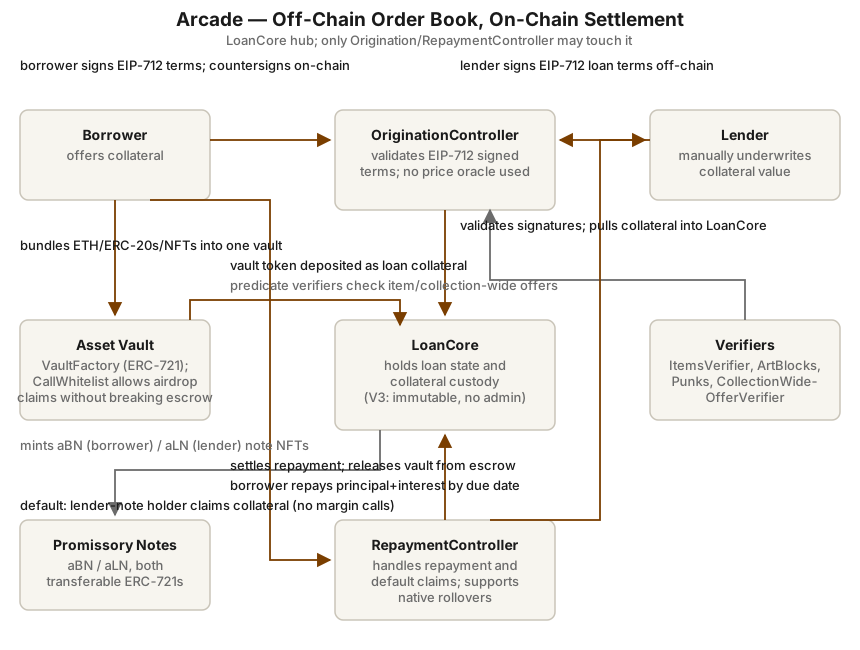 Open full-size diagram
Summary
Arcade (originally Pawn.fi) was one of the canonical peer-to-peer NFT-collateralized lending protocols on Ethereum, sitting alongside NFTfi and BendDAO in the first NFT-Fi wave. Founded in 2021 by Gabe Frank (whose family ran pawn shops — the pawn-lending framing was literal) and Robert Masiello, it raised a $15M Series A led by Pantera Capital in December 2021 and publicly launched its lending app on the "Pawn Protocol" on January 31, 2022. The core idea: let holders of blue-chip NFTs borrow ERC-20 stablecoins/ETH against their assets in fixed-rate, fixed-term loans negotiated peer-to-peer, with terms matched off-chain via signatures and settled on-chain into decentralized escrow. Arcade V1 (Feb 2022) did ~$15M in loans; V2 (Aug 2022) surpassed $120M in cumulative volume; V3 launched on mainnet September 6, 2023 with immutable, non-upgradeable contracts. An ARCD governance token and ArcadeDAO followed, with airdrop campaigns into early 2024. Despite clean engineering and multiple audits (Trail of Bits, Omniscia, 0xMacro, Quantstamp, Least Authority, plus a Code4rena contest for token/governance contracts), the NFT-lending market it depended on contracted severely after 2022, and Blur's Blend absorbed most remaining volume. As of mid-2026, the main arcade.xyz site is a "coming soon" placeholder for Arcade Labs Inc. and docs.arcade.xyz does not resolve; current operational status is unclear.
Design (Mechanism)
Arcade is a peer-to-peer order-book model, not a pooled/oracle model (contrast BendDAO):
- Off-chain matching, on-chain settlement. Borrowers and lenders exchange EIP-712-signed loan terms (principal, payable currency, interest, duration, collateral) off-chain; either side can initiate by countersigning on-chain, avoiding gas costs for unfilled offers. No price oracle is used — each lender manually underwrites collateral value.
- Core architecture (V2/V3).
LoanCoreis the hub holding loan state and collateral custody;OriginationControllervalidates signatures and pulls collateral in;RepaymentControllerhandles repayment and default claims. Only these controllers can touch LoanCore. - Asset Vaults. A
VaultFactory(ERC-721) mints vaults that can bundle ETH, ERC-20s, and multiple NFTs into a single collateral unit; aCallWhitelistallows limited utility calls from vaulted assets (e.g., claiming airdrops) without breaking escrow guarantees. - Tokenized loan positions. Borrower and lender positions are ERC-721 promissory notes (aBN/aLN), making both sides of a loan transferable — an early instance of secondary markets for loan positions.
- Verifiers and collection-wide offers. Predicate-based verifier contracts (ItemsVerifier, ArtBlocksVerifier, PunksVerifier, CollectionWideOfferVerifier) let lenders sign standing offers against any item in a collection or against vault contents matching criteria.
- Defaults and rollovers. Fixed-term loans: no margin calls or price-based liquidation; if the borrower fails to repay by expiry, the lender-note holder claims the collateral. Native rollovers let parties renew/renegotiate without unwinding escrow. V3 added on-chain collection/currency whitelisting, customizable fees, and immutability (no admin upgrade path).
Outcome
Technically successful, commercially marginal. Cumulative volume grew from ~$15M (V1) to $120M+ (through V2, per the official V3 launch post) — respectable, but an order of magnitude below Blur's Blend after mid-2023 and dwarfed by the broader DeFi lending market. No known protocol exploit or insolvency event was found (unlike BendDAO's 2022 liquidity crisis). The ARCD token and ArcadeDAO transferred governance to users, with airdrops to NFT communities in February 2024 reading, in hindsight, as user-acquisition attempts into a shrinking market. By 2026 the public app/docs presence has largely gone dark and arcade.xyz shows a placeholder page, suggesting wind-down or pivot; a definitive shutdown announcement was not found.
Why it worked
- Honest underwriting model. No oracle meant no oracle manipulation and no cascade liquidations; every loan was priced by a human lender who accepted the collateral risk. The design degraded gracefully in a falling market — lenders simply stopped offering.
- Composability of positions. ERC-721 promissory notes and bundleable vaults were genuinely novel primitives, later echoed across NFT-Fi and RWA lending designs.
- Security discipline. Multiple reputable audits, an Immunefi bounty, and V3's move to immutable contracts gave it a strong safety record for its category.
Why it failed or underperformed
- Market beta. The protocol's addressable market was blue-chip NFT valuations, which collapsed 80–95% from 2022 peaks; even perfect mechanism design cannot lend against collateral nobody wants to underwrite.
- P2P matching friction. Manual, negotiated loans have high coordination costs and slow fill times versus Blend's perpetual, rate-auction model attached to the dominant NFT marketplace's order flow; distribution beat mechanism elegance.
- Late, thin token. ARCD arrived after the NFT credit cycle had turned; incentive emissions could not manufacture organic borrowing demand.
Lessons
- A lending protocol is levered exposure to its collateral class; mechanism quality cannot outrun a collapsing collateral market.
- Oracle-free, fixed-term P2P lending is the robust end of the design spectrum (no liquidation cascades) but pays for that robustness in matching friction and capital inefficiency — the opposite trade of pooled models like BendDAO, which failed in the opposite direction.
- Tokenizing both sides of a loan (transferable ERC-721 notes) is cheap to build and strictly increases optionality; it has outlived Arcade as a pattern.
- Distribution attached to a marketplace (Blur/Blend) beats standalone lending venues; order flow ownership is the moat in P2P credit.
Redesign (EDITORIAL — hypothesis, not fact)
This section is editorial hypothesis, not a factual record. A redesigned Arcade might: (1) embed at the point of order flow rather than stand alone — e.g., ship its origination stack as a permissionless SDK inside marketplaces and wallets so any listing surface can originate loans against the signature standard; (2) keep the oracle-free fixed-term core but add an opt-in refinancing auction at expiry (Blend-style) so loans default only when no lender anywhere will roll the position, softening the P2P matching-friction problem without importing oracle risk; (3) generalize collateral from day one — the vault + verifier architecture was collateral-agnostic, and pointing it at tokenized T-bills, LP positions, or RWA receivables would have decoupled the protocol from NFT beta; and (4) skip the late-cycle governance token, instead sharing origination fees directly with lender-note holders to bootstrap a durable underwriter base. The counterfactual bet: the escrow/notes/verifier stack was the durable asset, and the NFT vertical was the mistake.
Sources
- arcadexyz/arcade-protocol (core protocol repo, MIT license) — primary (contract)
- arcadexyz/pawnfi-contracts (original V1 contracts) — primary (contract)
- Arcade V3 Protocol Launch (official Medium) — primary (docs)
- Arcade Launches NFT Lending Platform as Blue Chips Hold Strong (CoinDesk, Jan 31 2022) (news)
- NFT lending platform Arcade raises $15 million in Series A (The Block) (news)
- Code4rena audit contest: 2023-07-arcade (governance/token contracts) — primary (audit)
- Arcade.xyz Etherscan labels (LoanCore / RepaymentController / notes) — primary (contract)
- NFT Lender Arcade Reveals Airdrop for Ethereum, Solana, and Bitcoin Collectors (Decrypt, Feb 2024) (news)
- Arcade.xyz Dune dashboard (protocol vitals) (analysis)
Related experiments
Last verified: 2026-07-26 · Spot an error? Suggest a correction