AssangeDAO
Flash-mob crowdfunding DAO that raised 17,422 ETH (~$55M) on Juicebox in days to buy Pak's 'Clock' NFT and fund Julian Assange's legal defense — the mission succeeded, but the DAO's governance afterlife dissolved into 'soft rug' accusations.
▶ Run interactive simulation animated mechanism with editable parameters
How it works onchain
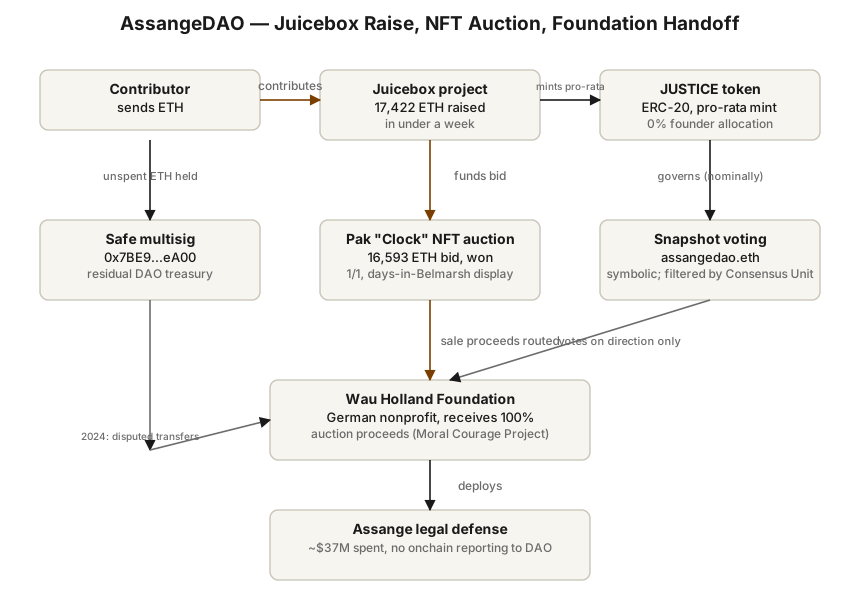 Open full-size diagram
Summary
AssangeDAO was a single-cause "flash mob" DAO formed to fund the legal defense of WikiLeaks founder Julian Assange. It began mobilizing in a Telegram group on December 10, 2021 — the day the U.S. government won its appeal reinstating Assange's extradition — and in early February 2022 ran a Juicebox crowdfund that raised 17,422 ETH ($55M), at the time the largest Juicebox raise ever, surpassing ConstitutionDAO's ~$47M. The DAO used the funds to win Pak's 1/1 dynamic NFT "Clock" (part of the Pak x Assange "Censored" collection) for 16,593 ETH ($52.7M) on February 9, 2022, with 100% of auction proceeds flowing to the German Wau Holland Foundation's "Moral Courage Project" earmarked for Assange's defense. Contributors received the pro-rata JUSTICE governance token. Assange was freed on June 24, 2024 after a plea deal; DAO organizer Silke Noa later stated roughly $37M was spent on the rescue effort. The endgame was messy: SlowMist flagged "suspicious" 2024 treasury transfers, co-organizer Amir Taaki alleged a rug, and the Assange family camp denied it — a fight over residual funds and legitimacy that the DAO never fully resolved.
Design (Mechanism)
The design chained together four simple, mostly off-the-shelf components:
Juicebox crowdfund. Contributors sent ETH to the AssangeDAO Juicebox project and received JUSTICE tokens pro-rata. Total supply ended at 17,346,149,507 JUSTICE (roughly 1M per ETH), with no allocation to founders, developers, or a DAO reserve — an unusually clean 100%-to-contributors distribution.
NFT auction as a donation conduit. Rather than donating directly to a legal fund, the DAO bid in Pak's "Censored" auction for "Clock" — an NFT that dynamically displayed the number of days Assange had spent in Belmarsh Prison. The auction structure meant the ETH legally became sale proceeds to the artist/collaboration, which were then routed (100%, per the DAO and Pak) to the Wau Holland Foundation, a German nonprofit that had long processed WikiLeaks donations. This laundered a legally awkward act (funding a fugitive publisher's defense) into an art purchase plus an established charity's grantmaking.
Fiscal-sponsor handoff. Once funds reached Wau Holland's multisig, spending was governed by the foundation's charitable mandate and German nonprofit law — not by JUSTICE votes. The DAO's own residual treasury sat in a Safe multisig (0x7BE9...eA00).
Symbolic governance. JUSTICE holders voted on Snapshot (assangedao.eth), with proposals filtered by a "Consensus Unit"; a family-aligned governance unit (Stella Assange, Gabriel Shipton, lawyer Jennifer Robinson) provided direction. In practice, once the auction closed, tokenholders governed almost nothing of consequence — the money was already out the door by design.
Outcome
The headline mission succeeded: the raise hit ~$55M in under a week, the Clock bid won, and Assange walked free in June 2024 (through diplomacy and a plea deal to which the DAO's funding of legal work contributed; causality is contested). Per Silke Noa, ~$37M of the funds were spent on the campaign and legal defense, with over $10M in ETH remaining at Wau Holland. The token side fared far worse: JUSTICE traded far below mint price for most of its life, and 2024 brought a legitimacy crisis — SlowMist and RescuETH flagged suspicious multisig outflows (including a March 10, 2024 transfer of 100 ETH from the Clock multisig) and floated a "soft rug"; Amir Taaki, an original organizer and multisig signer, publicly alleged the DAO had been rugged; Gabriel Shipton called the claims "just false." JUSTICE was listed on Bitfinex in September 2024 amid the dispute, and the DAO announced a post-release "revitalization" toward a broader free-information mission whose traction remains unclear.
Why it worked
- A pre-existing global cause with 12 years of activist infrastructure. AssangeDAO didn't build a community; it gave an existing one (WikiLeaks supporters, cypherpunks) a coordination tool at a moment of maximum urgency (the extradition ruling).
- Speed via off-the-shelf legos. Juicebox + Snapshot + Safe meant the DAO shipped in days with essentially no custom code to audit or exploit.
- The Pak/family endorsement stack. The artist collaboration, Stella Assange, Gabriel Shipton, and Edward Snowden's public support gave donors confidence the funds would actually reach the defense.
- Clean token distribution. Zero founder allocation blunted the usual grift accusations during the raise itself.
Where the design broke
- Governance was ornamental. JUSTICE conferred voting rights over a treasury that was, by design, immediately transferred to a legal entity outside tokenholder control. Contributors who believed they were joining a DAO had actually made a donation with a souvenir token.
- Accountability gap at the fiat boundary. Once ETH sat with Wau Holland, tokenholders had no enforceable claim or visibility beyond the foundation's periodic reporting — fertile ground for the 2024 "soft rug" narrative, whether or not misuse occurred.
- No endgame specification. Nothing defined what should happen to residual funds or the DAO itself if the mission succeeded. Assange's release triggered a fight rather than a wind-down.
- Speculative inflow mismatch. Some buyers treated JUSTICE as a trade, not a donation, and their losses converted into durable community grievance and rug accusations.
Lessons
- Single-cause DAOs should sell donations as donations. If governance rights are symbolic, say so explicitly at mint; ConstitutionDAO's refund path and AssangeDAO's grievance cycle both trace to ambiguous contributor expectations.
- Specify the success condition and the wind-down before raising. A charter clause covering "what happens to residual funds if we win" would have pre-empted most of the 2024 conflict.
- Crossing from crypto to a legal fiscal sponsor is a one-way trust door. Design the reporting cadence (onchain attestations, itemized disclosures) into the handoff agreement, because tokenholders lose all hard power at that boundary.
- Zero founder allocation protects the raise, not the aftermath. Clean tokenomics didn't prevent legitimacy collapse once discretionary control over remaining funds became visible.
Redesign (EDITORIAL — hypothesis, not fact)
This section is editorial hypothesis, not a description of anything AssangeDAO did. A redesign could keep the Juicebox raise but split it into two explicit tranches: a pure-donation tranche (no token, or a soulbound receipt NFT) flowing irrevocably to the fiscal sponsor, and a smaller governed tranche held in the Safe under real tokenholder control for campaign operations. The handoff to Wau Holland could be structured as a milestone-based streaming grant (e.g., via Sablier/Drips-style streams to the foundation's multisig) with quarterly onchain attestations of legal spend, giving the foundation privacy over case strategy but the community verifiable burn-rate data. Finally, a pre-committed sunset clause — on mission success, residual governed funds are voted among (a) refund pro-rata, (b) endowment for whistleblower defense, (c) burn — would convert the victory moment from a legitimacy crisis into a scheduled, legible decision.
Sources
- AssangeDAO official site (token, multisig, Snapshot, socials) — primary (docs)
- AssangeDAO: JUSTICE Token on Etherscan — primary (contract)
- AssangeDAO on Juicebox — primary (contract)
- Updates on Juicebox funding and $JUSTICE distribution (AssangeDAO Substack) — primary (governance)
- AssangeDAO Raised $56M and Quickly Split Up. Was It Still a Success? (CoinDesk) (analysis)
- Suspicious Transfers Behind AssangeDAO, Possible SoftRug? (SlowMist) (analysis)
- Julian Assange's brother denies AssangeDAO soft rug claims (Cointelegraph) (news)
- AssangeDAO member Silke Noa says $37M spent to rescue Assange (Cointelegraph) (news)
- Supporters of Julian Assange raise $56 million to buy an NFT (Fortune) (news)
- Clock NFT Sells for $52.7M to Fund Assange's Legal Defense (nft now) (news)
Related experiments
Last verified: 2026-07-27 · Spot an error? Suggest a correction