Async Art
The first programmable NFT platform, where a single artwork ('Master') is composed of independently-owned 'Layer' tokens whose owners can mutate the shared image on-chain.
▶ Run interactive simulation animated mechanism with editable parameters
How it works onchain
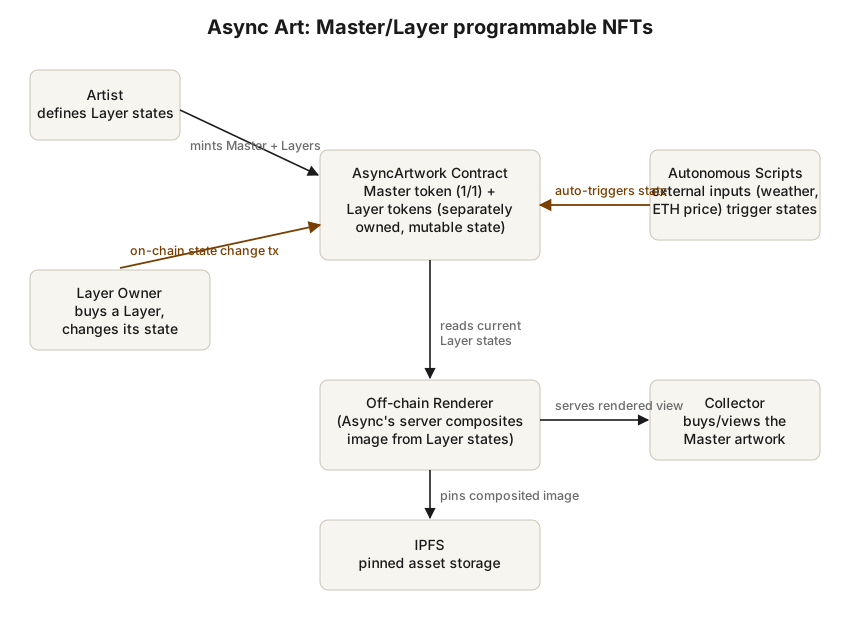 Open full-size diagram
Summary
Async Art, launched in February 2020 on Ethereum, was the first platform to make NFTs programmable and mutable rather than static. Its central invention is the Master / Layer model: a single artwork is minted as a "Master" (a 1-of-1 NFT) that is visually composed of multiple "Layer" NFTs. Each Layer is an independently-owned token, and its owner has exclusive rights to change one aspect of the shared image — the sky's color, a character's position, a background — from a menu of states the artist defined. When any Layer changes, the Master re-renders. The result is a shared, collectively-mutated artwork: one canvas whose appearance is controlled by many different wallets.
The company was founded by Conlan Rios (CEO), Lisa Liang (Co-Founder / CMO), and Nathan Clapp (Co-Founder / CCO), based in San Francisco. It raised a ~$2M seed round (announced February 2021) from backers including Divergence Ventures, Collab+Currency, The LAO, Lemniscap, Galaxy Interactive, and others. Async pioneered a genuinely new artistic primitive — "programmable media" — and later extended it to music and to generative "Blueprints." Despite critical acclaim and roughly $30M+ in reported cumulative sales, the platform announced a wind-down in October 2023 amid the collapse of the broader NFT market.
Design (Mechanism)
- Master token: the composite 1/1 artwork NFT. It references a set of Layers and renders the current combination.
- Layer tokens: separately-sellable NFTs, each governing one mutable parameter of the Master. The artist pre-defines the discrete states each Layer can occupy (e.g., "Layer: Moon" can be full / half / new). Only the current Layer owner can switch its state, and each state change is an on-chain transaction on the
AsyncArtworkcontract. - Rendering: metadata/artwork is composited off-chain by Async's renderer from the on-chain Layer states, with assets pinned to IPFS. The on-chain contract is the source of truth for which state each Layer holds.
- Autonomous / rule-based Layers: some Layers could be programmed to change based on external inputs — time of day, weather, ETH price — via scripts (the
autonomous-scriptsrepo), producing art that evolves without any human action. Async called this "autonomous art." - Programmable Music: the same Master/Layer model was applied to audio stems, letting owners remix a track's layers.
- Dynamic Blueprints (April 2023): a later generative model. A free/unlimited "Core" NFT is personalized with purchasable "Expansions" (trait layers contributed by many artists), with royalties shared among contributors. This shifted from 1/1 shared canvases toward scalable, community-composed collections. Its debut collection was Forever Supper.
The flagship launch piece, "First Supper" (Feb 2020), was a Master with 22 Layers made by 13 crypto-art figures (Shortcut, Josie Bellini, XCOPY, Hackatao, Coldie, Alotta Money, Matt Kane, Connie Digital, and others). It sold for 366 ETH ($85K at the time) and became the canonical demonstration of the mechanism — a single image simultaneously owned and mutated by many collectors.
Outcome
Status: technically successful, commercially unsuccessful. Async delivered a working, novel primitive and became a canonical reference in crypto-art history, cited widely as the origin of "programmable" and "dynamic" NFTs. It attracted major artists, a NETGEAR/Meural partnership (2021) to display programmable NFTs on physical frames, and reported cumulative sales in the tens of millions of dollars (~$30M+) across thousands of creators.
However, on October 23, 2023, Async Art announced it would wind down operations. New submissions stopped that day, and the marketplace was to stop supporting purchases by the end of 2023. The team committed to pinning all Async NFTs on IPFS so the underlying artwork would persist even after the front-end went offline. The shutdown was attributed primarily to market conditions — the 2022–2023 NFT downturn crushed trading volume, and the platform could not sustain operations on its seed funding. (Search results as of 2026 suggest some form of renewed/relaunched activity; this was not confirmable from a primary source at time of writing — treat as Unknown / not fully verified.)
Why it worked
- A genuinely new primitive. "Art that can be programmed" was a clear, ownable idea that nothing else offered in 2020, giving Async a defensible identity distinct from static-JPEG marketplaces.
- Star-studded, narratively perfect launch. "First Supper" bundled 13 respected crypto artists into one artwork, seeding credibility and demonstrating the shared-ownership mechanic in a single viral object.
- Composability of ownership. Splitting a piece into independently-tradeable Layers created multiple markets per artwork and an emotional hook — collectors weren't buying a picture, they were buying agency over a picture.
- Extensibility. The same model generalized cleanly to music and later to generative Blueprints, showing the primitive wasn't a one-off gimmick.
Where the design broke
- Market dependence. Async's economics were tied to NFT trading volume; when the 2022–2023 bear market hit, a niche premium platform had no cushion.
- Off-chain rendering / IPFS dependency. The "programmable" experience required Async's renderer and pinning infrastructure. Once the company stops paying for it, the mutability and live compositing degrade even if the tokens survive — a fragility inherent to the design.
- Complexity as a barrier. Master/Layer mechanics were harder to explain, price, and speculate on than a single-image PFP, limiting mainstream and speculative demand versus simpler competitors.
- Under-capitalized for the long game. A single ~$2M seed round was thin for a platform whose value proposition (long-lived, evolving art) implicitly promised indefinite operational upkeep.
Lessons
- Novel primitives still need a business model that survives a bear market. Being first and artistically important did not translate into durable revenue; "programmable art" had cultural product-market fit but not resilient commercial fit.
- If your NFT's value depends on off-chain infrastructure (renderers, pinning, autonomous scripts), you have created an ongoing liability, not a finished asset. Truly durable mutable NFTs need on-chain or fully-decentralized rendering, or a credible endowment/DAO to maintain services.
- Shared / fractional-control ownership is emotionally powerful but adds friction. Multi-party mutable artworks create rich dynamics but complicate pricing, custody, and secondary liquidity — plan the UX and market structure around that, not just the smart contract.
- Have a graceful-degradation plan from day one. Async's IPFS-pinning commitment at shutdown was responsible, but was a reaction; designing for "what does this artwork look like when the company is gone?" should be a launch requirement for evolving media.
Redesign (EDITORIAL — hypothesis, not fact)
The following is analysis and opinion, not established fact.
If rebuilt today, Async's core weakness — mutability that dies when the company does — is the thing to attack first. A redesign would push rendering on-chain or into a verifiably decentralized layer: fully on-chain SVG/canvas composition where feasible, or a Layer-state → image pipeline that any third party can reproduce deterministically from chain data alone, removing dependence on a proprietary renderer. Autonomous Layers driven by "weather" or "ETH price" should read from on-chain oracles (or be re-derivable) so the art keeps evolving without a company-run server.
Economically, a subscription- or endowment-backed maintenance DAO could hold pinning/rendering funds, funded by a slice of primary and secondary royalties, so the promise of "living art" is capitalized rather than dependent on the operating company's runway. The Blueprints direction — many artists contributing trait "Expansions" with shared royalties — was arguably the more scalable business than bespoke 1/1 Masters, and a redesign might lead with that composable, creator-network model while positioning Master/Layer pieces as high-end flagship collaborations. Finally, a modern version would treat exit as a feature: a public, contractual guarantee (ideally enforced on-chain) that on wind-down, artwork assets and the last-known Layer states are permanently retrievable and re-renderable by anyone — turning Async's ad-hoc 2023 IPFS rescue into a designed-in property of the primitive itself.
Sources
- Async Art GitHub organization (async-contracts, async-blueprint, autonomous-scripts) — primary (contract)
- AsyncArtwork_v2 contract on Etherscan — primary (contract)
- Async Art — OpenSea Blog: Paving the Way for Programmable, Dynamically Changing Art (docs)
- Async Art Confirms Its Decision to Wind Down Operations (news)
- Creator Platform Async Art Announces Shutdown (nft now) (news)
- Async Art's Dynamic Blueprints — Metaversal / Bankless (William M. Peaster) (analysis)
- Async Art — IQ.wiki (funding, investors, blockchain) (analysis)
- Async Art, NFTs and the Programmable Media Movement — ONE37pm (analysis)
Related experiments
Last verified: 2026-07-26 · Spot an error? Suggest a correction