Async Music
Async Art's 2021 'programmable music' system split songs into a Master Track NFT plus Stem NFTs whose owners could switch audio variants, making the canonical song a mutable, collectively-authored onchain object.
▶ Run interactive simulation animated mechanism with editable parameters
How it works onchain
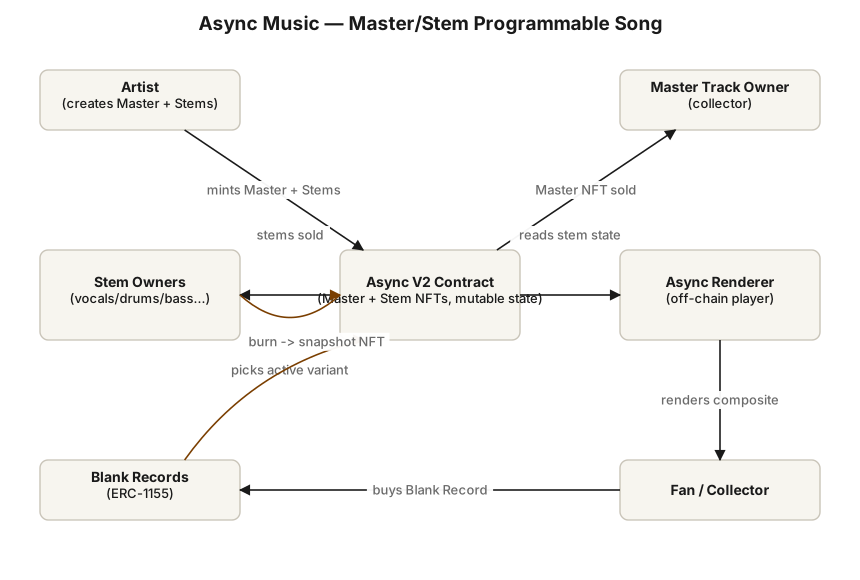 Open full-size diagram
Summary
Async Music was the music arm of Async Art, the Ethereum "programmable media" platform founded by Conlan Rios (Async Art launched February 2020; the music product launched April 29, 2021, after a March 2021 announcement). Where Async's programmable art split a painting into a "Master" canvas and "Layer" tokens, Async Music split a song into a Master Track NFT and multiple Stem NFTs (vocals, drums, bass, etc.). Each stem shipped with several artist-recorded variants, and whoever owned a stem could choose which variant was "live" — so the canonical version of the song anyone heard was the current combination of all stem owners' choices. The mechanism worked as designed and attracted credible launch artists (Grammy-winner RAC, HMLTD, Verdigris Ensemble, Connie Digital & Mighty33), but it remained a niche within an already-niche platform. Async Art announced its wind-down on October 23, 2023, with its marketplace closing by end of year; the NFTs remain onchain with media pinned to IPFS.
Design (Mechanism)
- Master Track NFT (ERC-721): the token representing the whole song. Its audio (and its album-cover artwork) is a function of state held by other tokens rather than a fixed file.
- Stem NFTs: separately owned tokens for each part of the arrangement. At launch, a Master was capped at 9 stems with up to 9 variants each — over 360,000 possible song combinations — limits Async described as arbitrary and raisable.
- Owner-controlled mutation: a stem owner calls the contract to switch their stem's active variant; the Master Track re-renders as the new composite. Ownership of a stem is thus ongoing creative authority over the song, not just memorabilia. Changes to stems could also alter the Master's visual cover art.
- Blank Records (ERC-1155 → ERC-721 snapshots): fans could buy "Blank Records" and burn one to mint an audio-visual snapshot of the Master Track exactly as configured at that moment, in Silver/Gold/Platinum tiers — freezing a transient state into permanent memorabilia and giving listeners (not just stem owners) something to collect.
- Distribution/UX: the April 29, 2021 launch added credit-card checkout and an in-browser player, an early attempt to reach non-crypto music fans.
- Music Blueprints (June 2, 2022): a second-generation product applying Async's generative "Blueprints" engine to audio — collectors minted one random song version out of thousands-to-millions of pre-parameterized combinations (e.g., "JANUS" with 75,000 combinations, "H0m3w0rk" with 700M+ combinations and 4,777 mints), each with rarity traits and downloadable stems.
- Contracts: music Masters/Stems were minted under the Async V2 ERC-721 contract at
0xb6dae651468e9593e4581705a09c10a76ac1e0c8(upgradeable transparent proxy); Async's original V1 contract is0x6c424c25e9f1fff9642cb5b7750b0db7312c29ad.
Outcome
Technically the system shipped and functioned: songs were minted, stems traded, and Masters mutated as owners changed variants. RAC's "Circular" was the flagship drop (its master reportedly sold for tens of ETH; exact figure not confirmed from a primary source — Unknown / not found). Commercially, music never became Async's engine: by mid-2022 the platform had grossed ~$29M in total sales, of which ~$23M came from visual Blueprints, implying music was a small slice. The 2022 NFT market collapse eroded volume, and on October 23, 2023 Rios announced the wind-down, stating the team could not sustain operations; the Async Market stopped transactions by end of 2023. All NFTs were pinned to IPFS and persist onchain, and third-party interfaces (async.market) later surfaced the collection. No exploit or failure of the mechanism itself is on record.
Why it worked
- It was a genuinely blockchain-native music format — the mutable, multi-owner song could not exist on Spotify or as a static NFT — which earned real artist participation and press attention as "the world's first programmable music."
- The Master/Stem split created a coherent ownership economy: many collectors could own meaningful, functional pieces of one song, at different price points, with the Blank Records burn-to-snapshot loop adding a lower-cost collector tier.
- Building on Async Art's proven programmable-layer contracts (already battle-tested with visual art since Feb 2020) meant the music product was an extension, not a from-scratch protocol.
Where the design broke
- Tiny intersection of audiences: in 2021, few music fans held ETH and few NFT collectors valued stems; the credit-card onramp couldn't overcome the conceptual overhead of "you own one instrument's settings in someone else's song."
- Weak listening loop: songs live on streaming platforms; a mutable master on a niche website had no distribution channel where the mutation would actually be heard, so creative authority over the mix had little audience-facing payoff.
- Novelty without recurring demand: after the initial configuration play, stem variants offered limited replay value; secondary markets for stems were thin, and the platform's revenue concentrated in visual Blueprints instead.
- Platform dependency: the composite audio rendering and player were platform services; when Async wound down in 2023, the tokens survived onchain but the living, remixable experience largely died with the interface — the classic mutable-media preservation problem.
Lessons
- Mutable NFTs need a rendering commons: if the "current state" of a token can only be experienced through one company's player, the mechanism's lifespan equals the company's runway. Composite-rendering logic should be reproducible from onchain/IPFS data alone.
- Creative authority must meet an audience: giving owners power to change a song only matters if people are listening where the change happens; programmable media needs distribution (streaming embeds, open players) before financialization.
- Fractionalizing a creative work by role (stems) is more legible than by percentage — collectors understood "I own the drums" — a design pattern later echoed by remix/stem platforms; the pattern outlived the platform.
- A strong mechanism can't rescue a small market: Async Music worked exactly as specified and still underperformed, a reminder that "technically successful, commercially unsuccessful" is a common terminal state for pioneering formats.
Redesign (EDITORIAL — hypothesis, not fact)
This section is editorial analysis — a hypothesis, not fact. A modern redesign would make the song self-rendering: store stems and mixing rules onchain/IPFS with an open-source, deterministic renderer so any frontend (or an L2 contract) can compute the current master without the founding company. Stem-variant switches could carry a small fee split between the artist and the Master owner, giving ongoing revenue and making mutation an economic event rather than a free toggle. Distribution should be embedded-first: a permissionless player widget plus automatic publishing of each new master state (or periodic snapshots) to open audio networks, so mutations are heard by real audiences. Blank-Record snapshots could become editioned "pressings" whose supply is governed by the stem owners collectively, turning the stem-holder set into a micro-label with governance over releases. Finally, launching on a low-fee L2 with credit-card minting would let variant-switching be cheap enough for fans, not just collectors, to participate.
Sources
- Programmable Music Coming to Async (official blog, now offline) — primary (docs)
- The World's First Programmable Music Launch (Async Art press release) — primary (news)
- Async Art Redefines Music NFTs By Launching Music Blueprints (press release) — primary (news)
- Async Art: ASYNC-V2 Token contract (Etherscan) — primary (contract)
- Async to launch 'programmable music' through stems and NFTs (Music Ally) (news)
- Async Music: a New NFT Paradigm (Bankless Metaversal) (analysis)
- Async Art announces its plan to cease operations (Oct 2023) (news)
- Creator Platform Async Art Announces Shutdown (nft now) (news)
Related experiments
Last verified: 2026-07-26 · Spot an error? Suggest a correction