CryptoPunks
10,000 algorithmically generated 24x24-pixel characters given away free on Ethereum in June 2017 with a built-in escrow marketplace, predating and directly inspiring the ERC-721 NFT standard.
▶ Run interactive simulation animated mechanism with editable parameters
How it works onchain
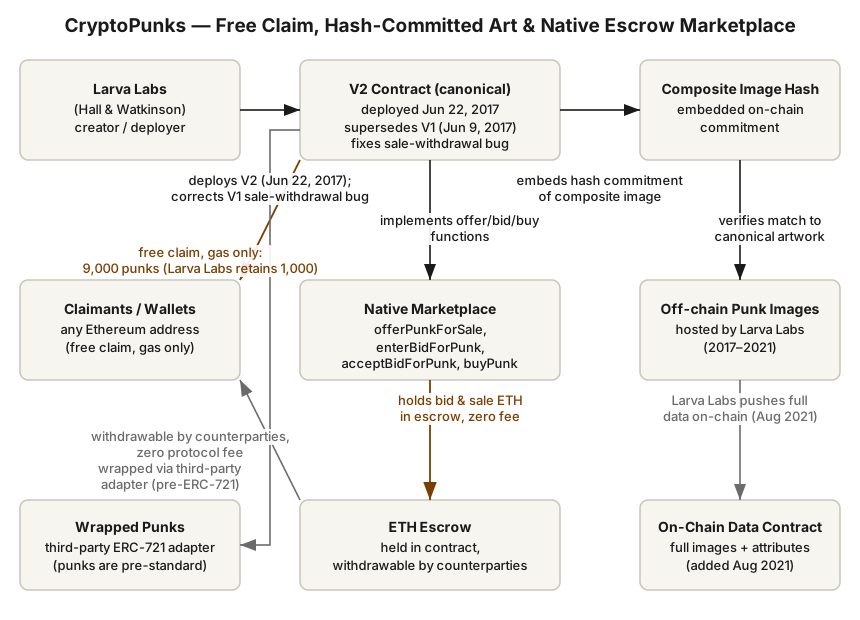 Open full-size diagram
Summary
CryptoPunks is a collection of 10,000 unique 24x24-pixel characters — humans, apes, zombies, and aliens — algorithmically generated by Larva Labs, the two-person studio of Matt Hall and John Watkinson, and released on Ethereum in June 2017. The project predates the term "NFT" and the ERC-721 standard; Larva Labs built non-fungible ownership by modifying the then-common fungible token pattern, and the ERC-721 authors later cited CryptoPunks as direct inspiration. Distribution was radical for its time: 9,000 punks were claimable for free by anyone with an Ethereum wallet (Larva Labs kept 1,000), and all were claimed within roughly eight days once press coverage hit. The contract shipped with its own escrow marketplace — offers, bids, and sales settle inside the contract itself with no platform fee. CryptoPunks became the archetypal "profile picture" identity asset, produced eight-figure auction sales at Christie's and Sotheby's, accumulated over $3 billion in cumulative sales (per the Infinite Node Foundation), and entered permanent museum collections including MoMA and Centre Pompidou. The IP passed from Larva Labs to Yuga Labs in March 2022 and to the nonprofit Infinite Node Foundation in May 2025, with Hall and Watkinson returning in advisory roles.
Design (Mechanism)
- Fixed supply, algorithmic traits. Exactly 10,000 punks, generated off-chain with pseudo-random attribute combinations (9 aliens, 24 apes, 88 zombies, and thousands of humans with accessories like hoodies, pipes, and VR goggles). Scarcity of trait combinations, not artist curation, defines the rarity hierarchy.
- Hash commitment instead of on-chain art. The images live off-chain, but the contract embeds the hash of a composite image of all 10,000 punks, letting anyone verify that a given punk matches the canonical artwork. (In August 2021, Larva Labs separately pushed the full image and attribute data on-chain in a companion contract.)
- Free-claim distribution. Claiming cost only gas. This was a distribution mechanism and a marketing mechanism at once: zero price meant zero purchase friction and maximal early dispersion.
- Native marketplace. The contract implements
offerPunkForSale,offerPunkForSaleToAddress,enterBidForPunk,acceptBidForPunk, andbuyPunk, with ETH held in escrow and withdrawable by counterparties. No royalties, no protocol fee, no intermediary — the market is a property of the asset itself. - Pre-standard token. Punks are not ERC-721 tokens (the standard did not exist); the bespoke interface is why wrapper contracts (e.g., Wrapped Punks) later emerged to trade punks on ERC-721 marketplaces.
- V1 → V2 migration. The original June 9, 2017 contract (V1) had a bug in the sale flow: the ETH paid for a punk was credited such that the buyer, not the seller, could withdraw it. Larva Labs deployed a corrected V2 contract on June 22, 2017 and airdropped all punks to claimants there, declaring V2 canonical.
Outcome
Major, era-defining success. The free claim was slow until a June 16, 2017 Mashable article, after which the remaining supply was claimed in days. After a quiet 2018–2020, the 2021 NFT bull market made punks the blue-chip benchmark: Christie's sold a lot of nine punks for $16.9M (May 2021), Sotheby's sold CryptoPunk #7523 for $11.75M (June 2021), and punk #5822 sold for roughly $23.7M in February 2022. Cumulative sales exceed $3.07B. Punks are held in the permanent collections of MoMA, the Whitney, Centre Pompidou, and LACMA. Yuga Labs acquired the IP in March 2022 and granted commercial rights to holders; in May 2025 the IP moved to the Infinite Node Foundation, a nonprofit endowed to preserve the collection permanently, with the Larva Labs founders returning as advisors. Notable turbulence: the 2022 resurgence of the deprecated V1 punks as tradeable wrapped tokens complicated the collection's canonical-supply story, since the deprecated V1 contract remained fully functional and its assets retained real market value despite non-canonical status.
Why it worked
- First-mover with verifiable scarcity. A fixed 10,000-item set launched before any NFT infrastructure existed gave punks unmatched historical provenance — "the first" is a Schelling point money cannot recreate.
- Free distribution maximized dispersion and legitimacy. Thousands of unrelated early owners created a real secondary market and community rather than a pre-sold treasury asset.
- The marketplace-in-the-asset removed platform dependence. Punks could trade trustlessly years before OpenSea mattered, and the zero-fee contract still functions today.
- Pixel-art identity fit the medium. Small, iconic, instantly recognizable avatars made punks the prototype of PFP-as-status, a use case that drove the entire 2021 cycle.
- Constraint over roadmap. No utility promises, no staking, no token — the artwork and its scarcity were the whole product, which aged better than most roadmapped competitors.
Limitations and criticisms
- The V1 escrow bug forced a full contract migration in week two — an early reminder that novel asset contracts carry novel failure modes — and left a "zombie" V1 collection that resurfaced in 2022 to cause brand confusion: a deprecated contract with real, ETH-tradeable assets and no formal on-chain marker of its non-canonical status could still generate market activity years later.
- Off-chain art dependence (until the 2021 on-chain data contract) meant the canonical images relied on continued off-chain hosting for four years.
- No royalties or fee capture meant the only monetization path ran through the retained 1,000 punks' appreciation rather than ongoing protocol fees — sustainable, but an incentive structure tied entirely to the later secondary market, and a factor in the eventual IP sale.
- IP ambiguity persisted for years — holders had unclear commercial rights until the Yuga acquisition in 2022, illustrating that on-chain ownership does not by itself resolve off-chain intellectual property.
Lessons
- Distribution is mechanism design: a free claim with fixed supply can outperform any priced sale at bootstrapping a legitimate, dispersed owner base.
- Embedding the marketplace in the asset contract makes the asset platform-independent and durable; punks still trade fee-free on a 2017 contract.
- Standards emerge from working artifacts — shipping a bespoke non-fungible token before ERC-721 shaped the standard rather than waiting for it.
- Deprecated contracts never fully die on a public chain; plan migrations assuming the old state will be resurfaced and monetized by others.
- On-chain scarcity without off-chain IP clarity defers, not avoids, governance conflict; codify holder rights early.
Redesign (EDITORIAL — hypothesis, not fact)
This section is editorial speculation. A modern re-run would: (1) commit full image and attribute data on-chain at genesis, eliminating the custodial gap punks carried until 2021; (2) keep the free claim but add light sybil resistance (per-address limits plus a time-decayed claim window) so the drop disperses beyond gas-war bots; (3) publish an explicit, immutable content license (CC0 or a holder-commercial-rights grant) at deploy time to prevent the years of IP ambiguity; (4) formally brick or flag the deprecated contract on migration — e.g., a canonical on-chain registry declaring V2 authoritative — to preempt V1-style resurrections; and (5) preserve the zero-fee native marketplace, which proved to be the design's most durable and under-copied feature, rather than adding royalties that marketplaces would later bypass anyway.
Sources
- Larva Labs — CryptoPunks — primary (docs)
- CryptoPunks V2 contract (Etherscan-verified, deployed June 22, 2017, block 3914495) — primary (contract)
- Larva Labs — About (Matt Hall & John Watkinson) — primary (docs)
- CryptoPunks announcement of Infinite Node Foundation acquisition — primary (governance)
- The Infinite Node Foundation Acquires CryptoPunks IP from Yuga Labs (Business Wire, May 2025) (news)
- punks.contracts — inside the CryptoPunks contracts incl. historic V1 (analysis)
- Why Larva Labs' Decision to Dump V1 CryptoPunks Is a Problem (nft now) (news)
- CryptoPunks — Wikipedia (archive)
- CryptoPunks Have New Home as Nonprofit Acquires Ethereum NFT IP From Yuga Labs (Decrypt) (news)
Related experiments
Last verified: 2026-07-27 · Spot an error? Suggest a correction